3D Geometry Ques 7
7. Let $\sqrt{3} \hat{\mathbf{i}}+\hat{\mathbf{j}}, \hat{\mathbf{i}}+\sqrt{3} \hat{\mathbf{j}}$ and $\beta \hat{\mathbf{i}}+(1-\beta) \hat{\mathbf{j}}$ respectively be the position vectors of the points $A, B$ and $C$ with respect to the origin $O$. If the distance of $C$ from the bisector of the acute angle between $O A$ and $O B$ is $\frac{3}{\sqrt{2}}$, then the sum of all possible values of $\beta$ is
(2019 Main, 11 Jan II)
(a) 1
(b) 3
(c) 4
(d) 2
Show Answer
Answer:
Correct Answer: 7.(a)
Solution:
- According to given information, we have the following figure.
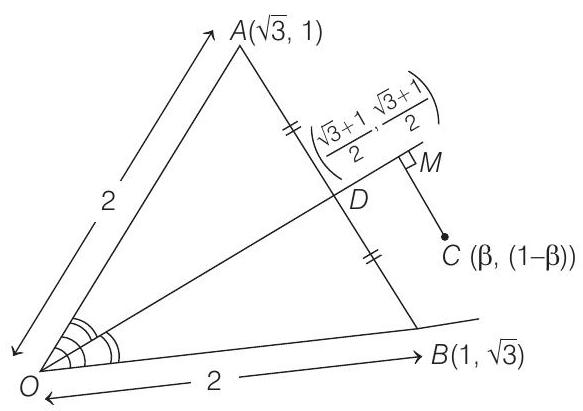
Clearly, angle bisector divides the sides $A B$ in $O A: O B$, i.e., $2: 2=1: 1$ [using angle bisector theorem] So, $D$ is the mid-point of $A B$ and hence coordinates of $D$ are $[\frac{\sqrt{3}+1}{2}, \frac{\sqrt{3}+1}{2}]$
Now, equation of bisector $O D$ is
$ \begin{aligned} & (y-0)=(\frac{\frac{\sqrt{3}+1}{2}-0}{\frac{\sqrt{3}+1}{2}-0})(x-0) \Rightarrow y=x \\ \Rightarrow \quad x-y & =0 \end{aligned} $
According to the problem,
$ \frac{3}{\sqrt{2}}=C M=\left|\frac{\beta-(1-\beta)}{\sqrt{2}}\right| $
Distance of a point $P\left(x_{1}, y_{1}\right)$ from the line
$ \begin{aligned} & a x+b y+c=0 \text { is }\left|\frac{a x_{1}+b y_{1}+c}{\sqrt{a^{2}+b^{2}}}\right| \\ & \Rightarrow \quad|2 \beta-1|=3 \Rightarrow 2 \beta= \pm 3+1 \\ & \Rightarrow \quad 2 \beta=4,-2 \Rightarrow \beta=2,-1 \end{aligned} $
Sum of 2 and -1 is 1 .
 BETA
BETA


