Circle Ques 103
- Let $T _1, T _2$ and be two tangents drawn from $(-2,0)$ onto the circle $C: x^{2}+y^{2}=1$. Determine the circles touching $C$ and having $T _1, T _2$ as their pair of tangents. Further, find the equations of all possible common tangents to these circles when taken two at a time.
(1999, 10M)
Show Answer
Answer:
Correct Answer: 103.$x+\frac{4}{3}^{2}+y^{2}=\frac{1}{3}^{2} ; y= \pm \frac{5}{\sqrt{39}} \quad x+\frac{4}{5}$
Solution:
Formula:
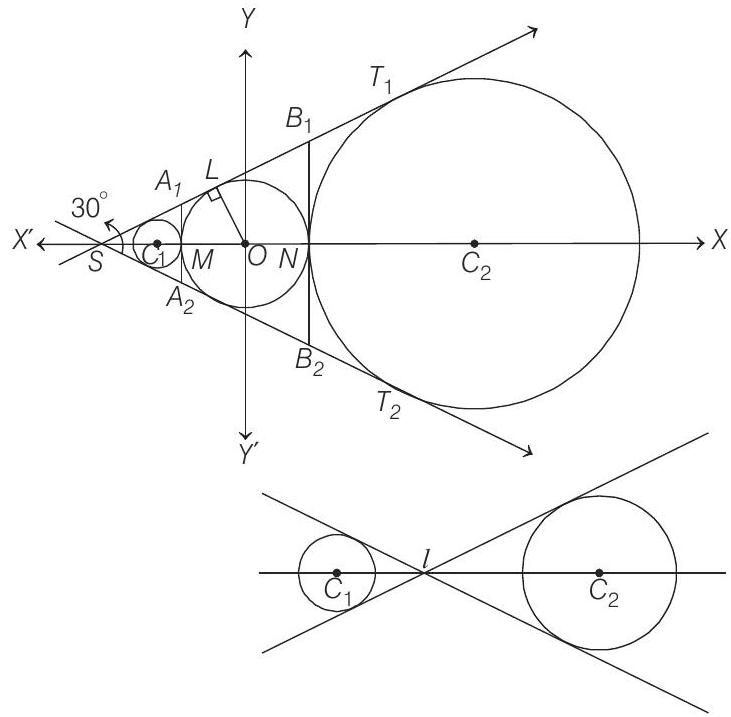
From figure it is clear that, $\triangle O L S$ is a right triangle with right angle at $L$.
Also,
$ O L=1 \text { and } O S=2 $
$\therefore 1 \sin (\angle L S O)=\frac{1}{2} \Rightarrow \angle L S O=30^{\circ}$
Since $SA_1 = SA_2$, $\Delta SA_1A_2$ is an equilateral triangle.
The circle with centre at $C _1$ is a circle inscribed in the $\triangle S A _1 A _2$. Therefore, centre $C _1$ is incenter of $\triangle S A _1 A _2$. This, $C _1$ divides $S M$ in the ratio $2: 1$. Therefore, coordinates of $C _1$ are $(-4 / 3,0)$ and its radius $=C _1 M=1 / 3$
$\therefore$ Its equation is $(x+4 / 3)^{2}+y^{2}=(1 / 3)^{2} ……(i)$
The other circle touches the equilateral triangle $S B _1 B _2$ externally. Its radius $r$ is given by $r=\frac{\Delta}{s-a}$,
where $B_1 B_2=a$. But $\Delta=\frac{1}{2}(a)(S N)=\frac{3}{2} a$
and
$ s-a=\frac{3}{2}a-a=\frac{a}{2} $
Thus,
$ r=3 $
$\Rightarrow$ Coordinates of $C _2$ are $(4,0)$
$\therefore$ Equation of circle with centre at $C_2$ is
$ (x-4)^{2}+y^{2}=3^{2} ……(ii) $
Equations of common tangents to circle (i) and circle $C$ are given by
$ x=-1 \quad \text { and } \quad y= \pm \frac{1}{\sqrt{3}}(x+2) \quad\left[T _1 \text { and } T _2\right] $
Equations of common tangents to circle (ii) and circle $C$ are
$ x=1 \quad \text { and } \quad y= \pm \frac{1}{\sqrt{3}}(x+2) \quad\left[T _1 \text { and } T _2\right] $
Two tangents common to (i) and (ii) are $T_1$ and $T_2$ at $O$. To find the remaining two transverse tangents to (i) and (ii), we find a point I which divides the line joining $C_1 C_2$ in the ratio $r_1: r_2=1/3: 3=1: 9$
Therefore, coordinates of I are $\left(-\frac{4}{5},0\right)$
Equation of any line through I is $y=m(x+4/5)$. It will touch (i) if
$ \begin{alignedat} & |\frac{m \frac{-4}{3}+\frac{4}{5}-0}|{\sqrt{1+m^{2}}}=\frac{1}{3} \Rightarrow |-\frac{8 m}{15}|=\frac{1}{3} \sqrt{1+m^{2}} \\ & \Rightarrow \quad 64 m^{2}=25\left(1+m^{2}\right) \\ & \Rightarrow \quad 39 m^{2}=25 \quad \Rightarrow \quad m= \pm \frac{5}{\sqrt{39}} \end{aligned} $
Therefore, these tangents are $y= \pm \frac{5\sqrt{39}}{39} \quad (x+\frac{4}{5})$
 BETA
BETA


