Circle Ques 51
- The circle $C _1: x^{2}+y^{2}=3$ with centre at $O$ intersects the parabola $x^{2}=2 y$ at the point $P$ in the first quadrant. Let the tangent to the circle $C _1$ at $P$ touches other two circles $C _2$ and $C _3$ at $R _2$ and $R _3$, respectively. Suppose $C _2$ and $C _3$ have equal radii $2 \sqrt{3}$ and centres $Q _2$ and $Q _3$, respectively. If $Q _2$ and $Q _3$ lie on the $Y$-axis, then
(a) $Q _2 Q _3=12$
(2016 Adv.)
(b) $R _2 R _3=4 \sqrt{6}$
(c) area of the $\triangle O R _2 R _3$ is $6 \sqrt{2}$
(d) area of the $\triangle P Q _2 Q _3$ is $4 \sqrt{2}$
Assertion and Reason
Show Answer
Answer:
Correct Answer: 51.$(a, b, c)$
Solution:
Formula:
- Given, $C _1: x^{2}+y^{2}=3$ intersects the parabola $x^{2}=2 y$.
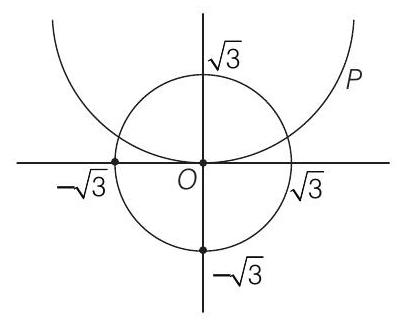
On solving $x^{2}+y^{2}=3$ and $x^{2}=2 y$, we get
$ \begin{array}{lc} & y^{2}+2 y=3 \\ \Rightarrow & y^{2}+2 y-3=0 \\ \Rightarrow & (y+3)(y-1)=0 \\ \therefore & y=1,-3[\text { neglecting } y=-3, \text { as }-\sqrt{3} \leq y \leq \sqrt{3}] \\ \therefore & y=1 \Rightarrow x= \pm \sqrt{2} \\ \Rightarrow & P(\sqrt{2}, 1) \in \text { I quadrant } \end{array} $
Equation of tangent at $P(\sqrt{2}, 1)$ to $C _1: x^{2}+y^{2}=3$ is
$ \sqrt{2} x+1 \cdot y=3 ……(i) $
Now, let the centres of $C _2$ and $C _3$ be $Q _2$ and $Q _3$, and tangent at $P$ touches $C _2$ and $C _3$ at $R _2$ and $R _3$ shown as below
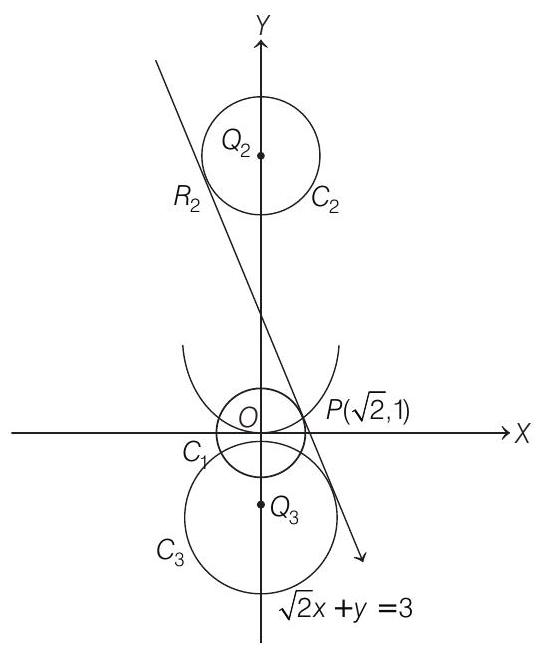
Let $Q _2$ be $(0, k)$ and radius is $2 \sqrt{3}$.
$ \begin{array}{lc} \therefore & \frac{|0+k-3|}{\sqrt{2+1}}=2 \sqrt{3} \\ \Rightarrow & |k-3|=6 \\ \Rightarrow & k=9,-3 \\ \therefore & Q _2(0,9) \text { and } Q _3(0,-3) \\ \text { Hence, } & Q _2 Q _3=12 \end{array} $
$\therefore$ Option (a) is correct.
Also, $R _2 R _3$ is common internal tangent to $C _2$ and $C _3$, and
$\therefore$
$ \begin{aligned} r _2 & =r _3=2 \sqrt{3} \\ R _2 R _3 & =\sqrt{d^{2}-\left(r _1+r _2\right)^{2}}=\sqrt{12^{2}-(4 \sqrt{3})^{2}} \\ & =\sqrt{144-48}=\sqrt{96}=4 \sqrt{6} \end{aligned} $
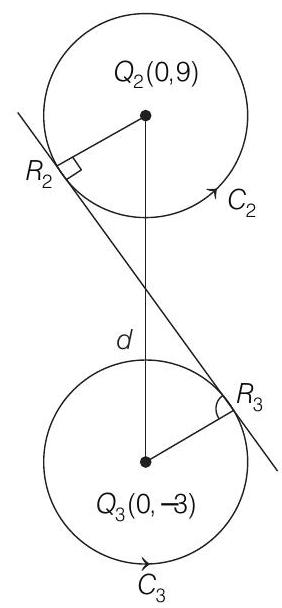
$\therefore$ Option (b) is correct.
$\because$ Length of perpendicular from $O(0,0)$ to $R _2 R _3$ is equal to radius of $C _1=\sqrt{3}$.
$\therefore$ Area of $\triangle O R _2 R _3=\frac{1}{2} \times R _2 R _3 \times \sqrt{3}=\frac{1}{2} \times 4 \sqrt{6} \times \sqrt{3}=6 \sqrt{2}$
$\therefore$ Option (c) is correct.
Also, area of $\triangle P Q _2 Q _3=\frac{1}{2} Q _2 Q _3 \times \sqrt{2}=\frac{\sqrt{2}}{2} \times 12=6 \sqrt{2}$
$\therefore$ Option (d) is incorrect.
 BETA
BETA


