Circle Ques 88
- Two circles with equal radii are intersecting at the points $(0,1)$ and $(0,-1)$. The tangent at the point $(0,1)$ to one of the circles passes through the centre of the other circle. Then, the distance between the centres of these circles is
(2019 Main, 11 Jan I)
(a) $\sqrt{2}$
(b) $2 \sqrt{2}$
(c) 1
(d) 2
Show Answer
Answer:
Correct Answer: 88.(d)
Solution:
Formula:
- Clearly, circles are orthogonal because tangent at one point of intersection is passing through centre of the other.
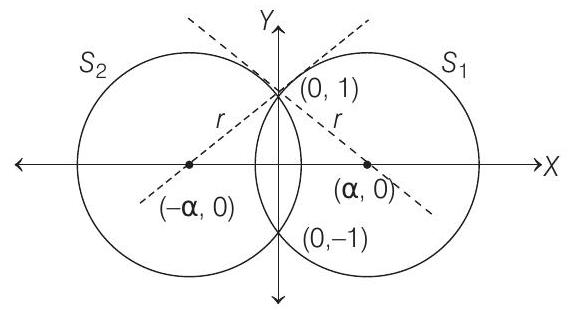
Let $C _1(\alpha, 0)$ and $C _2(-\alpha, 0)$ are the centres.
Then, $S _1 \equiv(x-\alpha)^{2}+y^{2}=\alpha^{2}+1$
$\Rightarrow \quad S _1 \equiv x^{2}+y^{2}-2 \alpha x-1=0$
$$ \left[\because \text { radius, } r=\sqrt{(\alpha-0)^{2}+(0-1)^{2}}\right] $$
and $\quad S _2 \equiv(x+\alpha)^{2}+y^{2}=\alpha^{2}+1$
$\Rightarrow \quad S _2 \equiv x^{2}+y^{2}+2 \alpha x-1=0$ Now, $2(\alpha)(-\alpha)+2 \cdot 0 \cdot 0=(-1)+(-1) \Rightarrow \alpha= \pm 1$
$\left[\because\right.$ condition of orthogonality is $2 g _1 g _2+2 f _1 f _2=c _1+c _2$ ]
$\therefore C _1(1,0)$ and $C _2(-1,0) \Rightarrow C _1 C _2=2$
 BETA
BETA


