Complex Numbers Ques 70
- For a non-zero complex number $z$, let $\arg (z)$ denote the principal argument with $-\pi<\arg (z) \leq \pi$. Then, which of the following statement(s) is (are) FALSE ? (2018 Adv.)
(a) $\arg (-1-i)=\frac{\pi}{4}$, where $i=\sqrt{-1}$
(b) The function $f: R \rightarrow(-\pi, \pi]$, defined by $f(t)=\arg (-1+i t)$ for all $t \in R$, is continuous at all points of $R$, where $i=\sqrt{-1}$.
(c) For any two non-zero complex numbers $z _1$ and $z _2$, $\arg \frac{z _1}{z _2}-\arg \left(z _1\right)+\arg \left(z _2\right)$ is an integer multiple of $2 \pi$.
(d) For any three given distinct complex numbers $z _1, z _2$ and $z _3$, the locus of the point $z$ satisfying the condition $\arg \frac{\left(z-z _1\right)\left(z _2-z _3\right)}{\left(z-z _3\right)\left(z _2-z _1\right)}=\pi$, lies on a straight line.
Show Answer
Answer:
Correct Answer: 70.$(a, b, d)$
Solution:
Formula:
- (a) Let
$$ z=-1-i \text { and } \arg (z)=\theta $$
Now, $\quad \tan \theta=\frac{\operatorname{im}(z)}{\operatorname{Re}(z)}=\frac{-1}{-1}=1$
$$ \Rightarrow \quad \theta=\frac{\pi}{4} $$
Since, $x<0, y<0$
$$ \therefore \quad \arg (z)=-\pi-\frac{\pi}{4}=-\frac{3 \pi}{4} $$
(b) We have, $f(t)=\arg (-1+i t)$
$$ \arg (-1+i t)=\begin{gathered} \pi-\tan ^{-1} t, \quad t \geq 0 \\ -\left(\pi+\tan ^{-1} t\right), \quad t<0 \end{gathered} $$
This function is discontinuous at $t=0$.
(c) We have,
$$ \begin{aligned} & \arg \frac{z _1}{z _2}-\arg \left(z _1\right)+\arg \left(z _2\right) \\ & \text { Now, } \quad \arg \frac{z _1}{z _2}=\arg \left(z _1\right)-\arg \left(z _2\right)+2 n \pi \\ & \therefore \quad \arg \frac{z _1}{z _2}-\arg \left(z _1\right)+\arg \left(z _2\right) \\ & =\arg \left(z _1\right)-\arg \left(z _2\right)+2 n \pi-\arg \left(z _1\right)+\arg \left(z _2\right) \\ & =2 n \pi \end{aligned} $$
So, given expression is multiple of $2 \pi$.
(d) We have, arg $\frac{\left(z-z _1\right)\left(z _2-z _3\right)}{\left(z-z _3\right)\left(z _2-z _1\right)}=\pi$
$\Rightarrow \frac{z-z _1}{z-z _3} \quad \frac{z _2-z _3}{z _2-z _1}$ is purely real
Thus, the points $A\left(z _1\right), B\left(z _2\right), C\left(z _3\right)$ and $D(z)$ taken in order would be concyclic if purely real.
Hence, it is a circle.
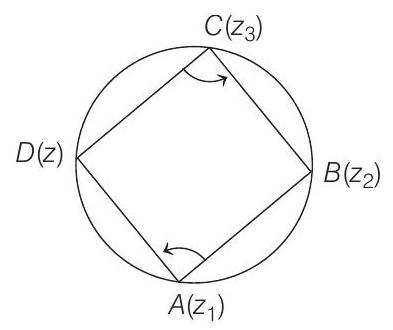
$\therefore$ (a), (b), (d) are false statement.
 BETA
BETA


