Differential Equations Ques 52
- A hemispherical tank of radius $2 m$ is initially full of water and has an outlet of $12 cm^{2}$ cross-sectional area at the bottom. The outlet is opened at some instant. The flow through the outlet is according to the law $v(t)=0.6 \sqrt{2 g h(t)}$, where $v(t)$ and $h(t)$ are respectively the velocity of the flow through the outlet and the height of water level above the outlet at time $t$ and $g$ is the acceleration due to gravity. Find the time it takes to empty the tank.
(2001, 10M)
Hint Form a differential equation by relating the decreases of water level to the outflow.
Show Answer
Answer:
Correct Answer: 52.$\frac{14 \pi \times 10^{5}}{27 \sqrt{g}}$ unit
Solution:
Let $O$ be the centre of hemispherical tank. Let at any instant $t$, water level be $B A B_1$ and at $t+d t$, water level is $B A^{\prime} B_1$. Let $\angle O_1 O B_1=\theta$.
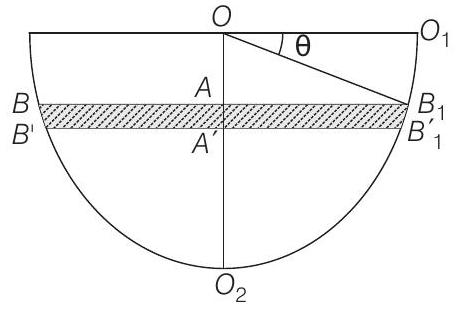
$\Rightarrow A B _1=r \cos \theta$ and $O A=r \sin \theta$ describe the coordinates of a point in polar form. The rate of change of volume with time is given by $d t=\pi A B _1^{2} \cdot d(O A)$
$\left[\pi r^{2}\right.$ is surface area of water level and $d(O A)$ is depth of water level]
$$ \begin{alignedat} & =\pi r^{2} \cdot \cos ^{2} \theta \cdot r \sin \theta d \theta \\ & =\pi r^{3} \cdot \cos ^{3} \theta , d\theta \end{aligned} $$
Also, $h(t)=r(1-\sin \theta)$
Now, outflow rate $Q=A \cdot v(t)=A \cdot 0.6 \sqrt{2 g h(1-\sin \theta)}$
Where, $A$ is the area of the outlet.
Thus, the volume flowing out in time $d t$.
$\Rightarrow \quad Q d t=A \cdot(0.6) \cdot \sqrt{2 g h} \cdot \sqrt{1-\sin \theta} d t$
We have, $\pi r^{3} \cos ^{3} \theta d \theta=A(0.6) \cdot \sqrt{2 g r} \cdot \sqrt{1-\sin ^{2} \theta} d t$
$\Rightarrow \quad \frac{\pi r^{3}}{A(0.6) \sqrt{2 g r}} \cdot \frac{\cos ^{3} \theta}{\sqrt{(1-\sin \theta)}} d \theta=d t$
Let the time taken to empty the tank be $T$.
Then, $\quad T=\int _0^{\pi / 2} \frac{\pi r^{3}}{A(0.6) \cdot \sqrt{2 g r}} \cdot \frac{\cos ^{3} \theta}{\sqrt{1-\sin \theta}} d \theta$
$$ =\frac{-\pi r^{3}}{A(0.6) \sqrt{2 g r}} \int _0^{\pi / 2} \frac{1-\sin ^{2} \theta(-\cos \theta)}{\sqrt{1-\sin \theta}} d \theta $$
Let $\quad t _1=\sqrt{1-\sin \theta}$
$\Rightarrow \quad d t _1=\frac{-\cos \theta}{\sqrt{1-\sin \theta}} d \theta$
$\therefore \quad T=\frac{-2 \pi r^{3}}{A(0.6) \sqrt{2 g r}} \int _1^{0}\left[1-\left(1-t _1^{2}\right)^{2}\right] d t _1$
$$ \begin{alignedat} & \Rightarrow \quad T=\frac{-2 \pi r^{3}}{A(0.6) \sqrt{2 g r}} \int _0^{1}\left[1-\left(1+t _1^{4}-2 t _1^{2}\right)\right] d t _1 \\ & \Rightarrow \quad T=\frac{-2 \pi r^{3}}{A(0.6) \sqrt{2 g r}} \int _0^{1}\left[1-1-t _1^{4}+2 t _1^{2}\right] d t _1 \\ & \Rightarrow \quad T=\frac{2 \pi r^{3}}{A(0.6) \sqrt{2 g r}} \int _0^{1}\left(t _1^{4}-2 t _1^{2}\right) d t _1 \\ & \Rightarrow \quad T=\frac{2 \pi r^{3}}{A(0.6) \sqrt{2 g r}} \frac{t_1^{5}}{5}-\frac{2 t_1^{3}}{3} \\ & \Rightarrow \quad T=\frac{2 \pi \cdot r^{5 / 2}}{A \frac{6}{10} \sqrt{2 g r}} \cdot \left(0-\frac{1}{5}-0+\frac{2}{3}\right) \\ & \Rightarrow \quad T=\frac{2 \pi \cdot 2^{5 / 2}\left(10^{2}\right)^{5 / 2}}{12 \cdot \frac{3}{5} \cdot \sqrt{2} \cdot \sqrt{g}} \left(\frac{2}{3}-\frac{1}{5}\right) \\ & =\frac{2 \pi \times 10^{5} \cdot 4 \cdot 5}{(12 \times 3) \sqrt{g}} \frac{10-3}{15} \\ & =\frac{2 \pi \times 10^{5} \times 7}{3 \cdot 3 \cdot \sqrt{g} \cdot 3}=\frac{14 \pi \times 10^{5}}{27 \sqrt{g}} \text { unit } \end{aligned} $$
 BETA
BETA


