Ellipse Ques 23
- Let $E _1$ and $E _2$ be two ellipses whose centres are at the origin. The major axes of $E _1$ and $E _2$ lie along the $X$-axis and $Y$-axis, respectively. Let $S$ be the circle $x^{2}+(y-1)^{2}=2$. The straight line $x+y=3$ touches the curves $S, E _1$ and $E _2$ at $P, Q$ and $R$, respectively.
Suppose that $P Q=P R=\frac{2 \sqrt{2}}{3}$. If $e _1$ and $e _2$ are the eccentricities of $E _1$ and $E _2$ respectively, then the correct expression(s) is/are
(2015 Adv.)
(a) $e _1^{2}+e _2^{2}=\frac{43}{40}$
(b) $e _1 e _2=\frac{\sqrt{7}}{2 \sqrt{10}}$
(c) $\left|e _1^{2}-e _2^{2}\right|=\frac{5}{8}$
(d) $e _1 e _2=\frac{\sqrt{3}}{4}$
Show Answer
Answer:
Correct Answer: 23.(a, b)
Solution:
- Here, $E _1: \frac{x^{2}}{a^{2}}+\frac{y^{2}}{b^{2}}=1,(a>b)$ $E _2: \frac{x^{2}}{c^{2}}+\frac{y^{2}}{d^{2}}=1,(c<d)$ and
$S: x^{2}+(y-1)^{2}=2$ as tangent to $E _1, E _2$ and $S$ is $x+y=3$.
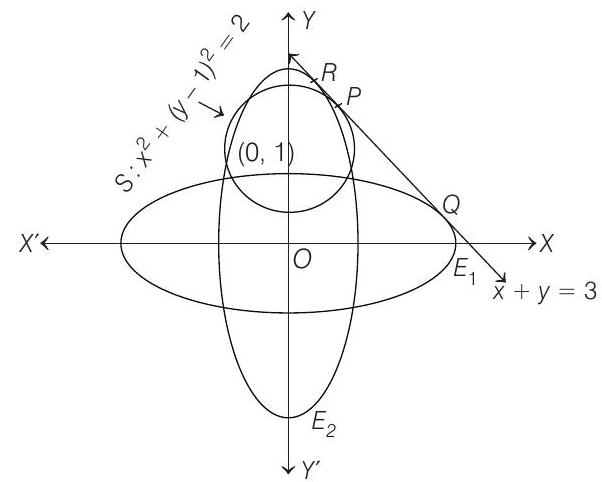
Let the point of contact of tangent be $\left(x _1, y _1\right)$ to $S$.
$ \therefore \quad x \cdot x _1+y \cdot y _1-\left(y+y _1\right)+1=2 $
or $x x _1+y y _1-y=\left(1+y _1\right)$, same as $x+y=3$.
$ \begin{array}{ll} \Rightarrow & \frac{x _1}{1}=\frac{y _1-1}{1}=\frac{1+y _1}{3} \\ \text { i.e. } & x _1=1 \text { and } y _1=2 \\ \therefore & P=(1,2) \end{array} $
Since, $P R=P Q=\frac{2 \sqrt{2}}{3}$. Thus, by parametric form,
$ \begin{array}{rlrl} & & \frac{x-1}{-1 / \sqrt{2}} & =\frac{y-2}{1 / \sqrt{2}}= \pm \frac{2 \sqrt{2}}{3} \\ \Rightarrow & (x=\frac{5}{3}, y & =\frac{4}{3}) \quad \text { and } \quad (x=\frac{1}{3}, y=\frac{8}{3}) \\ \therefore & Q & =(\frac{5}{3}, \frac{4}{3}) \text { and } \quad R=\frac({1}{3}, \frac{8}{3}) \end{array} $
Now, equation of tangent at $Q$ on ellipse $E _1$ is
$ \frac{x \cdot 5}{a^{2} \cdot 3}+\frac{y \cdot 4}{b^{2} \cdot 3}=1 $
On comparing with $x+y=3$, we get
$ \begin{aligned} a^{2} & =5 \text { and } b^{2}=4 \\ \quad e _1^{2} & =1-\frac{b^{2}}{a^{2}}=1-\frac{4}{5}=\frac{1}{5} \end{aligned} $
Also, equation of tangent at $R$ on ellipse $E _2$ is
$ \frac{x \cdot 1}{a^{2} \cdot 3}+\frac{y \cdot 8}{b^{2} \cdot 3}=1 $
On comparing with $x+y=3$, we get
$ \begin{aligned} & a^{2}=1, b^{2}=8 \\ & \therefore \quad e _2^{2}=1-\frac{a^{2}}{b^{2}}=1-\frac{1}{8}=\frac{7}{8} \\ & \text { Now, } \quad e _1^{2} \cdot e _2^{2}=\frac{7}{40} \Rightarrow e _1 e _2=\frac{\sqrt{7}}{2 \sqrt{10}} \\ & \text { and } \quad e _1^{2}+e _2^{2}=\frac{1}{5}+\frac{7}{8}=\frac{43}{40} \\ & \text { Also, } \quad\left|e _1^{2}-e _2^{2}\right|=\left|\frac{1}{5}-\frac{7}{8}\right|=\frac{27}{40} \end{aligned} $
 BETA
BETA


