Limit Continuity And Differentiability Ques 90
- A discontinuous function $y=f(x)$ satisfying $x^{2}+y^{2}=4$ is given by $f(x)=\sqrt{4-x^{2}}$.
$(1982,2 M)$
Analytical & Descriptive Questions
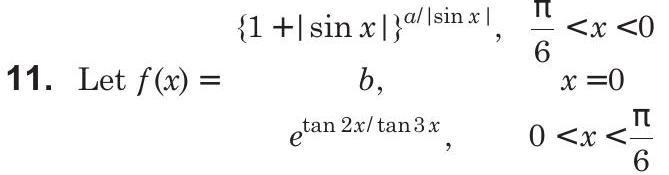
Determine $a$ and $b$ such that $f(x)$ is continuous at $x=0$.
(1994, 4M)
Show Answer
Answer:
90.$a=\frac{2}{3}, b=e^{2/3}$ 12 . $a=8$
Solution:
- $f(x)=[x] \sin \frac{\pi}{[x+1]}$
We know that, $[x]$ is continuous on $R \sim I$, where $I$ denotes the set of integers and $\sin \frac{\pi}{[x+1]}$ is discontinuous for $[x+1]=0$.
$$ \Rightarrow \quad 0 \leq x+1<1 \Rightarrow-1 \leq x<0 $$
Thus, the function is defined in the interval.
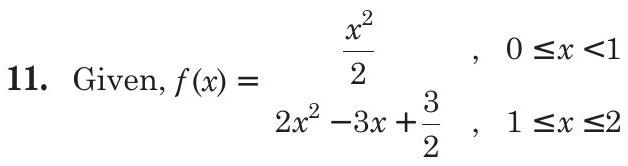
Clearly, RHL (at $x=1$) = $1 / 2$ and LHL (at $x=1$) = $1 / 2$ Also,
$$ f(x)=1 / 2 $$
$\therefore f(x)$ is continuous for all $x \in[0,2]$.
On differentiating Eq. (i), we get
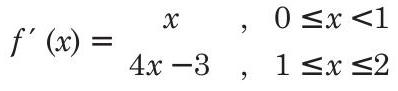
Clearly, RHL (at $x=1$ ) for $f^{\prime}(x)=1$
and LHL (at $x=1$ ) for $f(x)=1$
Also,
$$ f(1)=1 $$
Thus, $f^{\prime}(x)$ is continuous for all $x \in[0,2]$.
Again, differentiating Eq. (ii), we get
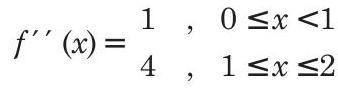
Clearly, RHL (at $x=1$) \neq \operatorname{LHL}($x=1$)
Thus, $f^{\prime \prime}(x)$ is not continuous at $x=1$.
or $f^{\prime \prime}(x)$ is continuous for all $x \in[0,2]-{1}$.
 BETA
BETA


