Limit Continuity And Differentiability Ques 94
- For each positive integer $n$, let
$$ y _n=\frac{1}{n}((n+1)(n+2) \ldots(n+n))^{\frac{1}{n}} $$
For $x \in R$, let $[x]$ be the greatest integer less than or equal to $x$. If $\lim _{n \rightarrow \infty} y _n=L$, then the value of $[L]$ is
Fill in the Blank
Show Answer
Answer:
Correct Answer: 94.(c)
Solution:
- Given function $f:[-1,3] \rightarrow R$ is defined as
$$ f(x)=\begin{array}{l} |x| + [x], \quad -1 \leq x < 1 \ x+|x|, & 1 \leq x<2 \\ x+[x], \quad 2 \leq x \leq 3 \end{array} $$
$$ \begin{aligned} & -x-1, \quad-1 \leq x<0 \\ & x, \quad 0 \leq x < 1 \\ & =2x, \quad 1 \leq x<2 \ & x+2, \quad 2 \leq x < 3 \\ & \text { 6, } \quad x=3 \end{aligned} $$
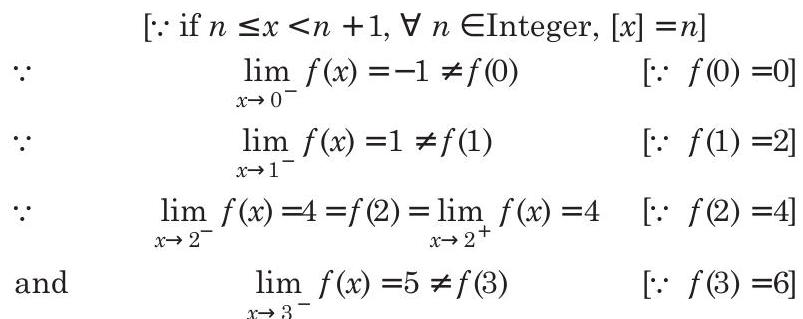
$\therefore$ Function $f(x)$ is discontinuous at points 0,1 and 3 .
 BETA
BETA


