Properties Of Triangles Ques 43
- In a $\triangle X Y Z$, let $x, y, z$ be the lengths of sides opposite to the angles $X, Y, Z$ respectively and $2 s=x+y+z$. If $\frac{s-x}{4}=\frac{s-y}{3}=\frac{s-z}{2}$ and area of incircle of the $\triangle X Y Z$ is $\frac{8 \pi}{3}$, then
(2016 Adv.)
(a) area of the $\triangle X Y Z$ is $6 \sqrt{6}$
(b) the radius of circumcircle of the $\triangle X Y Z$ is $\frac{35}{6} \sqrt{6}$
$\begin{array}{ll}\text { (c) } \sin \frac{X}{2} \sin \frac{Y}{2} \sin \frac{Z}{2}=\frac{4}{35} & \text { (d) } \sin ^{2} \frac{X+Y}{2}=\frac{3}{5}\end{array}$
Show Answer
Answer:
Correct Answer: 43.$(a, c, d)$
Solution:
- Given a $\triangle X Y Z$, where $2 s=x+y+z$
and
$$ \frac{s-x}{4}=\frac{s-y}{3}=\frac{s-z}{2} $$
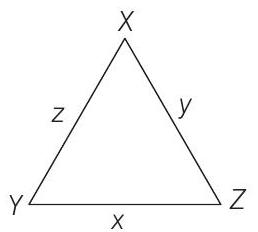
$$ \therefore \quad \frac{s-x}{4}=\frac{s-y}{3}=\frac{s-z}{2} $$
$$ =\frac{3 s-(x+y+z)}{4+3+2}=\frac{s}{9} $$
or
$$ \frac{s-x}{4}=\frac{s-y}{3}=\frac{s-z}{2}=\frac{s}{9}=\lambda(\text { let }) $$
$\Rightarrow \quad s=9 \lambda, s=4 \lambda+x, s=3 \lambda+y$
and $\quad s=2 \lambda+z$
$\therefore \quad s=9 \lambda, x=5 \lambda, y=6 \lambda, z=7 \lambda$
Now, $\quad \Delta=\sqrt{s(s-x)(s-y)(s-z)}$
[Heron’s formula]
$$ =\sqrt{9 \lambda \cdot 4 \lambda \cdot 3 \lambda \cdot 2 \lambda}=6 \sqrt{6} \lambda^{2} $$
Also, $\quad \pi r^{2}=\frac{8 \pi}{3}$
$$ \Rightarrow \quad r^{2}=\frac{8}{3} $$
and
$$ R=\frac{x y z}{4 \Delta}=\frac{(5 \lambda)(6 \lambda)(7 \lambda)}{4 \cdot 6 \sqrt{6} \lambda^{2}}=\frac{35 \lambda}{4 \sqrt{6}} $$
Now, $\quad r^{2}=\frac{8}{3}=\frac{\Delta^{2}}{S^{2}}=\frac{216 \lambda^{4}}{81 \lambda^{2}}$
$$ \Rightarrow \quad \frac{8}{3}=\frac{8}{3} \lambda^{2} $$
[from Eq. (ii)]
$\Rightarrow \quad \lambda=1$
(a) $\triangle X Y Z=6 \sqrt{6} \lambda^{2}=6 \sqrt{6}$
$\therefore$ Option (a) is correct.
(b) Radius of circumcircle $(R)=\frac{35}{4 \sqrt{6}} \lambda=\frac{35}{4 \sqrt{6}}$
$\therefore$ Option (b) is incorrect.
(c) Since,
$$ r=4 R \sin \frac{X}{2} \cdot \sin \frac{Y}{2} \cdot \sin \frac{Z}{2} $$
$$ \begin{array}{ll} \Rightarrow & \frac{2 \sqrt{2}}{\sqrt{3}}=4 \cdot \frac{35}{4 \sqrt{6}} \sin \frac{X}{2} \cdot \sin \frac{Y}{2} \cdot \sin \frac{Z}{2} \\ \Rightarrow & \frac{4}{35}=\sin \frac{X}{2} \cdot \sin \frac{Y}{2} \cdot \sin \frac{Z}{2} \end{array} $$
$\therefore$ Option (c) is correct.
(d) $\sin ^{2} \frac{X+Y}{2}=\cos ^{2} \frac{Z}{2}$
$$ \text { as } \frac{X+Y}{2}=90^{\circ}-\frac{Z}{2}=\frac{s(s-z)}{x y}=\frac{9 \times 2}{5 \times 6}=\frac{3}{5} $$
$\therefore$ Option (d) is correct.
 BETA
BETA


