Theory Of Equations Ques 73
- Let $a, b, c$ be real. If $a x^{2}+b x+c=0$ has two real roots $\alpha$ and $\beta$, where $\alpha<-1$ and $\beta>1$, then show that $1+\frac{c}{a}+\frac{b}{a}<0$
$(1995,5 M)$
Show Answer
Solution:
Formula:
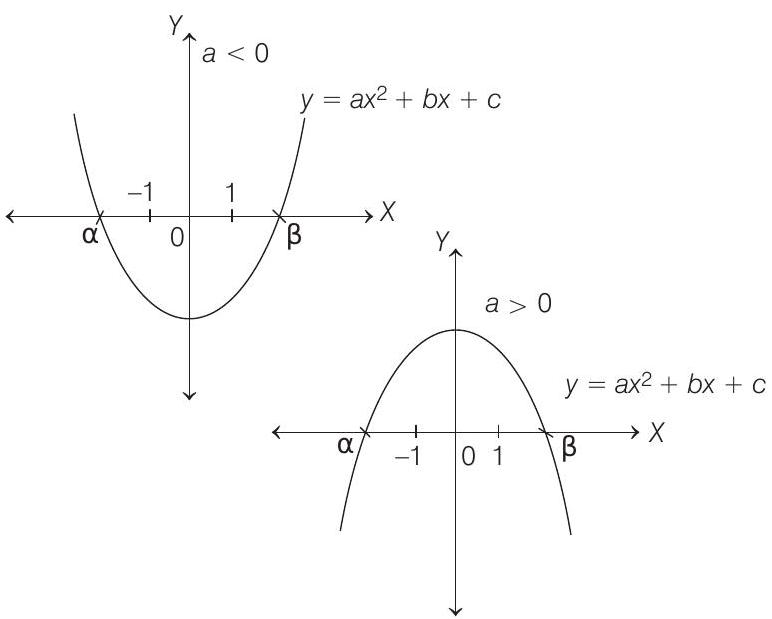
From figure, it is clear that, if $a>0$, then $f(-1)<0$ and $f(1)<0$ and if $a<0, f(-1)>0$ and $f(1)>0$. In both cases, $a f(-1)<0$ and $a f(1)<0$.
$$ \Rightarrow \quad a(a-b+c)<0 \quad \text { and } \quad a(a+b+c)<0 $$
On dividing by $a^{2}$, we get
$$73-\frac{b}{a}+\frac{c}{a}<0 \quad \text { and } \quad 1+\frac{b}{a}+\frac{c}{a}<0 $$
On combining both, we get
$$ \begin{aligned} & 1 \pm \frac{b}{a}+\frac{c}{a}<0 \\ \Rightarrow \quad & 1+\frac{b}{a}+\frac{c}{a}<0 \end{aligned} $$
 BETA
BETA


