Theory Of Equations Ques 78
- The function $f’(x)$ is
(a) increasing in $-t,-\frac{1}{4}$ and decreasing in $-\frac{1}{4}, t$
(b) decreasing in $-t,-\frac{1}{4}$ and increasing in $-\frac{1}{4}, t$
(c) increasing in $(-t, t)$
(d) decreasing in $(-t, t)$
Passage II
If a continuous function $f$ defined on the real line $\mathbb{R}$, assumes positive and negative values in $\mathbb{R}$, then the equation $f(x)=0$ has a root in $\mathbb{R}$. For example, if it is known that a continuous function $f$ on $\mathbb{R}$ is positive at some point and its minimum value is negative, then the equation $f(x)=0$ has a root in $\mathbb{R}$. Consider $f(x)=k e^{x}-x$ for all real $x$ where $k$ is real constant.
(2007, 4M)
Show Answer
Answer:
Correct Answer: 78.(b)
Solution:
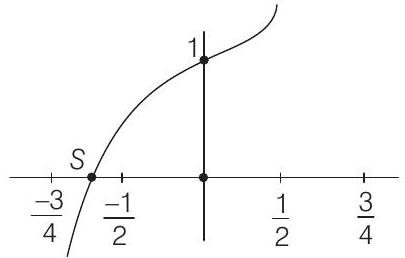
As, $f^{\prime \prime}(x)=24x+6$
$f^{\prime}(x)>0$, when $x>-\frac{1}{4}$ and
$f^{\prime}(x)<0$, when $x<-\frac{1}{4}$.
$\therefore$ It can be expressed as
 BETA
BETA


