Trigonometrical Equations Ques 35
- Find all values of $\theta$ in the interval $-\frac{\pi}{2}, \frac{\pi}{2}$ satisfying the equation $(1-\tan \theta)(1+\tan \theta) \sec ^{2} \theta+2^{\tan ^{2} \theta}=0$.
(1996, 2M)
Show Answer
Answer:
Correct Answer: 35.$\theta= \pm \pi / 3$
Solution:
Formula:
- Given, $(1-\tan \theta)(1+\tan \theta) \sec ^{2} \theta+2^{\tan ^{2} \theta}=0$
$\Rightarrow \quad\left(1-\tan ^{2} \theta\right) \cdot\left(1+\tan ^{2} \theta\right)+2^{\tan ^{2} \theta}=0$
$\Rightarrow \quad 1-\tan ^{4} \theta+2^{\tan ^{2} \theta}=0$
Put $\quad \tan ^{2} \theta=x$
$\therefore \quad 1-x^{2}+2^{x}=0$
$\Rightarrow \quad x^{2}-1=2^{x}$
NOTE $2^{x}$ and $x^{2}-1$ are incompatible functions, therefore we have to consider the range of both functions.
Curves $y=x^{2}-1$ and $y=2^{x}$
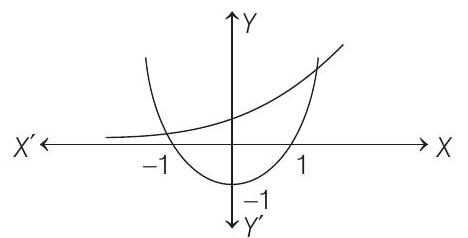
It is clear from the graph that two curves intersect at one point at $x=3, y=8$.
Therefore, $\quad \tan ^{2} \theta=3$
$$ \begin{aligned} \Rightarrow & & \tan \theta & = \pm \sqrt{3} \\ \Rightarrow & & \theta & = \pm \frac{\pi}{3} \end{aligned} $$
 BETA
BETA


