Vectors Ques 107
- Prove, by vector methods or otherwise, that the point of intersection of the diagonals of a trapezium lies on the line passing through the mid-points of the parallel sides. (you may assume that the trapezium is not a parallelogram).
(1998, 8M)
Show Answer
Solution:
Formula:
- Let $O$ be the origin of reference. Let the position vectors of $A$ and $B$ be $\overrightarrow{\mathbf{a}}$ and $\overrightarrow{\mathbf{b}}$ respectively.
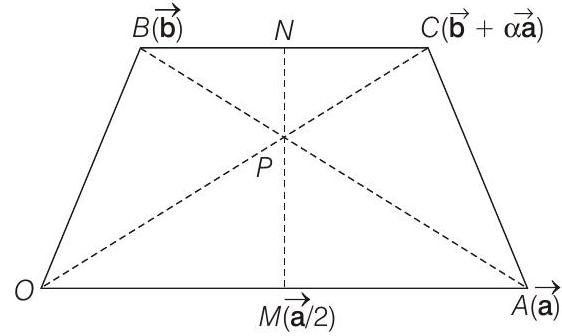
Since, $B C | O A, \overrightarrow{\mathbf{B C}}=\alpha \overrightarrow{\mathbf{O A}}=\alpha \overrightarrow{\mathbf{a}}$ for some constant $\alpha$.
Equation of $O C$ is $\overrightarrow{\mathbf{r}}=t(\overrightarrow{\mathbf{b}}+\alpha \overrightarrow{\mathbf{a}})$ and
equation of $A B$ is $\overrightarrow{\mathbf{r}}=\overrightarrow{\mathbf{a}}+\lambda(\overrightarrow{\mathbf{b}}-\overrightarrow{\mathbf{a}})$
Let $P$ be the point of intersection of $O C$ and $A B$. Then, at point $P, t(\overrightarrow{\mathbf{b}}+\alpha \overrightarrow{\mathbf{a}})=\overrightarrow{\mathbf{a}}+\lambda(\overrightarrow{\mathbf{b}}-\overrightarrow{\mathbf{a}})$ for some values of $t$ and $\lambda$.
$$ \Rightarrow \quad(t \alpha-1+\lambda) \overrightarrow{\mathbf{a}}=(\lambda-t) \overrightarrow{\mathbf{b}} $$
Since, $\overrightarrow{\mathbf{a}}$ and $\overrightarrow{\mathbf{b}}$ are non-parallel vectors, we must have
$$ t \alpha-1+\lambda=0 \text { and } \lambda=t \Rightarrow t=1 /(\alpha+1) $$
Thus, position vector of $P$ is $\overrightarrow{\mathbf{r} _1}=\frac{1}{\alpha+1}(\overrightarrow{\mathbf{b}}+\alpha \overrightarrow{\mathbf{a}})$
Equation of $M N$ is $\overrightarrow{\mathbf{r}}=\frac{1}{2} \overrightarrow{\mathbf{a}}+k\left[\overrightarrow{\mathbf{b}}+\frac{1}{2}(\alpha-1) \overrightarrow{\mathbf{a}}\right]$
For $k = \frac{1}{\alpha+1}$, which is the coefficient of $\overrightarrow{\mathbf{b}}$ in $\overrightarrow{\mathbf{r}_1}$, we get
$\overrightarrow{\mathbf{r}}=\frac{1}{2} \overrightarrow{\mathbf{a}}+\frac{1}{\alpha+1}\left[\overrightarrow{\mathbf{b}}+\frac{1}{2}(\alpha-1) \overrightarrow{\mathbf{a}}\right]$
$=\frac{1}{(\alpha+1)} \overrightarrow{\mathbf{b}}+\frac{1}{2}(\alpha-1) \cdot \frac{1}{\alpha+1} \overrightarrow{\mathbf{a}}+\frac{1}{2} \overrightarrow{\mathbf{a}}$
$=\frac{1}{(\alpha+1)} \overrightarrow{\mathbf{b}}+\frac{1}{2(\alpha+1)}(\alpha-1+\alpha+1) \overrightarrow{\mathbf{a}}$
$=\frac{1}{(\alpha+1)}(\overrightarrow{\mathbf{b}}+\alpha \overrightarrow{\mathbf{a}})=\overrightarrow{\mathbf{r}} _1 \Rightarrow P$ lies on $M N$.
 BETA
BETA


