Vectors Ques 68
- Let $\mathbf{u}=\mathbf{u} _1 \hat{\mathbf{i}}+\mathbf{u} _2 \hat{\mathbf{j}}+\mathbf{u} _3 \hat{\mathbf{k}}$ be a unit vector in $R^{3}$ and $\mathbf{w}=\frac{1}{\sqrt{6}}(\hat{\mathbf{i}}+\hat{\mathbf{j}}+2 \hat{\mathbf{k}})$. Given that there exists a vector $\mathbf{v}$ in $R^{3}$, such that $|\mathbf{u}+\mathbf{v}|=1$ and $\mathbf{w} \cdot(\mathbf{u}+\mathbf{v})=1$. Which of the following statement(s) is/are correct?
(a) There is exactly one choice for such $\mathbf{v}$
(b) There are infinitely many choices for such $\mathbf{v}$
(c) If $\hat{u}$ lies in the $X Y$-plane, then $\left|u_1\right|=\left|u_2\right|$
(d) If $\hat{u}$ lies in the $X Y$-plane, then $\left|u _3\right|=0$
Show Answer
Answer:
Correct Answer: 68.(b, c)
Solution:
- Let $\theta$ be the angle between $\hat{u}$ and $\vec{v}$.
$$ \begin{array}{lll} \therefore & |\mathbf{u} \times \overrightarrow{\mathbf{v}}|=1 \quad \Rightarrow \quad|\mathbf{u}||\overrightarrow{\mathbf{v}}| \sin \theta=1 \\ \therefore & |\overrightarrow{\mathbf{v}}| \sin \theta=1 & {[\because|\mathbf{u}|=1] \ldots(i)} \end{array} $$
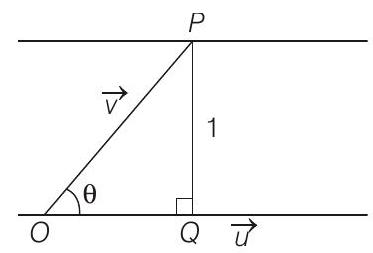
Clearly, there may be infinite vectors $\overrightarrow{\mathbf{O P}}=\overrightarrow{\mathbf{v}}$, such that $P$ is always 1 unit distance from $\hat{u}$.
$\therefore$ Option (b) is correct.
Again, let $\phi$ be the angle between $\mathbf{w}$ and $\mathbf{u} \times \overrightarrow{\mathbf{v}}$.
$$ \begin{aligned} & \therefore \quad \mathbf{w} \cdot(\mathbf{u} \times \overrightarrow{\mathbf{v}})=1 \quad \Rightarrow \quad|\mathbf{w}||\mathbf{u} \times \overrightarrow{\mathbf{v}}| \cos \phi=1 \\ & \Rightarrow \quad \cos \phi=1 \Rightarrow \phi=0 \end{aligned} $$
Thus,
$$ \mathbf{w}=\mathbf{u} \times \overrightarrow{\mathbf{v}} $$
Now, if $\hat{u}$ lies in $X Y$-plane, then
$$ \begin{array}{rlrl} & \mathbf{u} \times \overrightarrow{\mathbf{v}}=\left|\begin{array}{ccc} \mathbf{i} & \mathbf{j} & \mathbf{k} \ u_{1} & u_{2} & 0 \` v_1 & v_2 & v_3 \end{array}\right| \text { or } \quad \mathbf{u}=u \hat{\mathbf{i}}+u_2 \hat{\mathbf{j}} \ \therefore \quad & \quad \mathbf{w}=\left(u _2 v _3\right) \hat{\mathbf{i}}-\left(u _1 v _3\right) \hat{\mathbf{j}}+\left(u _1 v _2-v _1 u _2\right) \hat{\mathbf{k}} \\ & =\frac{1}{\sqrt{6}}(\hat{\mathbf{i}}+\hat{\mathbf{j}}+2 \hat{\mathbf{k}}) \\ \therefore \quad & u _2 v _3 & =\frac{1}{\sqrt{6}}, u _1 v _3=\frac{-1}{\sqrt{6}} \\ \Rightarrow \quad & \frac{u _2 v _3}{u _1 v _3} & = & -1 \text { or }\left|u _1\right|=\left|u _2\right| \end{array} $$
$\therefore$ Option (c) is correct.
Now, if $\hat{u}$ lies in $X Z$-plane, then $\mathbf{u}=u _1 \hat{\mathbf{i}}+u _3 \hat{\mathbf{k}}$
$$ \begin{alignedat} & \therefore \quad \mathbf{u} \times \overrightarrow{\mathbf{v}}=\left|\begin{array}{ccc} \hat{\mathbf{i}} & \hat{\mathbf{j}} & \hat{\mathbf{k}} \\ u _1 & 0 & u _3 \\ v_1 & v_2 & v_3 \end{array}\right| \\ & \Rightarrow \mathbf{w}=\left(-v _2 u _3\right) \hat{\mathbf{i}}-\left(u _1 v _3-u _3 v _1\right) \hat{\mathbf{j}}+\left(u _1 v _2\right) \hat{\mathbf{k}} \\ & \Rightarrow \hat{\mathbf{k}}=\frac{1}{\sqrt{6}}(\hat{\mathbf{i}}+\hat{\mathbf{j}}+2 \hat{\mathbf{k}}) \\ & \Rightarrow-v _2 u _3=\frac{1}{\sqrt{6}} \text { and } u _1 v _2=\frac{2}{\sqrt{6}} \\ & \therefore \quad\left|u _2\right|=2\left|u _3\right| \end{aligned} $$
$\therefore$ Option $(d)$ is wrong.
 BETA
BETA


