Centre Of Mass Ques 15
- Four particles $A, B, C$ and $D$ with masses $m _A=m$, $m _B=2 m, m _C=3 m$ and $m _D=4 m$ are at the corners of a square. They have accelerations of equal magnitude with directions as shown. The acceleration of the centre of mass of the particles (in $ms^{-2}$ ) is
(2019 Main, 8 April I)
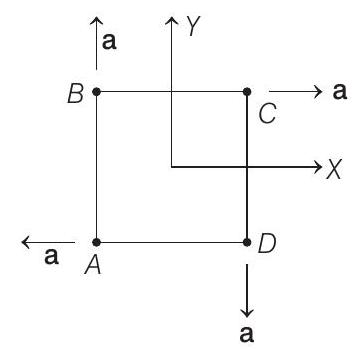
(a) $\frac{a}{5}(\hat{\mathbf{i}}-\hat{\mathbf{j}})$
(b) $a(\hat{\mathbf{i}}+\hat{\mathbf{j}})$
(c) zero
(d) $\frac{a}{5}(\hat{\mathbf{i}}+\hat{\mathbf{j}})$
Show Answer
Answer:
Correct Answer: 15.(a)
Solution:
Formula:
Motion of Centre of Mass and Conservation of Momentum:
- For a system of discrete masses, acceleration of centre of mass (CM) is given by
$$ \mathbf{a} _{CM}=\frac{m _A \mathbf{a} _A+m _B \mathbf{a} _B+m _C \mathbf{a} _C+m _D \mathbf{a} _D}{m _A+m _B+m _C+m _D} $$
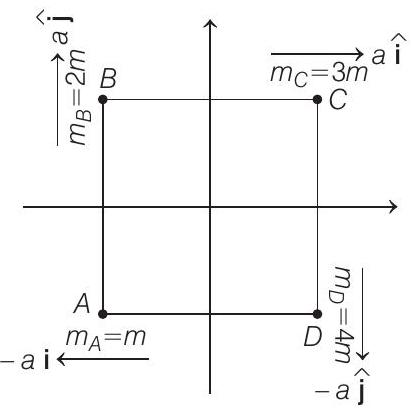
where, $\quad m _A=m, m _B=2 m, \quad m _C=3 m \quad$ and $\quad m _D=4 m$, $\left|\mathbf{a} _A\right|=\left|\mathbf{a} _B\right|=\left|\mathbf{a} _C\right|=\left|\mathbf{a} _D\right|=a$ (according to the question)
$$ \begin{aligned} a _{CM}= & \frac{-m a \hat{\mathbf{i}}+2 m a \hat{\mathbf{j}}+3 m a \hat{\mathbf{i}}-4 m a \hat{\mathbf{j}}}{m+2 m+3 m+4 m} \\ & =\frac{2 a \hat{\mathbf{i}}-2 a \hat{\mathbf{j}}}{10}=\frac{a}{5} \cdot(\hat{\mathbf{i}}-\hat{\mathbf{j}}) ms^{-2} \end{aligned} $$
 BETA
BETA


