Centre Of Mass Ques 55
- A block $A$ of mass $2 m$ is placed on another block $B$ of mass $4 m$ which in turn is placed on a fixed table. The two blocks have a same length $4 d$ and they are placed as shown in figure. The coefficient of friction (both static and kinetic) between the block $B$ and table is $\mu$. There is no friction between the two blocks. A small object of mass $m$ moving horizontally along a line passing through the centre of mass (CM) of the block $B$ and perpendicular to its face with a speed $v$ collides elastically with the block $B$ at a height $d$ above the table.
(1991, $4+4$ M)
(a) What is the minimum value of $v$ (call it $v _0$ ) required to make the block $A$ to topple?
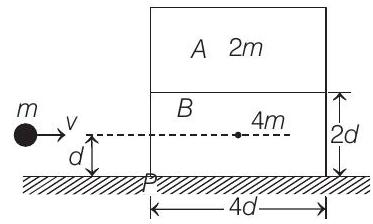
(b) If $v=2 v _0$, find the distance (from the point $P$ in the figure) at which the mass $m$ falls on the table after collision. (Ignore the role of friction during the collision.)
Show Answer
Answer:
Correct Answer: 55.(a) $\frac{5}{2} \sqrt{6 \mu g d}$
(b) $6 d \sqrt{3 \mu}$
Solution:
- If $v _1$ and $v _2$ are the velocities of object of mass $m$ and block of mass $4 m$, just after collision then by conservation of momentum,
$$ m v=m v _1+4 m v _2 \text {, i.e. } v=v _1+4 v _2 $$
Further, as collision is elastic
$$ \frac{1}{2} m v^{2}=\frac{1}{2} m v _1^{2}+\frac{1}{2} 4 m v _2^{2}, \text { i.e. } v^{2}=v _1^{2}+4 v _2^{2} $$
Solving, these two equations we get either
Therefore, $\quad v _2=\frac{2}{5} v$
$$ v _2=0 \quad \text { or } \quad v _2=\frac{2}{5} v $$
Substituting in Eq. (i) $v _1=\frac{3}{5} v$
when $v _2=0, v _1=v _2$, but it is physically unacceptable.
(a) Now, after collision the block $B$ will start moving with velocity $v _2$ to the right. Since, there is no friction between blocks $A$ and $B$, the upper block $A$ will stay at its position and will topple if $B$ moves a distance $s$ such that
$$ s>2 d $$
However, the motion of $B$ is retarded by frictional force $f=\mu(4 m+2 m) g$ between table and its lower surface. So, the distance moved by $B$ till it stops
$$ 0=v _2^{2}-2 \frac{6 \mu m g}{4 m} s, \text { i.e. } s=\frac{v _2^{2}}{3 \mu g} $$
Substituting this value of $s$ in Eq. (iii), we find that for toppling of $A$
or
$$ \begin{aligned} & v _2^{2}>6 \mu g d \\ & \frac{2}{5} v>\sqrt{6 \mu g d} \quad\left[\text { as } v _2=2 v / 5\right] \end{aligned} $$
$$ \begin{aligned} \text { i.e. } & v>\frac{5}{2} \sqrt{6 \mu g d} \\ \text { or } & v _{\min }=v _0=\frac{5}{2} \sqrt{6 \mu g d} \end{aligned} $$
(b) If $v=2 v _0=5 \sqrt{6 \mu g d}$, the object will rebound with speed $v _1=\frac{3}{5} v=3 \sqrt{6 \mu g d}$ and as time taken by it to fall down
$$ t=\sqrt{\frac{2 h}{g}}=\sqrt{\frac{2 d}{g}} \quad[\text { as } h=d] $$
The horizontal distance moved by it to the left of $P$ in this time $x=v _1 t=6 d \sqrt{3 \mu}$
NOTE
- Toppling will take place if line of action of weight does not pass through the base area in contact.
- $v _1$ and $v _2$ can be obtained by using the equations of head on elastic collision
$$ \begin{aligned} & v _1^{\prime}=\frac{m _1-m _2}{m _1+m _2} v _2+\frac{2 m _2}{m _1+m _2} v _2 \\ \text { and } & v _2^{\prime}=\frac{m _2-m _1}{m _1+m _2} \quad v _2+\frac{2 m _1}{m _1+m _2} \quad v _1 \end{aligned} $$
 BETA
BETA


