Electromagnetic Induction And Alternating Current Ques 24
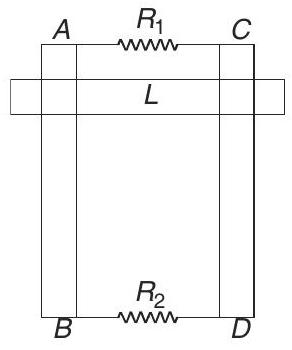
- Two parallel vertical metallic rails $A B$ and $C D$ are separated by $1 m$. They are connected at two ends by resistances $R _1$ and $R _2$ as shown in figure. A horizontal metallic bar of mass $0.2 kg$ slides without friction vertically down the rails under the action of gravity.
There is a uniform horizontal magnetic field of $0.6 T$ perpendicular to the plane of the rails. It is observed that when the terminal velocity is attained, the powers dissipated in $R _1$ and $R _2$ are $0.76 W$ and $1.2 W$ respectively. Find the terminal velocity of the bar $L$ and the values of $R _1$ and $R _2$. (1994,6M)
Show Answer
Answer:
Correct Answer: 24.$v=1 m / s, R _1=0.47 \Omega, R _2=0.3 \Omega$
Solution:
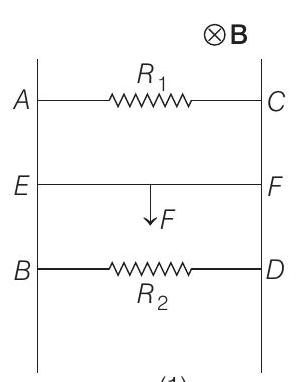
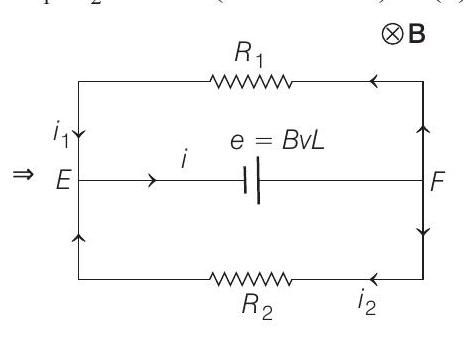
- Let the magnetic field be perpendicular to the plane of rails and inwards $\otimes$. If $v$ be the terminal velocity of the rails, then potential difference across $E$ and $F$ would be $B v L$ with $E$ at lower potential and $F$ at higher potential. The equivalent circuit is shown in figure (2). In figure (2)
$$ \begin{aligned} & i _1=\frac{e}{R _1} \\ & i _2=\frac{e}{R _2} \end{aligned} $$
Power dissipated in $R _1$ is $0.76 W$
Therefore $\quad e i _1=0.76 W$
Similarly, $\quad e i _2=1.2 W$
Now, the total current in bar $E F$ is
$$ i=i _1+i _2 $$
(from $E$ to $F$ ) …(v)
(1)
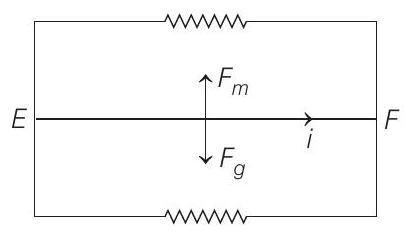
(2) Under equilibrium condition, magnetic force $\left(F _m\right)$ on bar $E F$ = weight $\left(F _g\right)$ of bar $E F$
i.e.
$$ F _m=F _g \quad \text { or } \quad i L B=m g $$
From Eq. (vi) $\quad i=\frac{m g}{L B}=\frac{(0.2)(9.8)}{(1.0)(0.6)}$
or
$$ i=3.27 A $$
Multiplying Eq. (v) by $e$, we get
$$ e i=e i _1+e i _2 $$
$$ \begin{aligned} & =(0.76+1.2) \quad[\text { From Eqs. (iii) and (iv) }] \\ & =1.96 W \\ & e=\frac{1.96}{i} V=\frac{1.96}{3.27} \\ & \text { or } \quad e=0.6 V \\ & \text { But since } \quad e=B v L \\ & v=\frac{e}{B L}=\frac{(0.6)}{(0.6)(1.0)}=1.0 m / s \end{aligned} $$
Hence, terminal velocity of bar is $1.0 m / s$.
Power in $R _1$ is $0.76 W$
$$ \begin{aligned} & \therefore \quad 0.76=\frac{e^{2}}{R _1} \Rightarrow \quad \therefore \quad R _1=\frac{e^{2}}{0.76}=\frac{(0.6)^{2}}{0.76} \\ & =0.47 \Omega \quad \Rightarrow \quad R _1=0.47 \Omega \\ & \text { Similarly, } \quad R _2=\frac{e^{2}}{1.2}=\frac{(0.6)^{2}}{1.2}=0.3 \Omega \\ & R _2=0.3 \Omega \end{aligned} $$
 BETA
BETA


