Electromagnetic Induction And Alternating Current Ques 74
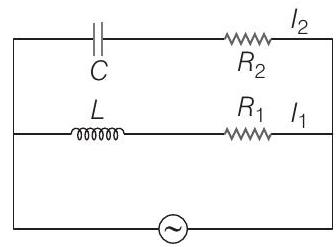
In the above circuit, $C=\frac{\sqrt{3}}{2} \mu F, R _2=20 \Omega, L=\frac{\sqrt{3}}{10} H$ and $R _1=10 \Omega$. Current in $L-R _1$ path is $I _1$ and in $C-R _2$ path is $I _2$. The voltage of AC source is given by $V=200 \sqrt{2} \sin (100 t)$ volts. The phase difference between $I _1$ and $I _2$ is
(a) $30^{\circ}$
(b) $60^{\circ}$
(c) $0^{\circ}$
(d) $90^{\circ}$
Show Answer
Answer:
Correct Answer: 74.(a)
Solution:
Formula:
- Phase difference between $I _2$ and $V$, i.e. $C-R _2$ circuit is given by
$$ \tan \varphi=\frac{X _C}{R _2} \Rightarrow \tan \varphi=\frac{1}{C \omega R _2} $$
Substituting the given values, we get
$$ \tan \varphi=\frac{1}{\frac{\sqrt{3}}{2} \times 10^{-6} \times 100 \times 20}=\frac{10^{3}}{\sqrt{3}} $$
$\therefore \varphi _1$, is nearly $90^{\circ}$.
Phase difference between $I _1$ and $V$, i.e. in $L-R _1$ circuit is given by
$$ \tan \varphi _2=-\frac{X _L}{R _1}=-\frac{L \omega}{R} $$
Substituting the given values, we get
$$ \tan \varphi _2=-\frac{\frac{\sqrt{3}}{10} \times 100}{10}=-\sqrt{3} $$
As, $\quad \tan \varphi _2=-\sqrt{3} \Rightarrow \varphi _2=120^{\circ}$
Now, phase difference between $I _1$ and $I _2$ is
$$ \Delta \varphi=\varphi _2-\varphi _1=120^{\circ}-90^{\circ}=30^{\circ} $$
 BETA
BETA


