Electrostatics Ques 57
- Four equal point charges $Q$ each are placed in the $x y$-plane at $(0,2),(4,2),(4,-2)$ and $(0,-2)$. The work required to put a fifth charge $Q$ at the origin of the coordinate system will be
(a) $\frac{Q^{2}}{4 \pi \varepsilon _0}$
(b) $\frac{Q^{2}}{4 \pi \varepsilon _0} 1+\frac{1}{\sqrt{3}}$
(c) $\frac{Q^{2}}{2 \sqrt{2} \pi \varepsilon _0}$
(d) $\frac{Q^{2}}{4 \pi \varepsilon _0} 1+\frac{1}{\sqrt{5}}$
Show Answer
Answer:
Correct Answer: 57.(d)
Solution:
Formula:
Work Done By An Electric Force:
- The four charges are shown in the figure below,
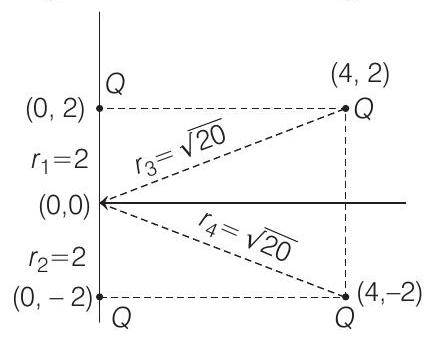
Electric potential at origin $(0,0)$ due to these charges can be found by scalar addition of electric potentials due to each charge.
$$ \begin{aligned} & \therefore V=\frac{K Q}{r _1}+\frac{K Q}{r _2}+\frac{K Q}{r _3}+\frac{K Q}{r _4} \\ & \Rightarrow V=K Q \frac{1}{2}+\frac{1}{2}+\frac{1}{\sqrt{20}}+\frac{1}{\sqrt{20}}=K Q 1+\frac{1}{\sqrt{5}} \\ & \Rightarrow V=K Q \frac{(\sqrt{5}+1)}{\sqrt{5}} V \end{aligned} $$
Now, if another charge $Q$ is placed at origin, then work done to get the charge at origin
$$ W=Q V $$
By putting the value of $V$ from Eq. (ii) in Eq. (iii), we get
or
$$ \begin{aligned} & W=K Q^{2} \frac{(\sqrt{5}+1)}{\sqrt{5}} J \\ & W=\frac{Q^{2}}{4 \pi \varepsilon _0} 1+\frac{1}{\sqrt{5}} J \end{aligned} $$
 BETA
BETA


