General Physics Ques 31
Question 10
- Column II shows five systems in which two objects are labelled as $X$ and $Y$. Also in each case a point $P$ is shown. Column I gives some statements about $X$ and/or $Y$. Match these statements to the appropriate system(s) from Column II
(2009)
Column I
(A) The force exerted by $X$ on $Y$ has a magnitude $M g$.
Column II
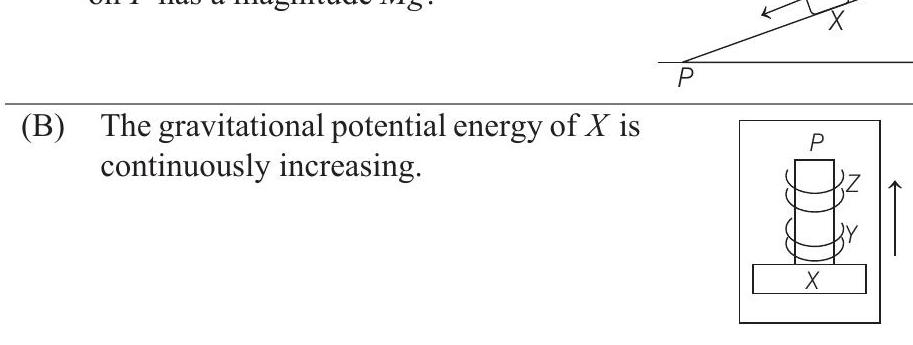
(p) Block $Y$ of mass $M$ left on a fixed inclined plane $X$, slides on it with a constant velocity.
(q) Two ring magnets $Y$ and $Z$, each of mass $M$, are kept in frictionless vertical plastic stand so that they repel each other. $Y$ rests on the base $X$ and $Z$ hangs in air in equilibrium. $P$ is the topmost point of the stand on the common axis of the two rings. The whole system is in a lift that is going up with a constant velocity.
(C) Mechanical energy of the system $X+Y$ is continuously decreasing.
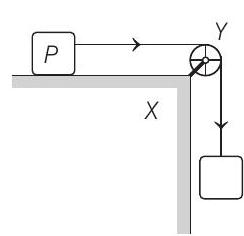
(r) A pulley $Y$ of mass $m_{0}$ is fixed to a table through a clamp $X$. A block of mass $M$ hangs from a string that goes over the pulley and is fixed at point $P$ of the table. The whole system is kept in a lift that is going down with a constant velocity.
(D) The torque of the weight of $Y$ about point $P$ is zero.
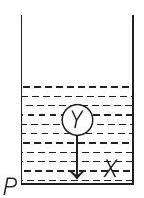
(s) A sphere $Y$ of mass $M$ is put in a non-viscous liquid $X$ kept in a container at rest. The sphere is released and it moves down in the liquid.
(t) A sphere $Y$ of mass $M$ is falling with its terminal velocity in a viscous liquid $X$ kept in a container.
Show Answer
Answer:
Correct Answer: 31.$\mathrm{A}-\mathrm{p}, \mathrm{t}$, B-q, s, t, $\quad C-p, r, s, t, \quad D-q$
Solution:
- (p) Constant velocity means, net acceleration or net force $=0$.
$\therefore$ Net force exerted by $X$ and $Y=M g$ in upward direction (opposite to its weight $M g$ ). Since $Y$ is moving with constant velocity, some friction is there between $X$ and $Y$.
Therefore, some work is done against friction and mechanical energy of $(X+Y)$ is continuously decreasing.
(s) Potential energy of $Y$ is decreasing but same volume of $X$ rises up. Hence, potential energy of $X$ is increasing. Some part of mechanical energy of $X+Y$ is lost in the form of heat in doing work against viscous forces. Net force on $Y$ in this case is downwards before $Y$ attains its terminal velocity.
(t) After attaining the terminal velocity, net force on $Y$ becomes zero. Hence, force on $Y$ from $X$ is $M g$, upwards. Rest of the logics are same as discussed in part (s).
 BETA
BETA


