Heat And Thermodynamics Ques 192
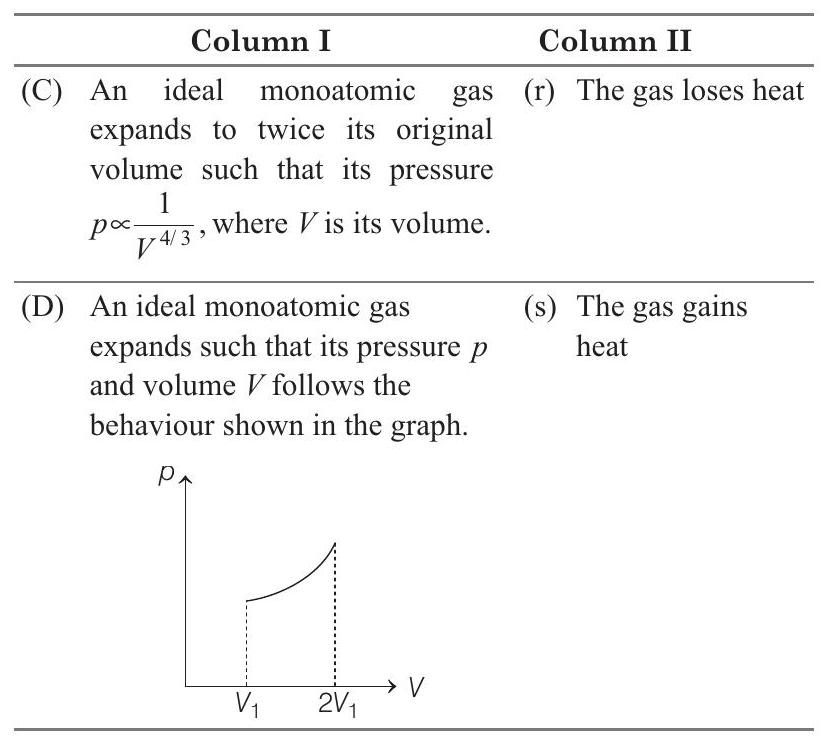
- Column I contains a list of processes involving expansion of an ideal gas. Match this with Column II describing the thermodynamic change during this process. Indicate your answer by darkening the appropriate bubbles of the $4 \times 4$ matrix given in the ORS.
$(2008,7 M)$
Show Answer
Answer:
Correct Answer: 192.(A) $\rightarrow$ q; (B) $\rightarrow$ p, r; (C) $\rightarrow$ p, s; (D) $\rightarrow$ q, s
Solution:
Formula:
- (A) In case of free expansion under adiabatic conditions, change in internal energy $\Delta U=0$.
$\therefore$ Internal energy and temperature will remain constant.
(B) $p \propto \frac{1}{V^{2}}$
$\Rightarrow \quad \therefore \quad p V^{2}=$ constant $\cdots(i)$
or $\left(\frac{n R T}{V}\right) \cdot V^{2}=$ constant $\quad \Rightarrow \quad \therefore \quad T \propto \frac{1}{V} \cdots(ii)$
If volume is doubled, temperature will decrease as per Eq. (ii).
Further, molar heat capacity in process $p V^{x}=$ constant is
$$ C=C _V+\frac{R}{1-x} $$
From Eq. (i), $x=2$
$\therefore \quad C=\frac{3}{2} R+\frac{R}{1-2}=+\frac{R}{2}$
Since, molar heat capacity is positive, according to $Q=n C \Delta T, Q$ will be negative if $\Delta T$ is negative. Or gas loses heat if temperature is decreasing.
(C) $p \propto \frac{1}{V^{4 / 3}}, \quad p V^{4 / 3}=$ constant
$$ \begin{aligned} & \therefore & \left(\frac{n R T}{V}\right) V^{4 / 3} & =\text { constant } \\ & \therefore & T & \propto \frac{1}{V^{1 / 3}} \end{aligned} $$
Further, with increase in volume temperature will decrease.
Here, $\quad x=\frac{4}{3} \Rightarrow C=\frac{3}{2} R+\frac{R}{1-4 / 3}=-1.5 R$
As molar heat capacity is negative, $Q$ will be positive if $\Delta T$ is negative. Or gas gains heat with decrease in temperature.
(D) $T \propto p V$
In expansion from $V _1$ to $2 V _1$, product of $p V$ is increasing. Therefore, temperature will increase. Or $\Delta U=+$ ve. Further, in expansion work done is also positive.
Hence, $Q=W+\Delta U=+$ ve or, gas gains heat.
 BETA
BETA


