Optics Ques 11
- A concave mirror has radius of curvature of $40 cm$. It is at the bottom of a glass that has water filled up to $5 cm$ (see figure). If a small particle is floating on the surface of water, its image as seen, from directly above the glass, is at a distance $d$ from the surface of water. The value of $d$ is close to
[Refractive index of water $=1.33$ ]
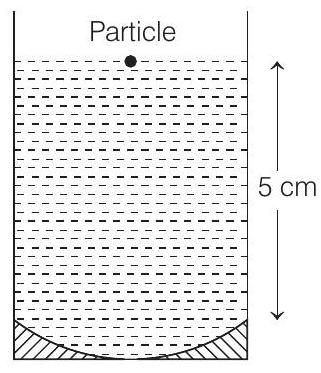
(a) $6.7 cm$
(b) $13.4 cm$
(c) $8.8 cm$
(2019 Main, 12 April I)
Show Answer
Answer:
Correct Answer: 11.(c)
Solution:
Formula:
Refraction at Spherical Thin Lens:
- In the given case,
$$ u=-5 cm $$
Focal length,
$$ f=\frac{-R}{2}=\frac{-40}{2}=-20 cm $$
Now, using mirror formula,
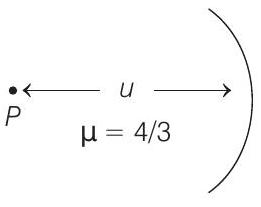
$R=40 cm$
$\frac{1}{v}+\frac{1}{u}=\frac{1}{f} \Rightarrow \frac{1}{v}=\frac{1}{f}-\frac{1}{u}$
$$ =-\frac{1}{20}+\frac{1}{5}=+\frac{3}{20} $$
$$ \Rightarrow \quad v=+\frac{20}{3} cm $$
For the light getting refracted at water surface, this image will act as an object.
So, distance of object, $d=5 cm+\frac{20}{3} cm=\frac{35}{3} cm$
(below the surface). Let’s assume final image at distance $d$ after refraction.
$$ \begin{aligned} \frac{d^{\prime}}{d} & =\frac{\mu _2}{\mu _1} \Rightarrow d^{\prime}=d \frac{\mu _2}{\mu _1}=\frac{35}{3} cm \quad \frac{1}{\frac{4}{3}} \\ & =\frac{35}{3} \times \frac{3}{4} cm=\frac{35}{4} cm=8.75 cm \approx 8.8 cm \end{aligned} $$
 BETA
BETA


