Optics Ques 149
- Two coherent monochromatic point sources $S _1$ and $S _2$ of wavelength $\lambda=600 $ $nm$ are placed symmetrically on either side of the centre of the circle as shown. The sources are separated by a distance $d=1.8$ $ mm$. This arrangement produces interference fringes visible as alternate bright and dark spots on the circumference of the circle. The angular separation between two consecutive bright spots is $\Delta \theta$. Which of the following options is/are correct?
(2017 Adv.)
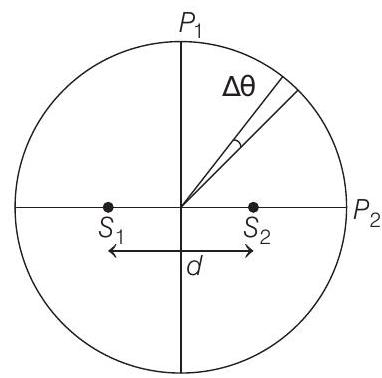
(a) The angular separation between two consecutive bright spots decreases as we move from $P _1$ to $P _2$ along the first quadrant
(b) A dark spot will be formed at the point $P _2$
(c) The total number of fringes produced between $P _1$ and $P _2$ in the first quadrant is close to $3000$
(d) At $P _2$ the order of the fringe will be maximum
Show Answer
Answer:
Correct Answer: 149.(c,d)
Solution:
Formula:
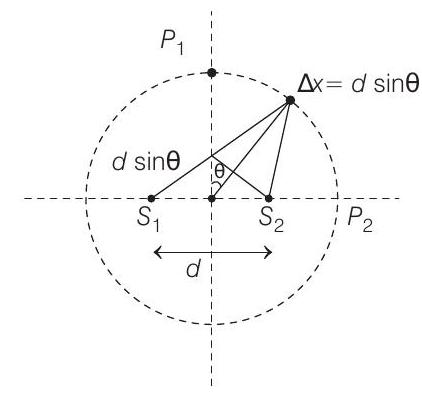
$\lambda = 600 $ $nm$
$ \text { at } P _1 \quad \Delta x=0 $
at $P _2 \quad \Delta x=1.8$ $ mm=n \lambda$
Number of maximas will be $n=\frac{\Delta x}{\lambda}=\frac{1.8 mm}{600 nm}=3000$
$ \text { at } P _2 \quad \Delta x=3000 \lambda $
Hence, bright fringe will be formed.
At $P _2, 3000$ th maxima is formed.
For (a) option
$ \begin{aligned} \Delta x & =d \sin \theta \Rightarrow d \Delta x=d \cos d \theta \\ R \lambda & =d \cos \theta R d \theta \Rightarrow R d \theta=\frac{R \lambda}{d \cos \theta} \end{aligned} $
As we move from $P _1$ to $P _2$
$\theta \uparrow \cos \theta \downarrow R d \theta \uparrow$
 BETA
BETA


