Optics Ques 216
- A convex lens of focal length $15 cm$ and a concave mirror of focal length $30 cm$ are kept with their optic axis $P Q$ and $R S$ parallel but separated in vertical direction by $0.6 cm$ as shown.
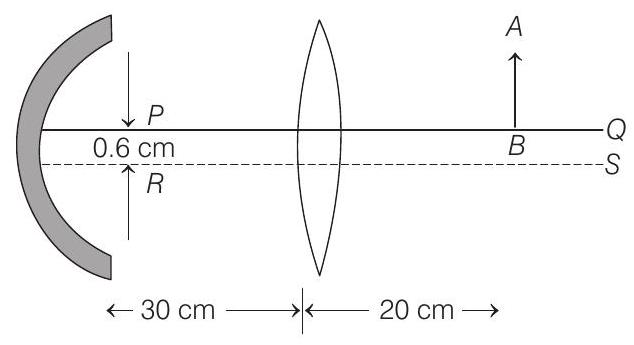
The distance between the lens and mirror is $30 cm$. An upright object $A B$ of height $1.2 cm$ is placed on the optic axis $P Q$ of the lens at a distance of $20 cm$ from the lens. If $A^{\prime} B^{\prime}$ is the image after refraction from the lens and the reflection from the mirror, find the distance of $A^{\prime} B^{\prime}$ from the pole of the mirror and obtain its magnification. Also locate positions of $A^{\prime}$ and $B^{\prime}$ with respect to the optic axis $R S$.
$(2000,6 M)$
Show Answer
Answer:
Correct Answer: 216.$15 cm,-3 / 2$
Solution:
- (a) Rays coming from object $A B$ first refract from the lens and then reflect from the mirror.
Refraction from the lens
$$ u=-20 cm, f=+15 cm $$
Using lens formula $\frac{1}{v}-\frac{1}{u}=\frac{1}{f} \Rightarrow \frac{1}{v}-\frac{1}{-20}=\frac{1}{15}$
$$ \therefore \quad v=+60 cm $$
and linear magnification, $m _1=\frac{v}{u}=\frac{+60}{-20}=-3$
i.e. first image formed by the lens will be at $60 cm$ from it (or $30 cm$ from mirror) towards left and 3 times magnified but inverted. Length of first image $A _1 B _1$ would be $1.2 \times 3=3.6 cm$ (inverted).
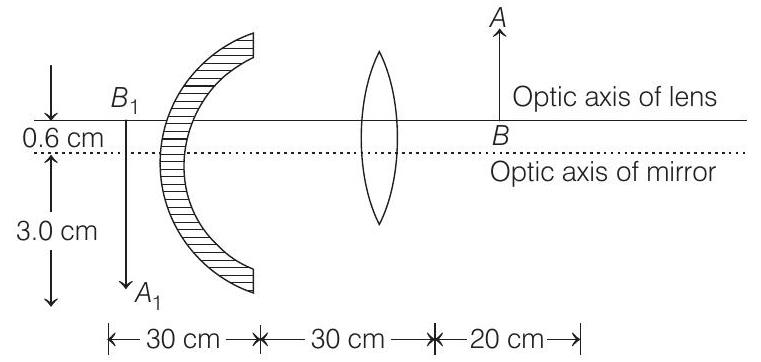
Reflection from mirror Image formed by lens $\left(A _1 B _1\right)$ will behave like a virtual object for mirror at a distance of $30 cm$ from it as shown. Therefore $u=+30 cm$, $f=-30 cm$.
Using mirror formula, $\frac{1}{v}+\frac{1}{u}=\frac{1}{f}$ or $\frac{1}{v}+\frac{1}{30}=-\frac{1}{30}$
$$ \therefore \quad v=-15 cm $$
and linear magnification,
$$ m _2=-\frac{v}{u}=-\frac{-15}{+30}=+\frac{1}{2} $$
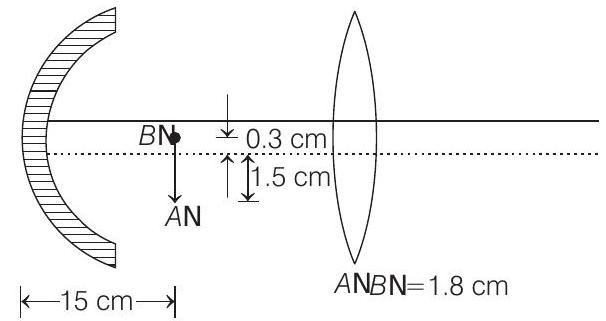
i.e. final image $A^{\prime} B^{\prime}$ will be located at a distance of $15 cm$ from the mirror (towards right) and since magnification is $+\frac{1}{2}$, length of final image would be $3.6 \times \frac{1}{2}=1.8 cm$.
$\therefore \quad A^{\prime} B^{\prime}=1.8 cm$
Point $B _1$ is $0.6 cm$ above the optic axis of mirror, therefore, its image $B^{\prime}$ would be (0.6) $\frac{1}{2}=0.3 cm$ above optic axis. Similarly, point $A _1$ is $3 cm$ below the optic axis, therefore, its image $A^{\prime}$ will be $3 \times \frac{1}{2}=1.5 cm$ below the optic axis as shown below
Total magnification of the image,
$$ \begin{gathered} m=m _1 \times m _2=(-3)+\frac{1}{2}=-\frac{3}{2} \\ \therefore \quad A^{\prime} B^{\prime}=(m)(A B)=-\frac{3}{2}(1.2)=-1.8 cm \end{gathered} $$
Note that, there is no need of drawing the ray diagram if not asked in the question.
NOTE With reference to the pole of an optical instrument (whether it is a lens or a mirror) the coordinates of the object $\left(X _0, Y _0\right)$ are generally known to us. The corresponding coordinates of image $\left(X _i, Y _i\right)$ are found as follows
$$ X _i \text { is obtained using } \frac{1}{v} \pm \frac{1}{u}=\frac{1}{f} $$
Here, $v$ is actually $X _i$ and $u$ is $X _0$ ie, the above formula can be written as $\frac{1}{X _i} \pm \frac{1}{X _0}=\frac{1}{f}$
Similarly, $Y _i$ is obtained from $m=\frac{1}{0}$
Here, $l$ is $Y _i$ and $O$ is $Y _0$ i.e., the above formula can be written as $m=Y _i / Y _0$ or $Y _i=m Y _0$.
 BETA
BETA


