Properties Of Matter Ques 43
- A boy’s catapult is made of rubber cord which is $42 cm$ long, with $6 mm$ diameter of cross-section and of negligible mass. The boy keeps a stone weighing $0.02 kg$ on it and stretches the cord by $20 cm$ by applying a constant force. When released the stone flies off with a velocity of $20 ms^{-1}$. Neglect the change in the area of cross-section of the cord while stretched. The Young’s modulus of rubber is closest to
(Main 2019, 8 April I)
(a) $10^{6} Nm^{-2}$
(b) $10^{4} Nm^{-2}$
(c) $10^{8} Nm^{-2}$
(d) $10^{3} Nm^{-2}$
Show Answer
Answer:
Correct Answer: 43.(a)
Solution:
Formula:
Potential Energy Per Unit Volume:
- When rubber cord is stretched, then it stores potential energy and when released, this potential energy is given to the stone as kinetic energy.
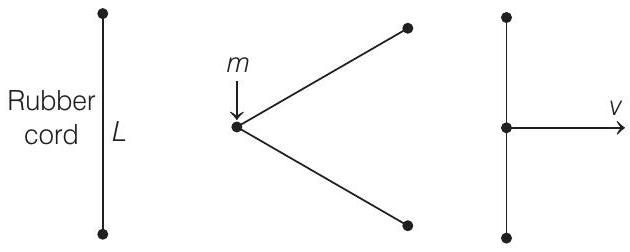
So, potential energy of stretched cord
$=$ kinetic energy of stone
$$ \Rightarrow \quad \frac{1}{2} Y\left(\frac{\Delta L}{L}\right)^{2} A \cdot L=\frac{1}{2} m v^{2} $$
Here, $\Delta L=20 cm=0.2 m, L=42 cm=0.42 m$, $v=20 ms^{-1}, m=0.02 kg, d=6 mm=6 \times 10^{-3} m$
$\therefore A=\pi r^{2}=\pi\left(\frac{d}{2}\right)^{2}=\pi\left(\frac{6 \times 10^{-3}}{2}\right)^{2}$
$$ =\pi\left(3 \times 10^{-3}\right)^{2}=9 \pi \times 10^{-6} m^{2} $$
On substituting values, we get
$$ Y=\frac{m v^{2} L}{A(\Delta L)^{2}}=\frac{0.02 \times(20)^{2} \times 0.42}{9 \pi \times 10^{-6} \times(0.2)^{2}} \approx 3.0 \times 10^{6} Nm^{-2} $$
So, the closest value of Young’s modulus is $10^{6} Nm^{-2}$.
 BETA
BETA


