Rotation Ques 16
- A cylinder uniform $\operatorname{rod}$ of mass $M$ and length $l$ is pivoted at one end so that it can rotate in a vertical plane (see the figure). There is negligible friction at the pivot. The free end is held vertically above the
 pivot and then released. The angular acceleration of the rod when it makes an angle $\theta$ with the vertical, is
(2017 Main)
(a) $\frac{2 g}{3 l} \sin \theta$
(b) $\frac{3 g}{2 l} \cos \theta$
(c) $\frac{2 g}{3 l} \cos \theta$
(d) $\frac{3 g}{2 l} \sin \theta$
Show Answer
Answer:
Correct Answer: 16.(d)
Solution:
- As the rod rotates in vertical plane so a torque is acting on it, which is due to the vertical component of weight of rod.

Initial condition
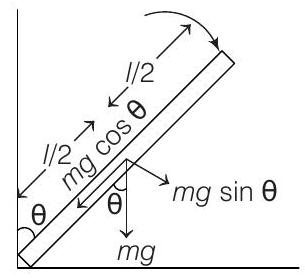
At any time $t$
Now, Torque $\tau=$ force $\times$ perpendicular distance of line of action of force from axis of rotation
$$ =m g \sin \theta \times \frac{l}{2} $$
Again, Torque, $\tau=I \alpha$
Where, $I=$ moment of inertia $=\frac{m l^{2}}{3}$
[Force and Torque frequency along axis of rotation
$\alpha=$ angular acceleration passing through in end]
$\therefore \quad m g \sin \theta \times \frac{l}{2}=\frac{m l^{2}}{3} \alpha$
$$ \therefore \quad \alpha=\frac{3 g \sin \theta}{2 l} $$
 BETA
BETA


