Rotation Ques 52
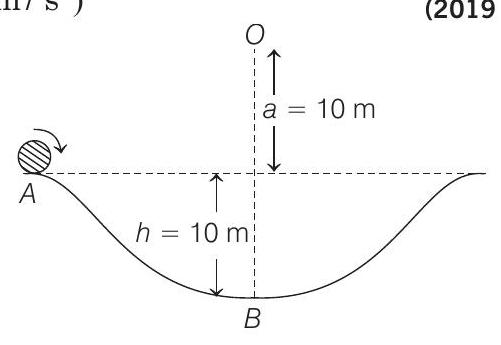
- A particle of mass $20 g$ is released with an initial velocity 5 $m / s$ along the curve from the point $A$, as shown in the figure. The point $A$ is at height $h$ from point $B$. The particle slides along the frictionless surface. When the particle reaches point $B$, its angular momentum about $O$ will be (Take, $g=10 m / s^{2}$ )
(a) $8 kg-m^{2} / s$
(b) $3 kg-m^{2} / s$
(c) $2 kg-m^{2} / s$
(d) $6 kg-m^{2} / s$
Show Answer
Answer:
Correct Answer: 52.(d)
Solution:
- The given figure is shown below as

As friction is absent, energy at $A=$ energy at $B$
$$ \begin{array}{lc} \Rightarrow & \frac{1}{2} m v _A^{2}+m g h=\frac{1}{2} m v _B^{2} \\ \Rightarrow & v _A^{2}+2 g h=v _B^{2} \\ \text { or } & v _B^{2}=(5)^{2}+2 \times 10 \times 10=225 \\ \Rightarrow & v _B=15 ms^{-1} \end{array} $$
Angular momentum about point ’ $O$ ‘,
$$ \begin{aligned} & =m v _B r _B \\ & =20 \times 10^{-3} \times 15 \times 20=6 kg-m^{2} s^{-1} \end{aligned} $$
 BETA
BETA


