Rotation Ques 63
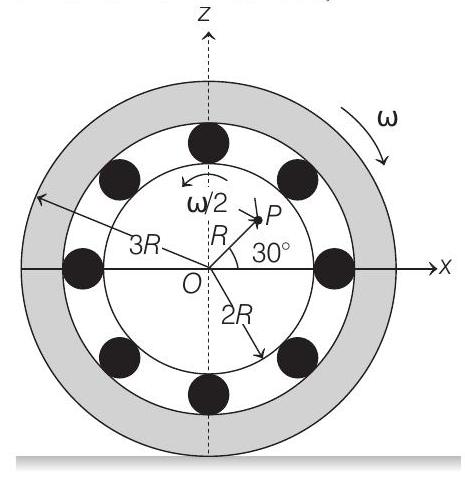
- The figure shows a system consisting of (i) a ring of outer radius $3 R$ rolling clockwise without slipping on a horizontal surface with angular speed $\omega$ and (ii) an inner disc of radius $2 R$ rotating anti-clockwise with angular speed $\omega / 2$.
The ring and disc are separated by frictionless ball bearings. The system is in the $x-z$ plane. The point $P$ on the inner disc is at a distance $R$ from the origin, where $O P$ makes an angle of $30^{\circ}$ with the horizontal. Then with respect to the horizontal surface,
(2012)
(a) the point $O$ has a linear velocity $3 R \omega \hat{\mathbf{i}}$
(b) the point $P$ has a linear velocity $\frac{11}{4} R \omega \hat{\mathbf{i}}+\frac{\sqrt{3}}{4} R \omega \hat{\mathbf{k}}$
(c) the point $P$ has a linear velocity $\frac{13}{4} R \omega \hat{\mathbf{i}}-\frac{\sqrt{3}}{4} R \omega \hat{\mathbf{k}}$
(d) the point $P$ has a linear velocity
$$63-\frac{\sqrt{3}}{4} R \omega \hat{\mathbf{i}}+\frac{1}{4} R \omega \hat{\mathbf{k}} $$
Show Answer
Answer:
Correct Answer: 63.$(a, b)$
Solution:
Formula:
- Velocity of point $O$ is
$$ v _O=(3 R \omega) \hat{\mathbf{i}} $$
$\mathbf{v} _{P O}$ is $\frac{R \cdot \omega}{2}$ in the direction shown in figure.
In vector form
$$ \begin{aligned} & \\ \mathbf{v} _{P O} & =-\frac{R \omega}{2} \sin 30^{\circ} \hat{\mathbf{i}}+\frac{R \omega}{2} \cos 30^{\circ} \hat{\mathbf{k}} \\ & =-\frac{R \omega}{4} \hat{\mathbf{i}}+\frac{\sqrt{3} R \omega}{4} \hat{\mathbf{k}} \\ \mathbf{v} _{P O} & =\mathbf{v} _P-\mathbf{v} _O \\ \mathbf{v} _P & =\mathbf{v} _{P O}+\mathbf{v} _O \\ & =-\frac{R \omega}{4} \hat{\mathbf{i}}+\frac{\sqrt{3} R \omega}{4} \hat{\mathbf{k}}+3 R \omega \hat{\mathbf{i}} \\ & =\frac{11}{4} R \omega \hat{\mathbf{i}}+\frac{\sqrt{3}}{4} R \omega \hat{\mathbf{k}} \end{aligned} $$
 BETA
BETA


