Rotation Ques 71
- Two identical uniform discs roll without slipping on two different surfaces $A B$ and $C D$ (see figure) starting at $A$ and $C$ with linear speeds $v _1$ and $v _2$, respectively, and always remain in contact with the surfaces. If they reach $B$ and $D$ with the same linear speed and $v _1=3 m / s$, then $v _2$ in $m / s$ is $\left(g=10 m / s^{2}\right)$
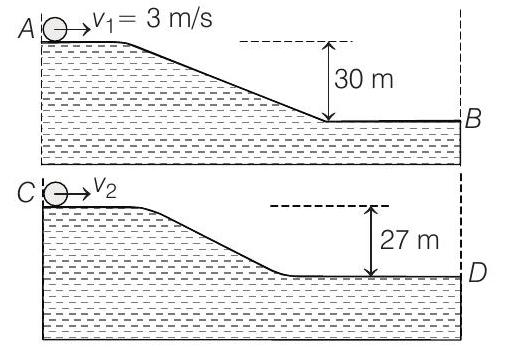
(2015 Adv.)
Show Answer
Answer:
Correct Answer: 71.7
Solution:
Formula:
In case of pure rolling, mechanical energy remains constant (as work done by friction is zero). Further in case of a disc,
$\frac{\text { translational kinetic energy }}{\text { rotational kinetic energy }}=\frac{K _T}{K _R}=\frac{\frac{1}{2} m v^{2}}{\frac{1}{2} I \omega^{2}}$
$$ =\frac{m v^{2}}{\frac{1}{2} m R^{2} \frac{v^{2}}{R}}=\frac{2}{1} $$
or,
$$ K _T=\frac{2}{3} \quad(\text { Total kinetic energy }) $$
or, Total kinetic energy
$$ K=\frac{3}{2} K_T=\frac{3}{2} \frac{1}{2} m v^{2}=\frac{3}{4} m v^{2} $$
Decrease in potential energy =increase in kinetic energy
or, $\quad m g h=\frac{3}{4} m\left(v _f^{2}-v _i^{2}\right) \quad$ or $\quad v _f=\sqrt{\frac{4}{3} g h+v _i^{2}}$
As the final velocity in both cases is the same.
So, value of $\sqrt{\frac{4}{3} g h+v _i^{2}}$ should be same in both cases.
$$ \therefore \quad \sqrt{\frac{4}{3} \times 10 \times 30+(3)^{2}}=\sqrt{\frac{4}{3} \times 10 \times 27+\left(v _2\right)^{2}} $$
Solving this equation, we obtain
$$ v₂ = 7 m/s $$
 BETA
BETA


