Rotation Ques 89
- $A \operatorname{rod} A B$ of mass $M$ and length $L$ is lying on a horizontal frictionless surface. A particle of mass $m$ travelling along the surface hits the end $A$ of the rod with a velocity $v _0$ in a direction perpendicular to $A B$. The collision is elastic. After the collision, the particle comes to rest.
(2000)
(a) Find the ratio $m / M$.
(b) A point $P$ on the rod is at rest immediately after collision. Find the distance $A P$.
(c) Find the linear speed of the point $P$ a time $\pi L / 3 v _0$ after the collision.
Show Answer
Answer:
Correct Answer: 89.(a) $\frac{1}{4}$
(b) $\frac{2}{3} L$
(c) $\frac{v_0}{2 \sqrt{2}}$
Solution:
- (a) Let just after collision, velocity of $CM$ of $\operatorname{rod}$ is $v$ and angular velocity about $CM$ is $\omega$. Applying following three laws.
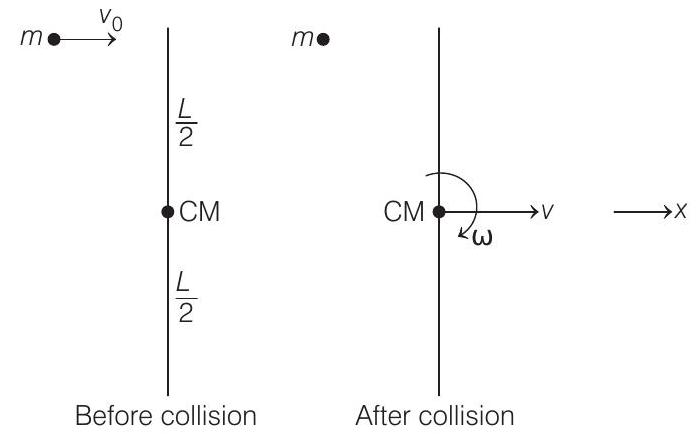
(1) External force on the system (rod + mass) in horizontal plane along $x$-axis is zero. $\therefore$ Applying conservation of linear momentum in $x$-direction.
$$ m v _0=m v $$
(2) Net torque on the system about CM of rod is zero.
$\therefore$ Applying conservation of angular momentum about $CM$ of rod, we get $m v _0 \frac{L}{2}=I \omega$
$$ \begin{aligned} \text { or } \quad m v _0 \frac{L}{2} & =\frac{M L^{2}}{12} \omega \\ \text { or } \quad m v _0 & =\frac{M L \omega}{6} \end{aligned} $$
(3) Since, the collision is elastic, kinetic energy is also conserved.
$$ \begin{aligned} \therefore & \frac{1}{2} m v _0^{2} & =\frac{1}{2} M v^{2}+\frac{1}{2} I \omega^{2} \\ \text { or } & m v _0^{2} & =M v^{2}+\frac{M L^{2}}{12} \omega^{2} \end{aligned} $$
From Eqs. (i), (ii) and (iii), we get the following results
$$ \begin{aligned} & \frac{m}{M}=\frac{1}{4} \\ & v=\frac{m v _0}{M} \text { and } \omega=\frac{6 m v _0}{M L} \end{aligned} $$
(b) Point $P$ will be at rest if $x \omega=v$
or $\quad x=\frac{v}{\omega}=\frac{m v _0 / M}{6 m v _0 / M L}$
or $\quad x=L / 6$
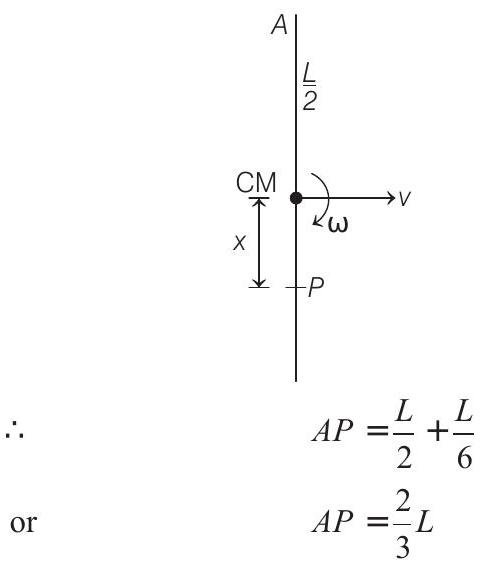
(c) After time
$$ t=\frac{\pi L}{3 v _0} $$
angle rotated by rod, $\theta=\omega t=\frac{6 m v _0}{M L} \cdot \frac{\pi L}{3 v _0}$
$$ \begin{aligned} & =2 \pi \frac{m}{M} \\ & =2 \pi \frac{1}{4} \quad \therefore \quad \theta=\frac{\pi}{2} \end{aligned} $$
Therefore, situation will be as shown below
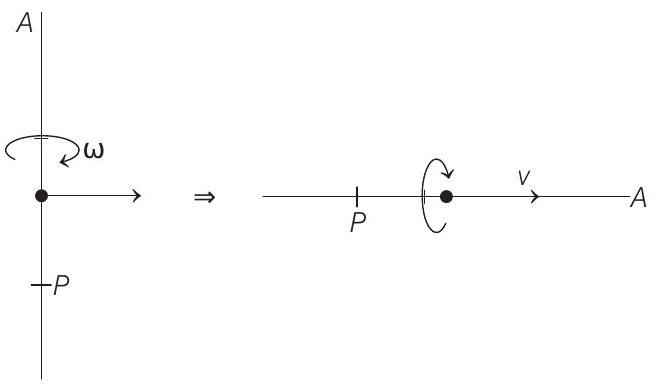
$\therefore$ Resultant velocity of point $P$ will be
$$ \begin{aligned} \left|\mathbf{v} _P\right| & =\sqrt{2} v=\sqrt{2} \quad \frac{m}{M} v _0 \\ & =\frac{\sqrt{2}}{4} v _0=\frac{v _0}{2 \sqrt{2}} \quad \text { or } \quad\left|\mathbf{v} _P\right|=\frac{v _0}{2 \sqrt{2}} \end{aligned} $$
 BETA
BETA


