Chapter 01 Number Systems Exercise-04
EXERCISE 1.4
1. Classify the following numbers as rational or irrational:
(i) $2-\sqrt{5}$
(ii) $(3+\sqrt{23})-\sqrt{23}$
(iii) $\frac{2 \sqrt{7}}{7 \sqrt{7}}$
(iv) $\frac{1}{\sqrt{2}}$
(v) $2 \pi$
Show Answer
Solution
(i) ${ }^{2-\sqrt{5}}=2-2.2360679 \ldots$
$=-0.2360679 \ldots$
As the decimal expansion of this expression is non-terminating non-recurring, therefore, it is an irrational number.
(ii)
$ (3+\sqrt{23})-\sqrt{23}=3=\frac{3}{1} \quad \text{ number. form, therefore, it is a } $
As it can be represented in $\frac{p}{q}$
(iii) $\frac{2 \sqrt{7}}{7 \sqrt{7}}=\frac{2}{7}$ : $\frac{2 \sqrt{7}}{7 \sqrt{7}}=\frac{2}{7}$, which is a rational number.
(iv) $\frac{1}{\sqrt{2}}=\frac{\sqrt{2}}{2}=0.7071067811 \ldots$
As the decimal expansion of this expression is non-terminating non-recurring, therefore, it is an irrational number. ( $v)$
$2 п=2(3.1415 \ldots)$
$=6.2830 \ldots$
As the decimal expansion of this expression is non-terminating non-recurring, therefore, it is an irrational number.
2. Simplify each of the following expressions:
(i) $(3+\sqrt{3})(2+\sqrt{2})$
(ii) $(3+\sqrt{3})(3-\sqrt{3})$
(iii) $(\sqrt{5}+\sqrt{2})^{2}$
(iv) $(\sqrt{5}-\sqrt{2})(\sqrt{5}+\sqrt{2})$
Show Answer
Solution
$ \begin{aligned} & (3+\sqrt{3})(2+\sqrt{2})=3(2+\sqrt{2})+\sqrt{3}(2+\sqrt{2}) \\ & =6+3 \sqrt{2}+2 \sqrt{3}+\sqrt{6} \\ & \quad(3+\sqrt{3})(3-\sqrt{3})=(3)^{2}-(\sqrt{3})^{2} \\ & \text{ (ii) } \\ & =9-3=6 \\ & \text{ (iii) }(\sqrt{5}+\sqrt{2})^{2}=(\sqrt{5})^{2}+(\sqrt{2})^{2}+2(\sqrt{5})(\sqrt{2}) \\ & =5+2+2 \sqrt{10}=7+2 \sqrt{10} \\ & \text{ (iv) }(\sqrt{5}-\sqrt{2})(\sqrt{5}+\sqrt{2})=(\sqrt{5})^{2}-(\sqrt{2})^{2} \\ & =5-2=3 \end{aligned} $
3. Recall, $\pi$ is defined as the ratio of the circumference (say $c$ ) of a circle to its diameter (say $d$ ). That is, $\pi=\frac{c}{d}$. This seems to contradict the fact that $\pi$ is irrational. How will you resolve this contradiction?
Show Answer
Solution
There is no contradiction. When we measure a length with scale or any other instrument, we only obtain an approximate rational value. We never obtain an exact value. For this reason, we may not realise that either $c$ or $d$ is irrational. Therefore,
the $\quad \frac{c}{d}$ fraction is irrational. Hence, $\pi$ is irrational.
4. Represent $\sqrt{9.3}$ on the number line.
Show Answer
Solution
Mark a line segment $O B=9.3$ on number line. Further, take $B C$ of 1 unit. Find the midpoint D of OC and draw a semi-circle on OC while taking D as its centre. Draw a
(i)
$\frac{1}{\sqrt{7}}=\frac{1 \times \sqrt{7}}{1 \times \sqrt{7}}=\frac{\sqrt{7}}{7}$
perpendicular to line $O C$ passing through point $B$. Let it intersect the semi-circle at $E$.
Taking B as centre and BE as radius, draw an arc in tersecting number line at $F$. BF is $\sqrt{9.3}$.

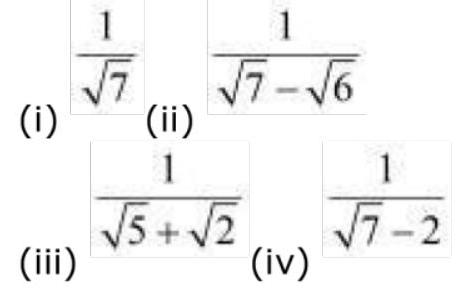
5. Rationalise the denominators of the following:
(i) $\frac{1}{\sqrt{7}}$
(ii) $\frac{1}{\sqrt{7}-\sqrt{6}}$
(iii) $\frac{1}{\sqrt{5}+\sqrt{2}}$
(iv) $\frac{1}{\sqrt{7}-2}$
Show Answer
Solution
(i)
$ \begin{aligned} 64^{\frac{1}{2}} & =(2^{6})^{\frac{1}{2}} & =2^{2}=4 \\ & =2^{6 \times \frac{1}{2}} & {[(a^{m})^{n}=a^{m m !}] _{(16)^{\frac{3}{4}}=(2^{4})^{\frac{3}{4}}}^{(iii)} } \\ & =2^{3}=8 & \end{aligned} $
$ =2^{5 \times \frac{2}{3}} \quad[(a^{m})^{n \prime}=a^{m m n}] $
(ii)
$ \begin{aligned} 32^{\frac{1}{5}} & =(2^{5})^{\frac{1}{5}} \\ & =(2)^{5 \times \frac{1}{5}} \\ & =2^{1}=2 \end{aligned} $
$ \begin{aligned} & =2^{4 \times \frac{3}{4}} \\ & {[(a^{m})^{n}=a^{m m}]} \\ & {[(a^{m})^{n}=a^{m m}] _{(125)^{\frac{-1}{3}}}^{(iv)}=\frac{1}{(125)^{\frac{1}{3}}}} \\ & =2^{3}=8 \end{aligned} $
$(125)^{\frac{1}{3}}=(5^{3})^{\frac{1}{3}}$
$ \begin{matrix} =5^{3 \times \frac{1}{3}} & {[(a^{m})^{n}=a^{m m}]} & =\frac{1}{5^{3 \times \frac{1}{3}}} \\ =5^{1}=5 & =\frac{1}{5} \end{matrix} $
$ [a^{-m}=\frac{1}{a^{m}}] $
 BETA
BETA


