CIRCLE-11 (Problem Solving)
Examples
1. Find the equation of the image of the circle $x^{2}+y^{2}+16 x-24 y+183=0$ by the line mirror $4 x+7 y+13=0$
Show Answer
Solution :
The given circle and line are
$x^{2}+y^{2}+16 x-24 y+183=0$
(1) and $4 x+7 y+13=0$
Centre and radius if the circle are
$(-8,12)$ and $\sqrt{64+144-183}=\sqrt{25}=5$ respectively.
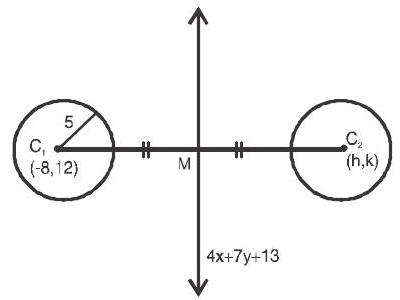
Equation of line $ {C} _{1} {C} _{2}$ is $7 {x}-4 {y}+ {k}=0$ it passes through $(-8,12)$
$\therefore-56-48+ {k}=0$
$ {k}=104$
Equation of line $ {C} _{1} {C} _{2}$ is $7 {x}-4 {y}+104=0$
To get the coordinates of M. Solve the equation
(2) & (3)
(2) $\times 4+(3) \times 7$
| $16 x+28 y+52=0$ |
|---|
| $49 x-28 y+728=0$ |
| $65 x+780=0$ |
$ {x}=-12$
put the value of $x$ in (2) we get
$-48+7 y+13=0$
$7 {y}=35$
$ {y}=5$
$\therefore$ coordinate of $ {M}$ is $(-12,5)$
$M$ is the midpoint of $ {C} _{1}$ and $ {C} _{2}$
$\therefore-12=\frac{ {h}-8}{2} \Rightarrow {h}=-16$
$5=\frac{ {k}+12}{2} \Rightarrow {K}=-2$
$\therefore$ Equation of imaged circle is
$ (x+16)^{2}+(y+2)^{2}=25 $
$ x^{2}+y^{2}+32 x+4 y+235=0 $
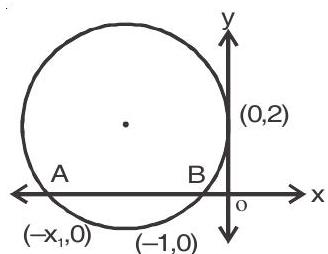
2. The circle passing through the point $(-1,0)$ and touching the $y$-axis at $(0,2)$ also passes through the point
(a) $\left(\frac{-3}{2}, 10\right)$
(b) $\left(\frac{-5}{2}, 12\right)$
(c) $\left(\frac{-3}{2}, \frac{5}{2}\right)$
(d) $(-4,0)$
Show Answer
Solution:
Family of circles passing through a point $(0,2)$ and touching line $x=0$ (y-axis) is
$ (x-0)^{2}+(y-2)^{2}+\lambda x=0 $
It passes through $(-1,0)$
$\therefore 1+4-\lambda=0$
$\therefore \lambda=5$
$\therefore$ equation of circle is
$x^{2}+y^{2}+5 x-4 y+4=0$
If also passes through $ {A}\left(- {x} _{1}, 0\right)$
$\therefore {x} _{1}^{2}-5 {x} _{1}+4=0$
$\left( {x} _{1}-4\right)\left( {x} _{1}-1\right)=0$
$ {x} _{1}=4, {x} _{1}=1$
$\therefore$ it also passes through $ {A}(-4,0)$
3. Two parallel chords of a circle of radius 2 are at a distance $\sqrt{3}+1$ apart. If the chords subtend at the centre, angles of $\frac{\pi}{ {k}}$ and $\frac{2 \pi}{ {k}}$, where $ {k}>0$ then the value of $[ {k}]$ is…………..
( $[ {k}]$ denotes the greatest integer)
Show Answer
Solution:
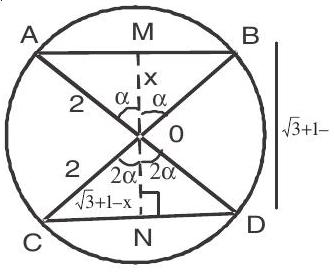
Let $\frac{\pi}{2 {k}}=\alpha=\frac{1}{2} \angle {AOB}=\angle {AOM}$
Then $\angle {CON}=2 \alpha$
In $\Delta {AOM}$
$\cos \alpha=\frac{ {X}}{2}$
In $\Delta {CON}$
$\cos 2 \alpha=\frac{\sqrt{3}+1- {x}}{2}$
$\cos 2 \alpha=2 \cos ^{2} \theta-1$
$\cos 2 \alpha=2 \frac{x^{2}}{4}-1$
$\therefore \quad \frac{\sqrt{3}+1- {x}}{2}=\frac{ {x}^{2}}{2}-1$
$ \begin{aligned} & \sqrt{3}+1-x=x^{2}-2 \\ & x^{2}+x-\sqrt{3}-3=0 \\ & \therefore \quad x=\frac{-1 \pm \sqrt{1+4(3+\sqrt{3})}}{2} \\ & =\frac{-1 \pm \sqrt{13+4 \sqrt{3}}}{2} \\ & =\frac{-1 \pm(2 \sqrt{3}+1)}{2} \quad\left(\therefore 13+4 \sqrt{3}=(2 \sqrt{3}+1)^{2}\right) \\ & x=\frac{-1+2 \sqrt{3}+1}{2} \\ & x=\sqrt{3} \\ & \quad \cos \alpha=\frac{\sqrt{3}}{2}=\cos \frac{\pi}{6} \\ & \quad \alpha=\frac{\pi}{6} \\ & \quad \text { Required angle }=\frac{\pi}{k}=2 \alpha=\frac{\pi}{3} \quad \Rightarrow \quad k=6 \text { thus }[ {k}]=6 \end{aligned} $
4. Let $ {ABC}$ and $ {AB}^{\prime}$ be two non-congruent triangles with sides $ {AB}=4, {AC}= {AC}^{\prime}=2 \sqrt{2}$ and angle $\beta=30^{\circ}$. The absolute value of the difference between the areas of these triangles is
Show Answer
Solution:
Draw circle through $ {AC}^{\prime}$ and $ {AB}$ intersect the circle and $ {P}$
$ \begin{aligned} & {In} _{\Delta} {ABD} \\ & =\frac{ {AD}}{ {AB}}=\sin 30^{\circ} \\ & \frac{ {AD}}{4}=\frac{1}{2} \\ & \therefore A D=2=D C=C^{\prime} D \end{aligned} $
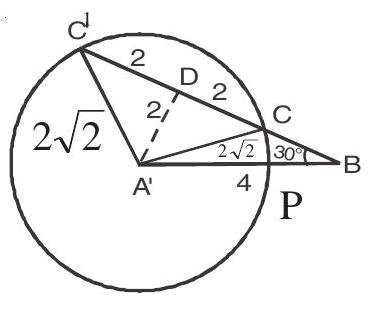
Difference of areas of $\triangle {ABC}$ and ${ } _{\Delta} {AB} {C}^{\prime}$ is $\Delta {ACC}^{\prime}$
$\therefore \operatorname{ar}\left(\Delta {ACC}^{\prime}\right)=\frac{1}{2} \times 4 \times 2=4$ sq.u.
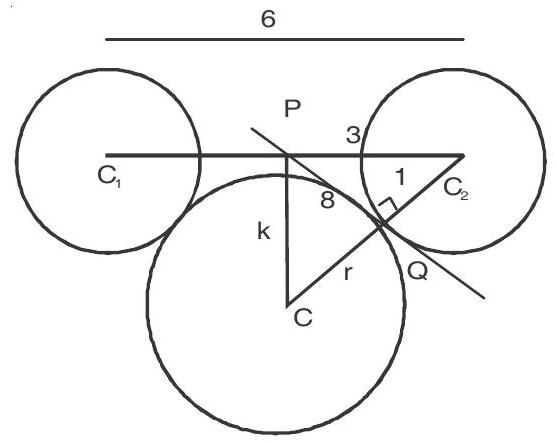
5. The centres of two circles $ {C} _{1}$ and $ {C} _{2}$ each of unit radius are at a distance of 6 units from each other. Let $ {P}$ be the mid-point of the line segment joining the centres of $ {C} _{1}$ and $ {C} _{2}$ and $ {C}$ be a circle touching circles $C _{1}$ and $C _{2}$ externally. If a common tangents to $C _{1}$ and $C$ passing through $P$ is also a common tangent to $ {C} _{2}$ and $ {C} _{1}$ then the radius of the circle $ {C}$ is
Show Answer
Solution :
In $\triangle {CPC} _{2}$
$ {CP}^{2}=\left( {CC} _{2}\right)^{2}-\left( {C} _{2} {P}\right)^{2}$
$ {k}^{2}=( {r}+1)^{2}-9$
$ {k}^{2}= {r}^{2}+2 {r}-8…….(1)$
In $\Delta {PQC} _{2}$
$P Q^{2}=3^{2}-1^{2}$
$=8$
$\therefore$ In ${ } _{\Delta} {CPQ}$
$ {k}^{2}= {r}^{2}+8………..(2)$
From (1) & (2)
$ {r}^{2}+8= {r}^{2}+2 {r}+2 {r}-8..$
$16= {r}$
$\therefore {r}=8$
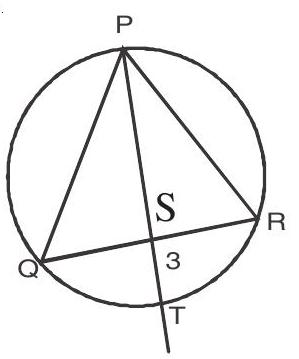
6. A straight line through the vertex $ {P}$ of a triangle $ {PQR}$ intersects the side $ {QR}$ at the point $ {S}$ and the circumcircle of the triangle $ {PQR}$ at the point $ {T}$. If $ {S}$ is not the centre of the circumcircle then
(a) $\frac{1}{ {PS}}+\frac{1}{ {ST}}<\frac{2}{\sqrt{ {QS} \cdot {SR}}}$
(b) $\frac{1}{ {PS}}+\frac{1}{ {ST}}>\frac{2}{\sqrt{ {QS} . {SR}}}$
(c) $\frac{1}{ {PS}}+\frac{1}{ {ST}}<\frac{4}{ {QR}}$
(d) $\frac{1}{ {PS}}+\frac{1}{ {ST}}>\frac{4}{ {QR}}$
Show Answer
Solution :
Points P, Q, T, R are concyclic
$\therefore$ PS.ST $=$ QS.SR
$\Rightarrow \frac{ {PS}+ {ST}}{2} \geq \sqrt{ {PS} . {ST}}( {AM} \geq {GM})$
$\therefore {PT} \geq 2 \sqrt{ {PS} . {ST}}$
and $\frac{1}{ {PS}}+\frac{1}{ {ST}} \geq \frac{2}{\sqrt{ {PS} . {ST}}}=\frac{2}{\sqrt{ {QS} . {SR}}}$
Also, $\frac{S Q+S R}{2} \geq \sqrt{\text { SQ.SR }}$
$\Rightarrow \frac{ {QR}}{2} \geq \sqrt{ {SQ} . {SR}}$
$\Rightarrow \frac{1}{\sqrt{\text { SQ.SR }}} \geq \frac{2}{ {QR}}$
$\Rightarrow \frac{2}{\sqrt{\text { SQ.SR }}} \geq \frac{4}{ {QR}}$ $( {AM} \geq {GM})$
(Dividing by PS.ST)
$\frac{1}{ {PS}}+\frac{1}{ {ST}} \geq \frac{2}{\sqrt{ {QS} . {SR}}} \geq \frac{4}{ {QR}}$
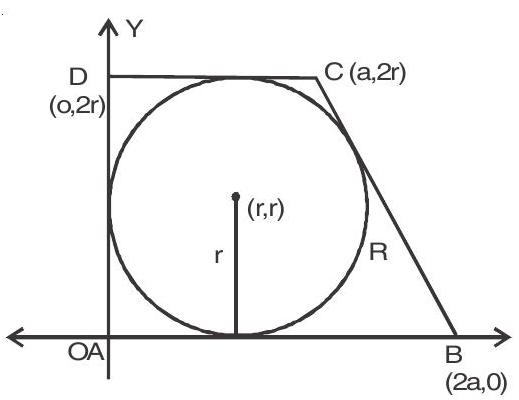
7. Let $ {ABCD}$ be a quadrilateral with area 18 , with side $ {AB}$ parallel to the side $ {CD}$ and $A B=2 C D$. Let $A D$ be perpendicular to $A B$ and $C D$. If a circle is drawn inside the quadrilateral $ {ABCD}$ touching all the sides then its radius is
(a) $3$
(b) $2$
(c) $3 / 2$
(d) $1$
Show Answer
Solution :
$ {ABCD}$ is a trapezium ( $ {AB}$ parallel to $ {CD}$ )
$\therefore \operatorname{ar}( {ABCD})=\frac{1}{2} \times {h}$ (sum of parallel sides)
$=\frac{1}{2} \times 2 {r}(2 {a}+ {a})$
$18= {r} \times 3 {a}$
ar $=6$
$ {CB}$ is a tangent to the circle
$\therefore$ equation of tangent is
$y=\frac{-2 r}{a}(x-2 a) \Rightarrow 2 r x+a y-4 a r=0$
It is a tangent to the circle $(x-r)^{2}+(y-r)^{2}=r^{2}$
$\therefore {r}=\left|\frac{2 {r}^{2}+ {ar}-4 {ar}}{\sqrt{4 {r}^{2}+ {a}^{2}}}\right|$
$r \sqrt{4 r^{2}+a^{2}}=2 r^{2}-3 a r$
$\sqrt{4 {r}^{2}+ {a}^{2}}=2 {r}-3 {a}$
Squaring
$4 {r}^{2}+ {a}^{2}=4 {r}^{2}+9 {a}^{2}-12 {ar}$
$12 {r}=8 {a} \Rightarrow 3 {r}=2 {a}$
ar $=6$
$ {r}=\frac{29}{3}$
$\frac{2 {a}^{2}}{3}=6$
$ {a}^{2}=9$
$a= \pm 3$
$\therefore {r}=2$
8. The radius of the least circle passing through the point $(8,4)$ and cutting the circle $x^{2}+y^{2}=40$ orthogonally is
(a) $\sqrt{5}$
(b) $\sqrt{7}$
(c) $2 \sqrt{5}$
(d) $3 \sqrt{5}$
Show Answer
Solution :
Let the circle be $x^{2}+y^{2}+2 g x+2 f y+c=0$
Given circle is $ {x}^{2}+ {y}^{2}=40$
These two circles are orthogonal
$\therefore {c}-40=0 \Rightarrow {c}=40$
(1) passes through $(8,4)$
$64+16+16 g+8 f+40=0$
$120+16 {~g}+8 {f}=0$
$ {f}+2 {~g}+15=0$ or $ {f}=-(2 {~g}+15)$
radius $=\sqrt{ {g}^{2}+ {f}^{2}- {c}}$
$ =\sqrt{g^{2}+(2 g+15)^{2}-40} $
For least circle radius must be minimum
Let $f(g)=g^{2}+(2 g+15)^{2}-40$ is minimum
$ {f}^{\prime}( {g})=2 {~g}+4(2 {~g}+15)=0$
$10 {~g}=-60$
$ {g}=-6$
$ {f}^{\prime \prime}( {g})=10>0$ minimum
$ {f}=-(-12+15)=-3$
Equation of circle in $x^{2}+y^{2}-12 x-6 y+40=0$
radius $=\sqrt{36+9-40}$
$=\sqrt{5}$
9. $ {P}$ is a point (a,b) in the first quadrant. If the two circles which pass throngh $ {P}$ and touch both the co-ordinate axes cut at right angles, then
(a) $a^{2}-6 a b+b^{2}=0$
(b) $a^{2}+2 a b-b^{2}=0$
(c) $ {a}^{2}-4 {ab}+ {b}^{2}=0$
(d) $a^{2}-8 a b+b^{2}=0$
Show Answer
Solution :
Equation of the two circles be
$(x-r)^{2}+(y-r)^{2}=r^{2} \Rightarrow x^{2}+y^{2}-2 x r-2 y r+r^{2}=0$
These two circles passes through $( {a}, {b})$
$\therefore( {a}- {r})^{2}+( {b}- {r})^{2}= {r}^{2}$
$ {a}^{2}+ {r}^{2}-2 {ar}+ {b}^{2}+ {r}^{2}-2 {br}- {r}^{2}=0$
$ {r}^{2}-2 {r}( {a}+ {b})+\left( {a}^{2}+ {b}^{2}\right)=0$
It is a quadratic equation in $ {r}$
$\therefore {r} _{1}+ {r} _{2}=2( {a}+ {b})$ and $ {r} _{1} {r} _{2}= {a}^{2}+ {b}^{2}$
Condition for orthogonality is
$2 {~g} _{1} {~g} _{2}+2 {f} _{1} {f} _{2}= {C} _{1}+ {C} _{2}$
$2 {r} _{1} {r} _{2}+2 {r} _{1} {r} _{2}= {r} _{1}^{2}+ {r} _{2}^{2}$
$4 {r} _{1} {r} _{2}= {r} _{1}{ }^{2}+ {r} _{2}{ }^{2}$
$6 {r} _{1} {r} _{2}= {r} _{1}{ }^{2}+ {r} _{2}{ }^{2}+2 {r} _{1} {r} _{2}$
$6 {r} _{1} {r} _{2}=\left( {r} _{1}+ {r} _{2}\right)^{2}$
$6\left(a^{2}+b^{2}\right)=4(a+b)^{2}$
$ \begin{aligned} & 6 a^{2}+6 b^{2}=4 a^{2}+4 b^{2}+8 a b \\ & 2 a^{2}+2 b^{2}-8 a b=0 \\ & a^{2}+b^{2}-4 a b=0 \end{aligned} $
10. A circle $ {S} _{\equiv} 0$ passes throngh the common points of family of circles $ {x}^{2}+ {y}^{2}+ {dx}-4 {y}+3=0(\lambda \in {R})$ and have minimum area then
(a) area of $S \equiv 0$ is $\pi$ squ.
(b) radius of director circle of $S \equiv 0$ is $\sqrt{2}$
(c) Radius of director circle of $ {S} \equiv 0$ for $ {x}$-axis is 1 unit
(d) $ {S} \equiv 0$ never cuts $|2 {x}|=1$
Show Answer
Solution :
$\left(x^{2}+y^{2}-4 y+3\right)+\lambda x=0$
$\therefore {x}=0$ and $ {y}^{2}-4 {y}+3=0$
$( {y}-3)( {y}-1)=0$
$ {y}=3,1$
$\therefore(0,3)(0,1)$ are common points.
$x^{2}+y^{2}+2 g x+2 f y+c=0$
passion through $(0,3) \&(0,1)$
$9+6 {f}+ {c}=0$
$1+2 {f}+ {c}=0$
(1) - (2) we get
$8+4 {f}=0$
$ {f}=-2$ and $ {c}=3$
$\therefore {x}^{2}+ {y}^{2}+2 {gx}-4 {y}+3=0$
radius $=\sqrt{ {g}^{2}+4-3}=\sqrt{ {g}^{2}+1}$
for minimum area radius must be minimum
Since $ {g}^{2}+1$ is positive so $ {g}$ must be zero
$\therefore$ radius $=1$
Area $=\pi {r}^{2}=\pi$ sq.u.
Radius of director circle is $\sqrt{2}$ times the radius of the given circle.
$\therefore$ Radius of director circle is $\sqrt{2}$
11. Area of part of circle $x^{2}+y^{2}-4 x-6 y+12=0$ above the line $4 x+7 y-29=0$ is $\Delta$, then $[\Delta]=$ $ \qquad $ [.] is greatest integer function.
Show Answer
Solution :
Since line $4 x+7 y-29=0$
passes through the centre $(2,3)$ of the circle
$\therefore $ The line is a diameter of a circle with radius $\sqrt{4+9-12}=1$
$\therefore $ area of semi circle is $=\frac{1}{2} \pi \mathrm{r}^2$
$=\frac{1}{2} \pi$
$ =\frac{3.14}{2}=1.57 $
Hence $[\Delta]=[1.57]=1$

Practice questions
1. Let $0<\alpha<\frac{\pi}{2}$ be a fixed angle. If $ {P}=(\cos \theta, \sin \theta)$ and $ {Q}=(\cos (\alpha-\theta), \sin (\alpha-\theta) {Q}$ is obtained from $ {P}$ by
(a). clockwise rotation around origin through an angle $\alpha$
(b). anti-clockwise rotation around origin through an angle $\alpha$
(c). reflection in the line through origin with slope $\tan \alpha$
(d). reflection in the line through origin with slope tan $\alpha / 2$
Show Answer
Answer: (d)2. If the tangent at the point $P$ on the circle $x^{2}+y^{2}+6 x+6 y=2$ meets the straight line $5 x-2 y+6=0$ at a point $ {Q}$ on the $ {y}$-axis, then the length of $ {PQ}$ is
(a). 4
(b).
(c). 5
(d). $3 \sqrt{5}$
Show Answer
Answer: (c)3. The equations to the sides $ {AB}, {BC}, {CA}$ of a $\triangle {ABC}$ are drawn on $ {AB}, {BC}, {CA}$ as diameters. The point of concurrence of the common chord is
(a). centroid of the triangle
(b). orthocenter
(c). circumcentre
(d). incentre
Show Answer
Answer: (b)4. The number of rational point(s) (a point $( {a}, {b})$ is rational, if $ {a}$ and $ {b}$ both are rational numbers) on the circumference of a circle having centre $(\pi, {e})$ is
(a). at most one
(b). at least two
(c). exactly two
(d). infinite
Show Answer
Answer: (a)5. The locus of a point such that the tangents drawn from it to the circle $x^{2}+y^{2}-6 x-8 y=0$ are perpendicular to each other is
(a). $x^{2}+y^{2}-6 x-8 y-25=0$
(b). $x^{2}+y^{2}+6 x-8 y-5=0$
(c). $x^{2}+y^{2}-6 x+8 y-5=0$
(d). $x^{2}+y^{2}-6 x-8 y+25=0$
Show Answer
Answer: (a)6. If the two circles $x^{2}+y^{2}+2 g x+2 f y=0$ and $x^{2}+y^{2}+2 g _{1} x+2 f _{1} y=0$ touch each other, then
(a). $f _{1} g=f g _{1}$
(b). $ {ff} _{1}= {gg} _{1}$
(c). $ {f}^{2}+ {g}^{2}= {f} _{1}^{2}+ {g} _{1}^{2}$
(d). none of these
Show Answer
Answer: (a)7. The number of integral values of $\lambda$ for which $x^{2}+y^{2}+\lambda x+(1-\lambda) y+5=0$ is the equation of a circle whose radius cannot exceed 5 , is
(a). 14
(b). 18
(c). 16
(d). none of these
Show Answer
Answer: (c)8. The circle $x^{2}+y^{2}+4 x-7 y+12=0$ cuts an intercept on $y$-axis of length
(a). 3
(b). 4
(c). 7
(d). 1
Show Answer
Answer: (d)9. One of the diameter of the circle $x^{2}+y^{2}-12 x+4 y+6=0$ is given by
(a). $x+y=0$
(b). $ x+3 y=0$
(c). $x=y$
(d). $3 x+2 y=0$
Show Answer
Answer: (b)10. The coordinates of the middle point of the chord cut off by $2 x-5 y+18=0$ by the circle $ {x}^{2}+ {y}^{2}- {x}+ {y} 2-54=0$ are
(a). $(1,4)$
(b). $(2,4)$
(c). $(4,1)$
(d). $(1,1)$
Show Answer
Answer: (a)11. A variable chord is drawn through the origin to the circle $x^{2}+y^{2}-2 a x=0$. The locus of the centre of the circle drawn on this chord as diameter is
(a). $x^{2}+y^{2}+a x=0$
(b). $x^{2}+y^{2}+a y=0$
(c). $x^{2}+y^{2}-a x=0$
(d). $x^{2}+y^{2}-a y=0$
Show Answer
Answer: (c)12. If $O$ is the origin and $O P, O Q$ are distinct tangents to the circle $x^{2}+y^{2}+2 g x+2 f y+c=0$, the circumcentre of the triangle $ {OPQ}$ is
(a). $(- {g},- {f})$
(b). $\quad( {g}, {f})$
(c). $(- {f},- {g})$
(d). none of these
Show Answer
Answer: (d)13. Equation of the normal to the circle $x^{2}+y^{2}-4 x+4 y-17=0$ which passes through $(1,1)$ is
(a). $3 x+2 y-5=0$
(b). $3 x+y-4=0$
(c). $3 x+2 y-2=0$
(d). $3 {x}- {y}-8=0$
Show Answer
Answer: (b)14. The equation of the circle touching the lines $|y|=x$ at a distance $\sqrt{2}$ unit from the origin is
(a). $x^{2}+y^{2}-4 x+2=0$
(b). $x^{2}+y^{2}+4 x-2=0$
(c). $x^{2}+y^{2}+4 x+2=0$
(d). none of these
Show Answer
Answer: (a)15. The shortest distance from the point $(2,-7)$ to the circle $x^{2}+y^{2}-14 x-10 y-151=0$ is
(a). 1
(b). 2
(c). 3
(d). 4
Show Answer
Answer: (b)16. The equation of the image of the circle $(x-3)^{2}+(y-2)^{2}=1$ by the mirror $x+y=19$ is
(a). $(x-14)^{2}+(y-13)^{2}=1$
(b). $(x-15)^{2}+(y-14)^{2}=1$
(c). $(x-16)^{2}+(y-15)^{2}=1$
(d). $(x-17)^{2}+(y-16)^{2}=1$
Show Answer
Answer: (d)17. If $ {P}$ and $ {Q}$ are two points on the circle $ {x}^{2}+ {y}^{2}-4 {x}-4 {y}-1=0$ which are farthest and nearest respectively from the point $(6,5)$, then
(a). $ {P}=-\frac{22}{5}, 3$
(b). $ {Q}=\frac{22}{5}, \frac{19}{5}$
(c). ${P}=\frac{14}{3},-\frac{11}{5}$
(d). $ {Q}=-\frac{14}{3},-4$
Show Answer
Answer: (b)18. A circle of the coaxial system with limiting points $(0,0)$ and $(1,0)$ is
(a). $x^{2}+y^{2}-2 x=0$
(b). $x^{2}+y^{2}-6 x+3=0$
(c). $x^{2}+y^{2}=1$
(d). $x^{2}+y^{2}-2 x+1=0$
Show Answer
Answer: (d)19. If a variable circle touches externally two given circles, then the locus of the centre of the variable circle is
(a). a straight line
(b). a parabola
(c). an ellipse
(d). a hyperbola
Show Answer
Answer: (d)Passage - 1
Let $A \equiv(a, 0)$ and $B $ be two fixed points and $P$ moves on a plane such that $ {PA}= {nPB}$
On the basis of above information, answer the following questions:
20. If $| {n}| \neq 1$, then the locus of a point $ {P}$ is
(a). a straight line
(b). a circle
(c). a parabola
(d). an ellipse
Show Answer
Answer: (b)21. If $ {n}=1$, then the locus of a point $ {P}$ is
(a). a straight line
(c). a circle
(c). a parabola
(d). a hyperbola
Show Answer
Answer: (a)22. If $0< {n}<1$, then
(a). A lies inside the circle and $B$ lies outside the circle
(b). A lies outside the circle and $B$ lies inside the circle
(c). both $ {A}$ and $ {B}$ lies on the circle
(d). both $ {A}$ and $ {B}$ lies inside the circle
Show Answer
Answer: (a)23. If $ {n}>1$, then
(a). A lies outside the circle and $B$ leis inside the circle
(b). A lies outside the circle and $B$ leis inside the circle
(c). both $ {A}$ and $ {B}$ lies on the circle
(d). both $ {A}$ and $ {B}$ lies inside the circle
Show Answer
Answer: (b)24. If focus of $ {P}$ is a circle, then the circle
(a). passes through $ {A}$ and $ {B}$
(b). never passes through $A$ and $B$
(c). passes through $A$ but does not pass through $B$
(d). passes through B but does not pass through A
Show Answer
Answer: (b)Passage - 2
For each natural number $ {k}$, let $ {Ck}$ denotes the circle with radius $ {k}$ units and centre at the origin. On the $ {Cke}$, a particle moves $ {k}$ units in the counter clockwise direction. After completing its motion on $ {Ck}$, the particle moves to $ {C} _{ {kt1}}$ in some well defined manner, where $ {k}>0$. The motion of the particle continues in this manner.
On the basis of above information, answer the following questions:
25. Let, $ {K}=1$ the particle starts at $(1,0)$. If the particle crossing the positive direction of the $ {x}$-axis for the first time on the circle $ {Cn}$, then $ {n}$ is equal to
(a). 3
(b). 5
(c). 7
(d). 8
Show Answer
Answer: (c)26. If $ {k} \in {N}$ and , the particle starts $(-1,0)$ the particle cross $ {x}$-axis again at
(a). $(3,0)$
(b). $(1,0)$
(c). $(4,0)$
(d). $(2,0)$
Show Answer
Answer: (c)27. If and , the particle moves in the radial direction from circle $ {Ck}$ to $ {CK}+1$. If particle starts form the point $(-1,0)$, then
(a). it will cross the + ve $y$-axis at $(0,4)$
(b). it will cross the - ve $y$-axis at $(0,-4)$
(c). it will cross the + ve $y$-axis at $(0,5)$
(d). it will cross the - ve $y$-axis at $(0,-5)$
Show Answer
Answer: (c)28. If and , particle moves tangentially form the circle $ {Ck}$ to $ {Ck}+1$, such that the length of tangent is equal to $ {k}$ units itself. If particle starts form the point $(1,0)$, then
(a). the particle will cross $ {x}$-axis again at $ {x}=3$
(b). the particle will cross $x$-axis again at $x=4$
(c). the particle will cross +ve $x$-axis again at $x=$
(d). the particle will cross +ve $x$-axis again at $x \in(2 \sqrt{2}, 4)$
Show Answer
Answer: (d)29. Let the particle starts from the point $(2,0)$ and moves $\pi / 2$ units, on circle $ {C} 2$ in the counterclockwise direction, then moves on the circle $ {C} 3$ along the tangential path, let this straight line (tangential path traced by particle) intersect the circle $ {C} 3$ at the points $ {A}$ and $ {B}$ tangents drawn at $ {A}$ and $ {B}$ intersect at
(a). $\frac{9}{2 \sqrt{2}} ; \frac{9}{2 \sqrt{2}}$
(b). $(9 \sqrt{2}, 9 \sqrt{2})$
(c). $(9, 9)$
(d). $(\sqrt{2}, \sqrt{2})$
Show Answer
Answer: (a)Match Type:
30. Observe the following columns:
| Columns I | Columns II |
|---|---|
| (a). If the shortest and largest distance from the point $(10,7)$ to the circle $x^{2}+y^{2}-4 x-2 y-20=0$ are $L$ and $M$ respectively, then | p. $ {M}+ {L}=10$ |
| (b). If the shortest and largest distance from the point $(3,-6)$ to the circle $x^{2}+y^{2}-16 x-12 y-125=0$ are $L$ and $ {M}$ respectively, then | q. $ {M}+ {L}=20$ |
| (c). If the shortest and largest distance from the point $(6,-6)$ to the circle $x^{2}+y^{2}-4 x+6 y-20=0$ are $L$ and $M$ respectively, then | r. $ {M}+ {L}=30$ |
| s. $ {M}- {L}=10$ | |
| t. $ {M}- {L}=26$ |
Show Answer
Answer: a $\rarr$ q, s; b $\rarr$ r, t; c $\rarr$ s31. Observe the following columns:
| Columns I | Columns II |
|---|---|
| (a). If the straight lines $y=a_1 x+b$ and $y=a_2 x+b\left(a_1 \neq a_2\right) \quad$ meet the coordinate axes in concyclic points, then | p. $\mathrm{a}_1^2+\mathrm{a}_2^2=4$ |
| (b). If the chord of contact of the tangents drawn to $\mathrm{x}^2+\mathrm{y}^2=\mathrm{b}^2 \quad$ from any point on $\mathrm{x} 2+\mathrm{y} 2=$, touches the circle $\mathrm{x} 2+\mathrm{y} 2=\mathrm{a}_2^2\left(\mathrm{a}_1 \neq \mathrm{a}_2\right)$, then | q. $\quad \mathrm{a} 1+\mathrm{a} 2=3$ |
| (c). If the circles $x^2+y^2+2 a_1 x+b=0$ and $x^2+y^2+2 a_2 x+b=0\left(a_1 \neq a_2\right)$ and orthogonally, then | r. $\quad a_1 a_2=b$ |
| s. $\quad a_1 a_2=1$ | |
| t. $\quad a_1 a_2=b^2$ |
 BETA
BETA


