COMPLEX NUMBERS AND QUADRATIC EQUATIONS - 1 (Quadratic Equations)
Quadratic equations
The general form of a quadratic equation over real numbers is $a x^{2}+b x+c=0$ where $a, b, c \in R \& a \neq$ 0 . The solution of the quadrati equation $\mathrm{ax}^{2}+\mathrm{bx}+\mathrm{c}=0$ is given by
$x=\frac{-b \pm \sqrt{b^{2}-4 a c}}{2 a}$. The expression $b^{2}-4 a c$ is called the discriminant of the quadratic equation and is denoted by D.
Nature of roots : For the quadratic equation $a x^{2}+b x+c=0$, where $a, b, c \in R$ and $a \neq 0$, then

For the quadratic equation $\mathrm{ax}^{2}+\mathrm{bx}+\mathrm{c}=0$ where $\mathrm{a}, \mathrm{b}, \mathrm{c} \in \mathrm{Q}$ and $\mathrm{a} \neq 0$, then :

Note 1: If $\alpha$ is a root of $f(\mathrm{x})=0$, then the polynomial $f(\mathrm{x})$ is exactly divisible by $\mathrm{x}-\alpha$ or $(\mathrm{x}-\alpha)$ is a factor of $f(\mathrm{x})$ and vice versa.
Note 2: $x^{2}+b x+c=0$ cannot have three different roots. If it has, then the equation becomes an identity in $\mathrm{x}$. ie, $\mathrm{a}=\mathrm{b}=\mathrm{c}=0$.
Relation between roots and coefficients
If $\alpha _{1}, \alpha _{2}, \ldots \ldots \ldots \alpha _{n}$ are roots of the equation $f(x)=a _{n} x^{n}+a _{n-1} x^{n-1}+a _{n-2} x^{n-2}+\ldots \ldots \ldots a _{2} x^{2}+a _{1} x+a _{0}=0$, then $f(\mathrm{x})=\mathrm{a} _{\mathrm{n}}\left(\mathrm{x}-\alpha _{1}\right)\left(\mathrm{x}-\alpha _{2}\right)\left(\mathrm{x}-\alpha _{3}\right)$ $\left(\mathrm{x}-\alpha _{\mathrm{n}}\right)$
$\therefore \mathrm{a} _{\mathrm{n}} \mathrm{x}^{\mathrm{n}}+\mathrm{a} _{\mathrm{n}-1} \mathrm{x}^{\mathrm{n}-1}+\mathrm{a} _{\mathrm{n}-2} \mathrm{x}^{\mathrm{n}-2}+\ldots \ldots \ldots \ldots+\mathrm{a} _{2} \mathrm{x}^{2}+\mathrm{a} _{1} \mathrm{x}+\mathrm{a} _{0}=\mathrm{a} _{\mathrm{n}}\left(\mathrm{x}-\alpha _{1}\right)\left(\mathrm{x}-\alpha _{2}\right)$.
Comparing the coefficients of like powers of $x$ an both sides, we get,
$ \begin{aligned} & S _{1}=\alpha _{1}+\alpha _{2}+\ldots \ldots \ldots \ldots+\alpha _{n}=\sum \alpha _{i}=\frac{-a _{n-1}}{a _{n}}=\frac{- \text { coeft. of } x^{n-1}}{\text { coeft of } x^{n}} \\ & S _{2}=\alpha _{1} \alpha _{2}+\alpha _{1} \alpha _{3}+\ldots \ldots \ldots \ldots \ldots \sum _{i \neq j} \alpha _{i} \alpha _{j}=(-1)^{2} \frac{a _{n-2}}{a _{n}}=(-1)^{2} \frac{\text { coeft. of } x^{n-2}}{\text { coeft of } x^{n}} \\ & S _{3}=\alpha _{1} \alpha _{2} \alpha _{3}+\alpha _{2} \alpha _{3} \alpha _{4}+\ldots \ldots \ldots \ldots \ldots \sum _{i \neq j \neq k} \alpha _{i} \alpha _{j} \alpha _{k}=(-1)^{3} \frac{a _{n-3}}{a _{n}}=(-1)^{3} \frac{\text { coeft. of } x^{n-3}}{\text { coeft of } x^{n}} \end{aligned} $
$ \mathrm{S} _{\mathrm{n}}=\alpha _{1} \alpha _{2} \alpha _{3} \ldots \ldots \ldots \ldots \ldots \ldots \ldots \alpha _{n}=(-1)^{\mathrm{n}} \frac{\mathrm{a} _{0}}{\mathrm{a} _{\mathrm{n}}}=(-1)^{\mathrm{n}} \frac{\text { constant term }}{\operatorname{coeft} \text { of } \mathrm{x}^{\mathrm{n}}} $
Here $\mathrm{S} _{\mathrm{k}}$ denotes the sum of the products of the roots taken ’ $\mathrm{k}$ ’ at a time.
Particular cases :-
Quadratic equation : If $\alpha \& \beta$ are the roots of the quadratic equation $\mathrm{ax}^{2}+\mathrm{bx}+\mathrm{c}=0$, then $\mathrm{S} _{1}=\alpha+\beta=\frac{-\mathrm{b}}{\mathrm{a}}, \& \mathrm{~S} _{2}=\alpha \beta=\frac{\mathrm{c}}{\mathrm{a}}$
Cubic equation: If $\alpha, \beta, \gamma$ are the roots of the cubic equation $\mathrm{ax}^{3}+\mathrm{bx}^{2}+\mathrm{cx}+\mathrm{d}=0$, then
$ \begin{aligned} & \mathrm{S} _{1}=\alpha+\beta+\gamma=\frac{-b}{\mathrm{a}} \\ & \mathrm{S} _{2}=\alpha \beta+\beta \alpha+\gamma \alpha=(-1)^{2} \frac{\mathrm{c}}{\mathrm{a}}=\frac{\mathrm{c}}{\mathrm{a}} \\ & \mathrm{S} _{3}=\alpha \beta \gamma=(-1)^{3} \frac{\mathrm{d}}{\mathrm{a}}=\frac{-\mathrm{d}}{\mathrm{a}} \end{aligned} $
Biquadratic equation : If $\alpha, \beta, \gamma, \delta$ are roots of the biquadratic equation $\mathrm{ax}^{4}+\mathrm{bx}^{3}+\mathrm{cx}^{2}+\mathrm{dx}+\mathrm{e}=0$, then
$ \begin{aligned} & \mathrm{S} _{1}=\alpha+\beta+\gamma+\delta=\frac{-b}{\mathrm{a}} \quad \frac{\text { constant term }}{\text { coeft of }^{\mathrm{n}}} \\ & \mathrm{S} _{2}=\alpha \beta+\beta \gamma+\alpha \delta+\beta \gamma+\beta \delta+\gamma \delta=(-1)^{2} \frac{\mathrm{c}}{\mathrm{a}} \\ & \text { Or } \mathrm{S} _{2}=(\alpha+\beta)(\gamma+\delta)+\alpha \beta+\gamma \delta=\frac{\mathrm{c}}{\mathrm{a}} \\ & \mathrm{S} _{3}=\alpha \beta \gamma+\beta \gamma \delta+\gamma \delta \alpha+\alpha \beta \delta=(-1)^{3} \frac{\mathrm{d}}{\mathrm{a}} \\ & \text { Or } \mathrm{S} _{3}=\alpha \beta(\gamma+\delta)+\gamma \delta(\alpha+\beta)=\frac{-\mathrm{d}}{\mathrm{a}} \\ & \text { and } \mathrm{S} _{4}=\alpha \beta \gamma \delta=(-1)^{4} \frac{\mathrm{e}}{\mathrm{a}}=\frac{\mathrm{e}}{\mathrm{a}} \end{aligned} $
Formation of a polynomial equation from given roots
If $\alpha _{1}, \alpha _{2}, \alpha _{3}, \ldots \ldots \ldots \ldots \ldots, \alpha _{n}$ are the roots of an $\mathrm{n}^{\text {th }}$ degree equation, then the equation is $\mathrm{x}^{\mathrm{n}}-\mathrm{S} _{1} \mathrm{x}^{\mathrm{n}-1}+\mathrm{S} _{2} \mathrm{x}^{\mathrm{n}-2}-\mathrm{S} _{3} \mathrm{x}^{\mathrm{n}-3}+\ldots \ldots \ldots \ldots .+(-1)^{\mathrm{n}} \mathrm{S} _{\mathrm{n}}=0$ where $\mathrm{S} _{\mathrm{k}}$ denotes the sum of the products of roots taken $\mathrm{k}$ at a time.
Particular cases
Quadratic equation : If $\alpha, \beta$ are the roots of a quadratic equation, then the equation is $x^{2}-S _{1} x+S _{2}=0$ ie, $x^{2}-(\alpha+\beta) x+\alpha \beta=0$.
Cubic equation : If $\alpha, \beta, \gamma$ are the roots of a cubic equation. Then the equation is, $\mathrm{x}^{3}-\mathrm{S} _{1} \mathrm{x}^{2}+\mathrm{S} _{2} \mathrm{x}-\mathrm{S} _{3}=0$ ie, $\mathrm{x}^{3}-(\alpha+\beta+\gamma) \mathrm{x}^{2}+(\alpha \beta+\beta \gamma+\gamma \alpha) \mathrm{x}-\alpha \beta \gamma=0$
Biquadratic equation : If $\alpha, \beta, \gamma, \delta$ are the roots of a biquadratic equation, then the equation is $\mathrm{x}^{4}-\mathrm{S} _{1} \mathrm{x}^{3}+\mathrm{S} _{2} \mathrm{x}^{2}-\mathrm{S} _{3} \mathrm{x}+\mathrm{S} _{4}=0$
ie, $x^{4}-(\alpha+\beta+\gamma+\delta) x^{3}+(\alpha \beta+\beta \gamma+\gamma \delta+\alpha \delta+\beta \delta+\alpha \gamma) x^{2}-$ $(\alpha \gamma \beta+\alpha \beta \delta+\beta \gamma \delta+\alpha \gamma \delta) x+\alpha \beta \gamma \delta=0$.
Quadratic Expression : An expression of the form $a x^{2}+b x+c$, where $a, b, c \in R \& a \neq 0$ is called a quadratic expression in $\mathrm{x}$. So in general quadratic expression is represented as: $f(\mathrm{x})=\mathrm{ax}^{2}+\mathrm{bx}+\mathrm{c}$ or $\mathrm{y}=$ $a x^{2}+b x+c$.
Graph of a quadratic Expression
Let $\mathrm{y}=\mathrm{ax}^{2}+\mathrm{bx}+\mathrm{c}$ where $\mathrm{a} \neq 0$.
Then $y=a\left(x^{2}+\frac{b}{a} x+\frac{c}{a}\right) \Rightarrow y=a\left(x^{2}+\frac{b x}{a}+\frac{b^{2}}{4 a^{2}}+\frac{c}{a}-\frac{b^{2}}{4 a^{2}}\right)$
$\Rightarrow y+\frac{b^{2}-4 a c}{4 a}=a\left(x+\frac{b}{2 a}\right)^{2} \Rightarrow y+\frac{D}{4 a}=a\left(x+\frac{b}{2 a}\right)^{2}$
Let $y+\frac{D}{4 a}=Y \& x+\frac{b}{2 a}=X$
$\therefore \mathrm{Y}=\mathrm{aX}^{2}$ or $\mathrm{X}^{2}=\frac{\mathrm{Y}}{\mathrm{a}}$
Clearly it is the equation of a parabola having its vertex at $\left(\frac{-b}{2 a}, \frac{-D}{4 a}\right)$.
If $\mathrm{a}>0$, then the parabola open upwards.
If $a<0$, then the parabola open downwards.
Sign of quadratic Expression
(1) The parabola will intersect the $x$-axis in two distinct points if $\mathrm{D}>0$.
(i) $ \mathrm{a}>0$
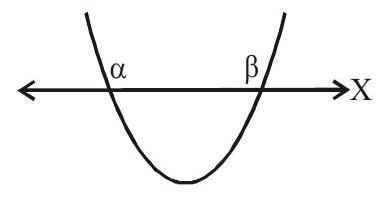
Let $f(\mathrm{x})=0$ have 2 real roots
$\alpha \& \beta(\alpha<\beta)$. Then $f(x)>0$
$\forall \mathrm{x} \in(-\infty, \alpha) \cup(\beta \infty)$ and $f(\mathrm{x})<0$
$\forall \mathrm{x} \in(\alpha, \beta)$
(ii) $ \mathrm{a}<0$
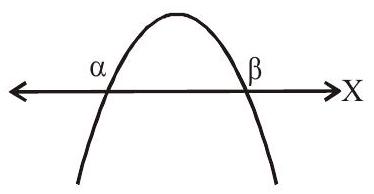
Let $f(\mathrm{x})=0$ have 2 real roots
$\alpha \& \beta(\alpha<\beta)$ Then $f(\mathrm{x})<0$
$\forall \mathrm{x} \in(-\infty, \alpha) \cup(\beta \infty)$
$\& f(\mathrm{x})>0$ for all $\mathrm{x} \in(\alpha, \beta)$
(2) The parabola will touch the $\mathrm{x}$-axis at one point if $\mathrm{D}=0$

(3) The parabola will not intersect $\mathrm{x}$-axis if $\mathrm{D}<0$.

NOTE : Condition that a quadratic function $f(\mathrm{x}, \mathrm{y})=\mathrm{ax}^{2}+2 \mathrm{hxy}+\mathrm{by}^{2}+2 \mathrm{gx}+2 f \mathrm{y}+\mathrm{c}$ may be resolved into two linear factions is that
$a b c+2 f g h-a f^{2}-b^{2}-c h^{2}=\left|\begin{array}{lll}\mathrm{a} & \mathrm{h} & \mathrm{g} \\ \mathrm{h} & \mathrm{b} & \mathrm{f} \\ \mathrm{g} & \mathrm{f} & \mathrm{c}\end{array}\right|=0$
NOTE :
(i) For $\mathrm{a}>0, f(\mathrm{x})=\mathrm{ax}^{2}+\mathrm{bx}+\mathrm{c}$ has least value at $\mathrm{x}=\frac{-\mathrm{b}}{2 \mathrm{a}}$. This least value is given by $\frac{-\mathrm{D}}{4 \mathrm{a}}$
(ii) For $\mathrm{a}<0, f(\mathrm{x})=\mathrm{ax}^{2}+\mathrm{bx}+\mathrm{c}$ has greatest value at $\mathrm{x}=\frac{-\mathrm{b}}{2 \mathrm{a}}$. This greatest value is given by $\frac{-\mathrm{D}}{4 \mathrm{a}}$
Solved Examples
1. If $\alpha, \beta$ are roots of $\mathrm{ax}^{2}+\mathrm{bx}+\mathrm{c}=0 ; \alpha+\mathrm{h}$ and $\beta+\mathrm{h}$ are roots of $\mathrm{px}^{2}+\mathrm{qx}+\mathrm{r}=0$ and $\mathrm{D} _{1}, \mathrm{D} _{2}$ are their discriminants, then $\mathrm{D} _{1}: \mathrm{D} _{2}=$
(a). $\frac{\mathrm{a}^{2}}{\mathrm{p}^{2}}$
(b). $\frac{b^{2}}{q^{2}}$
(c). $\frac{\mathrm{c}^{2}}{\mathrm{r}^{2}}$
(d). None of these
Show Answer
Solution : $\alpha-\beta=(\alpha+h)-(\beta+h)$
$ \begin{aligned} & \Rightarrow(\alpha-\beta)^{2}=((\alpha+h)-(\beta+h))^{2} \\ & \Rightarrow(\alpha+\beta)^{2}-4 \alpha \beta=((\alpha+h)+(\beta+h))^{2}-4(\alpha+h)(\beta+h) \\ & \left(\frac{-b}{a}\right)^{2}-4 \frac{c}{a}=\left(\frac{-q}{p}\right)^{2}-\frac{4 r}{p} \end{aligned} $
$ \begin{aligned} & \frac{\mathrm{b}^{2}-4 \mathrm{ac}}{\mathrm{a}^{2}}=\frac{\mathrm{q}^{2}-4 \mathrm{pr}}{\mathrm{p}^{2}} \Rightarrow \frac{\mathrm{D} _{1}}{\mathrm{a}^{2}}=\frac{\mathrm{D} _{2}}{\mathrm{p}^{2}} \\ & \Rightarrow \frac{\mathrm{D} _{1}}{\mathrm{D} _{2}}=\frac{\mathrm{a}^{2}}{\mathrm{p}^{2}} \end{aligned} $
Answer : (a).
2. If $a \in Z$ and the equation $(x-a)(x-10)+1=0$ has integral roots, then the values of $a$ are
(a). 10, 8
(b). 12, 10
(c). 12, 8
(d). None of these
Show Answer
Solution: $(\mathrm{x}-\mathrm{a})(\mathrm{x}-10)=-1$
$\begin{aligned} & \Rightarrow \quad x-a=1 & \quad {\&} \quad \quad x-10=-1 \\ & 9-a=1 & x=10-1 \\ & a=8 & x=9 \end{aligned}$
$\begin{aligned} & \text { OR } \quad \mathrm{x}-\mathrm{a}=-1 \quad {\&} & \quad\mathrm{x}-10=1 \\ & 11-a=-1 & x=11 \\ & \mathrm{a}=12 \\ & \end{aligned}$
Answer : (c).
3. If $\alpha, \beta$ are roots of the equation $(x-a)(x-b)+c=0(c \neq 0)$, then then roots of the equation ( $x-c-$ $\alpha)(\mathrm{x}-\mathrm{c}-\beta)=\mathrm{c}$ are
(a). $a$ and $b+c$
(b). $a+\mathrm{c}$ and $b$
(c). $a+c$ and $b+c$
(d). None of these
Show Answer
Solution: $\mathrm{x}^{2}-(\mathrm{a}+\mathrm{b}) \mathrm{x}+\mathrm{ab}+\mathrm{c}=0$
$\Rightarrow \quad \alpha+\beta=\mathrm{a}+\mathrm{b}$ and $\alpha \beta=\mathrm{ab}+\mathrm{c}$
Now $(\mathrm{x}-\mathrm{c}-\alpha)(\mathrm{x}-\mathrm{c}-\beta)=\mathrm{c}$
$\Rightarrow \quad(\mathrm{x}-\mathrm{c})^{2}-(\alpha+\beta)(\mathrm{x}-\mathrm{c})+\alpha \beta-\mathrm{c}=0$
$(\mathrm{x}-\mathrm{c})^{2}-(\mathrm{a}+\mathrm{b})(\mathrm{x}-\mathrm{c})+\mathrm{ab}=0$
$(\mathrm{x}-\mathrm{c})^{2}-\mathrm{a}(\mathrm{x}-\mathrm{c})-\mathrm{b}(\mathrm{x}-\mathrm{c})+\mathrm{ab}=0$
$\Rightarrow \quad(\mathrm{x}-\mathrm{c}-\mathrm{a})(\mathrm{x}-\mathrm{c}-\mathrm{b})=0$
$\therefore \quad \mathrm{x}=\mathrm{c}+\mathrm{a}$ and $\mathrm{b}+\mathrm{c}$
Answer: (c).
4. Let $\Delta^{2}$ be the discriminant and $\alpha, \beta$ be the roots of the equation $\mathrm{ax}^{2}+\mathrm{bx}+\mathrm{c}=0$. Then $2 \mathrm{a} \alpha+\Delta$ and $2 \mathrm{a} \beta-\Delta$ can be roots of the equation
(a). $\mathrm{x}^{2}+2 \mathrm{bx}+\mathrm{b}^{2}=0$
(b). $\mathrm{x}^{2}-2 \mathrm{bx}+\mathrm{b}^{2}=0$
(c). $x^{2}+2 b x-3 b^{2}-16 a c=0$
(d). $\mathrm{x}^{2}+2 \mathrm{bx}-3 \mathrm{~b}^{2}+16 \mathrm{ac}=0$
Show Answer
Solution : $\alpha, \beta=\frac{-b \pm \sqrt{\Delta^{2}}}{2 a}$
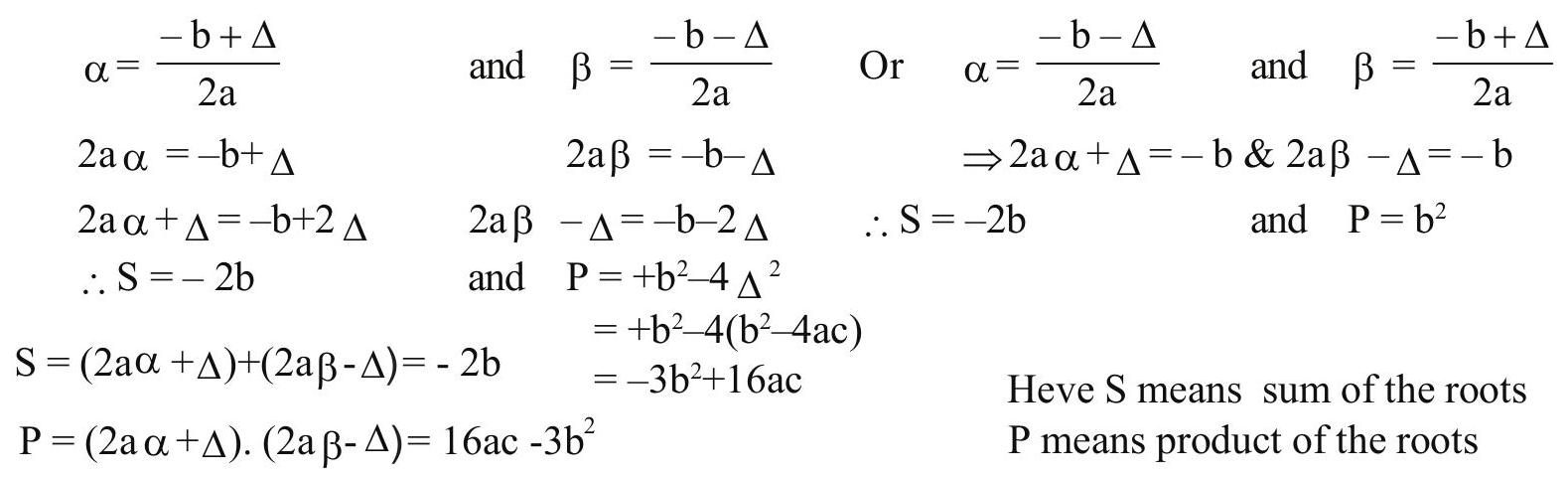
$\therefore$ quadatic equation is
- $\mathrm{x}^{2}+2 \mathrm{bx}-3 \mathrm{~b}^{2}+16 \mathrm{ac}=0$
$\therefore$ quadratic equation is
- $\mathrm{x}^{2}+2 b \mathrm{bx}+\mathrm{b}^{2}=0$
Answer : (a and d)
5. The polynomial equation $\left(a x^{2}+b x+c\right)\left(a x^{2}-d x-c\right)=0, a c \neq 0$ has
(a). four real roots
(b). atleast two real roots
(c). atmost two real roots
(d). No real roots
Show Answer
Solution : $\mathrm{ac} \neq 0$
$\Rightarrow \quad \mathrm{ac}>0$ or $\mathrm{ac}<0$
Now $\mathrm{D} _{1}=\mathrm{b}^{2}-4 \mathrm{ac} \& \mathrm{D} _{2}=\mathrm{d}^{2}+4 \mathrm{ac}$
When ac $>0 \Rightarrow \mathrm{D} _{2}>0$ but $\mathrm{D} _{1}$ may positive or negative
When ac $<0 \Rightarrow \mathrm{D} _{1}>0$ but $\mathrm{D} _{2}$ may be positive or negative In either case the polynomial has atleast two real roots
Answer: (b).
6. If $\alpha, \beta$ are roots of $x^{2}-p(x+1)-q=0$, then the value of $\frac{\alpha^{2}+2 \alpha+1}{\alpha^{2}+2 \alpha+q}+\frac{\beta^{2}+2 \beta+1}{\beta^{2}+2 \beta+q}$ is
(a). 1
(b). 2
(c). 3
(d). None of these
Show Answer
Solution : $\mathrm{x}^{2}-\mathrm{px}-\mathrm{p}-\mathrm{q}=0$
$ \begin{aligned} & \Rightarrow \alpha+\beta=\mathrm{p} \\ & \text { and } \alpha \beta=-p-q \\ & \operatorname{Now}(\alpha+1)(\beta+1) \quad=(\alpha+\beta)+\alpha \beta+1 \\ & =\mathrm{p}-\mathrm{q}-\mathrm{p}+1=1-\mathrm{q} \\ & \text { Now } \frac{\alpha^{2}+2 \alpha+1}{\alpha^{2}+2 \alpha+q}+\frac{\beta^{2}+2 \beta+1}{\beta^{2}+2 \beta+q} \\ & =\frac{(\alpha+1)^{2}}{(\alpha+1)^{2}+q-1}+\frac{(\beta+1)^{2}}{(\beta+1)^{2}+q-1} \\ & =\frac{(\alpha+1)^{2}}{(\alpha+1)^{2}-(\alpha+1)(\beta+1)}+\frac{(\beta+1)^{2}}{(\beta+1)^{2}-(\alpha+1)(\beta+1)} \\ & =\frac{1}{1-\left(\frac{\beta+1}{\alpha+1}\right)}+\frac{1}{1-\frac{(\alpha+1)}{\beta+1}}=\frac{\alpha+1}{(\alpha+1)-(\beta+1)}+\frac{\beta+1}{\beta+1-(\alpha+1)} \\ & =\frac{\alpha+1}{\alpha-\beta}+\frac{\beta+}{\beta-\alpha}=\frac{\alpha+1-\beta-1}{\alpha-\beta} \\ & \Rightarrow \frac{\alpha-\beta}{\alpha-\beta}=1 \end{aligned} $
Answer: (a).
7. Let $\alpha, \beta, \gamma$ be the roots of the equation $x^{3}+4 x+1=0$, then $(\alpha+\beta)^{-1}+(\beta+\gamma)^{-1}+(\gamma+\alpha)^{-1}$ equals
(a). 2
(b). 3
(c). 4
(d). 5
Show Answer
Solution : $\alpha+\beta+\gamma=0, \alpha \beta+\beta \gamma+\gamma \alpha=4, \alpha \beta \gamma=-1$
$\therefore \frac{1}{\alpha+\beta}+\frac{1}{\beta+\gamma}+\frac{1}{\gamma+\alpha}=-\frac{1}{\gamma}-\frac{1}{\alpha}-\frac{1}{\beta}=-\frac{\alpha \beta+\beta \gamma+\gamma \alpha}{\alpha \beta \gamma}=-\left(\frac{4}{-1}\right)=4$
Answer : (c).
Practice questions
1. The minimum value of $f(\mathrm{x})=\mathrm{x}^{2}+2 \mathrm{bx}+2 \mathrm{c}^{2}$ is greatest than the maximum value of $g(x)=-x^{2}-2 c x+b^{2}$, then ( $x$ being a real )
(a). $|c|>\frac{|b|}{\sqrt{3}}$
(b). $\frac{|\mathrm{c}|}{\sqrt{2}}>|\mathrm{b}|$
(c). $-1<\mathrm{c}<\sqrt{2} \mathrm{~b}$
(d). Non real value of b & c exist
Show Answer
Answer: (b)2. If $\mathrm{P}(\mathrm{x})$ is a polynomial of degree less than or equal to 2 and $\mathrm{S}$ is the set of all such polynomials so that $\mathrm{P}(1)=1, \mathrm{P}(0)=0$ and $\mathrm{P}^{1}(\mathrm{x})>0 \forall \mathrm{x} \in[0,1]$, then $\mathrm{S}=$ Here, $\mathrm{P}(\mathrm{x})=\mathrm{b} \mathrm{x}^{2}+\mathrm{ax}+\mathrm{c}$
(a). $\phi$
(b). $\left\{(1-\mathrm{a}) \mathrm{x}^{2}+\mathrm{ax}, 0<\mathrm{a}<2\right\}$
(c). $\left\{(1-\mathrm{a}) \mathrm{x}^{2}+\mathrm{ax}, \mathrm{a}>0\right\}$
(d). $\left\{(1-\mathrm{a}) \mathrm{x}^{2}+\mathrm{ax}, 0<\mathrm{a}<1\right\}$
Show Answer
Answer: (b)3. In the quadratic equation $\mathrm{ax}^{2}+\mathrm{bx}+\mathrm{c}=0$ if $\Delta=\mathrm{b}^{2}-4 \mathrm{ac}$ and $\alpha+\beta, \alpha^{2}+\beta^{2}$ and $\alpha^{3}+\beta^{3}$ are in G.P, where $\alpha, \beta$ are the roots of the equation, then
(a). $\Delta \neq 0$
(b). $\mathrm{b} _{\Delta}=0$
(c). $\mathrm{c} _{\Delta}=0$
(d). $\Delta=0$
Show Answer
Answer: (c)4. If $a, b, c$ are the sides of a triangle $A B C$ such that $x^{2}-2(a+b+c) x+3 \lambda(a b+b c+c a)=0$ has real roots, then
(a). $\lambda<\frac{4}{3}$
(b). $\lambda>\frac{5}{3}$
(c). $\lambda \in\left(\frac{4}{3}, \frac{5}{3}\right)$
(d). $ \lambda \in\left(\frac{1}{3}, \frac{5}{3}\right)$
Show Answer
Answer: (a)5. Let $\alpha \& \beta$ be the roots of $x^{2}-6 x-2=0$, with $\alpha>\beta$. If $a _{n}=\alpha^{n}-\beta^{n}$ for $n \geq 1$, then the value of $\frac{\mathrm{a} _{10}-2 \mathrm{a} _{8}}{2 \mathrm{a} _{9}}$ is
(a). 1
(b). 2
(c). 3
(d). 4
Show Answer
Answer: (c)6. If $x^{2}-10 a x-11 b=0$ have roots $c \& d \cdot x^{2}-10 c x-11 d=0$ have roots $a \& b$, then $a+b+c+d$ is
(a). 1210
(b). 1120
(c). 1200
(d). None of these
Show Answer
Answer: (a)7. If $\mathrm{t} _{\mathrm{n}}$ denotes the $\mathrm{n}^{\text {th }}$ term of an A.P. and $\mathrm{t} _{\mathrm{p}}=\frac{1}{\mathrm{q}}$ and $\mathrm{t} _{\mathrm{q}}=\frac{1}{\mathrm{p}}$, then which of the following is necessarily a root of the equation $(p+2 q-3 r) x^{2}+(q+2 r-3 p) x+(r+2 p-3 q)=0$ is
(a). $t _{p}$
(b). $\mathrm{t} _{\mathrm{q}}$
(c). $t _{\mathrm{pq}}$
(d). $t _{p+q}$
Show Answer
Answer: (c)8. The curve $y=(\lambda+1) x^{2}+2$ intersect the curve $y=\lambda x+3$ in exactly one point, if $\lambda$ equals
(a). $\{-2,2\}$
(b). $\{1\}$
(c). $\{-2\}$
(d). $\{2\}$
Show Answer
Answer: (c)9. Read the passage and answer the following questions.
Consider the equation $x^{4}+(1-2 k) x^{2}+k^{2}-1=0$ where $k$ is real. If $x^{2}$ is imaginary, or $x^{2}<0$, the equation has no real roots. If $x^{2}>0$, the equation has real roots.
(i) The equation has no real roots if $\mathrm{k} \in$
(a). $(-\infty-1)$
(b). $(-1,1)$
(c). $\left(1, \frac{5}{4}\right)$
(d). $\left(\frac{5}{4}, \infty\right)$
Show Answer
Answer: (a, d)(ii) The equation has only two real roots if $\mathrm{k} \in$
(a). $(-\infty-1)$
(b). $(0, 1)$
(c). $(1, 2)$
(d). $(-1, 1)$
Show Answer
Answer: (d)(iii) The equation has four real roots if $\mathrm{k} \in$
(a). $(-\infty, 0)$
(b). $(-1,1)$
(c). $\left(1, \frac{5}{4}\right)$
(d). $(1, \infty)$
Show Answer
Answer: (c)10. If $\alpha, \beta$ are the roots of the equation $a x^{2}+b x+c=0$, then the value of $\left|\begin{array}{ccc}1 & \cos (\beta-\alpha) & \cos \alpha \\ \cos (\alpha-\beta) & 1 & \cos \beta \\ \cos \alpha & \cos \beta & 1\end{array}\right|$ is
(a). $\sin (\alpha+\beta)$
(b). $\sin \alpha \sin \beta$
(c). $1+\cos (\alpha+\beta)$
(d). None of these
Show Answer
Answer: (d)11. If $(1+k) \tan ^{2} x-4 \tan x-1+k=0$ has real roots, then
(a). $\mathrm{k}^{2} \leq 5$
(b). $\tan \left(\mathrm{x} _{1}+\mathrm{x} _{2}\right)=2$
(c). for $\mathrm{k}=2, \mathrm{x} _{1}=\frac{\pi}{4}$
(d). for $\mathrm{k}=1, \mathrm{x} _{1}=0$
Show Answer
Answer: (a, b, c, d)12. If $p, q \in\{1,2,3,4\}$, the number of equations of the form $\mathrm{px}^{2}+\mathrm{qx}+1=0$ having real roots is
(a). 15
(b). 9
(c). 7
(d). 8
Show Answer
Answer: (c)13. In $\triangle \mathrm{PQR} \angle \mathrm{R}=\frac{\pi}{2}$. If $\tan \frac{\mathrm{p}}{2} \& \tan \frac{\mathrm{Q}}{2}$ are the roots of the equation $\mathrm{ax}^{2}+\mathrm{bx}+\mathrm{c}=0(\mathrm{a} \neq 0)$ then
(a). $\mathrm{a}+\mathrm{b}=\mathrm{c}$
(b). $\mathrm{b}+\mathrm{c}=0$
(c). $a+\mathrm{c}=\mathrm{b}$
(d). $\mathrm{b}=\mathrm{c}$
 BETA
BETA


