COORDINATE GEOMETRY - 7 (Straight Line)
Examples
1. Locus of the image of the point $(2,3)$ in the line $(x-2 y+3)+\lambda(2 x-3 y+4)=0$ is
(a) $x^{2}+y^{2}-3 x-4 y-4=0$
(b) $2 x^{2}+2 y^{2}+2 x+4 y-7=0$
(c) $x^{2}+y^{2}-2 x-4 y+4=0$
(d) None
Show Answer
Solution :
$\begin{aligned} & x-2 y+3=0 \\ & 2 x-3 y+4=0\end{aligned} \quad P(1,2)$
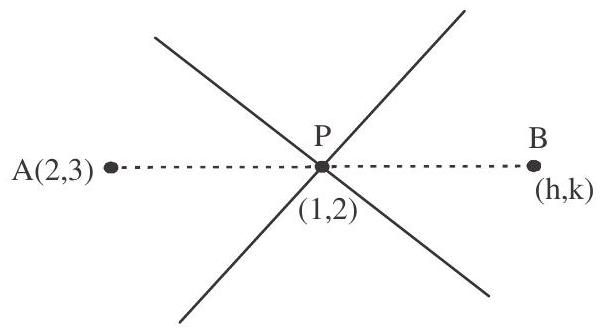
Let image be $\mathrm{B}(\mathrm{h}, \mathrm{k})$ then $\mathrm{AP}=\mathrm{BP}$
$(\mathrm{h}-1)^{2}+(\mathrm{k}-2)^{2}=1^{2}+1^{2}$
$\mathrm{h}^{2}+\mathrm{k}^{2}-2 \mathrm{~h}-4 \mathrm{k}+5=2$
$\mathrm{x}^{2}+\mathrm{y}^{2}-2 \mathrm{x}-4 \mathrm{y}+3=0$
Answer: d
2. If the lines $a x+y+1=0, x+b y+1=0$ and $x+y+c=0(a, b, c$ being distinct and different from 1$)$ are concurrent, then $\left(\frac{1}{1-\mathrm{a}}\right)+\frac{1}{1-\mathrm{b}}+\frac{1}{1-\mathrm{c}}=$
(a) 0
(b) 1
(c) $\frac{1}{a+b+c}$
(d) None
Show Answer
Solution :
$\mathrm{c} _{2} \rightarrow \mathrm{c} _{2}-\mathrm{c} _{1}, \mathrm{c} _{3} \rightarrow \mathrm{c} _{3}-\mathrm{c} _{1}$
$\left|\begin{array}{ccc}\mathrm{a} & 1 & 1 \\ 1 & \mathrm{~b} & 1 \\ 1 & 1 & \mathrm{c}\end{array}\right|=0 \Rightarrow\left|\begin{array}{ccc}\mathrm{a} & 1-\mathrm{a} & 1-\mathrm{a} \\ 1 & \mathrm{~b}-1 & 0 \\ 1 & 0 & \mathrm{c}-1\end{array}\right|=0$
$\mathrm{a}(\mathrm{b}-1)(\mathrm{c}-1)-(1-\mathrm{a})(\mathrm{c}-1)+(1-\mathrm{a})(1-\mathrm{b})=0$
divide by $(1-a)(1-b)(1-c)$ we get
$\Rightarrow \quad \frac{\mathrm{a}}{1-\mathrm{a}}+\frac{1}{1-\mathrm{b}}+\frac{1}{1-\mathrm{c}}=0$
$\Rightarrow \quad \frac{1}{1-\mathrm{a}}+\frac{1}{1-\mathrm{b}}+\frac{1}{1-\mathrm{c}}=1$
3. The set of values of ’ $b$ ’ for which the origin and the point $(1,1)$ lie on the same side of the st. line $\mathrm{a}^{2} \mathrm{x}+\mathrm{aby}+1=0 \quad \forall \mathrm{a} \in \mathrm{R}, \mathrm{b}>\mathrm{o}$ are
(a) $\mathrm{b} \in[2,4)$
(b) $\mathrm{b} \in(0,2)$
(c) $\mathrm{b} \in[0,2]$
(d) None of these
Show Answer
Solution : $(0,0) \&(1,1)$ are on the same side
$0+1>0$ so $a^{2}+a b+1>0$
$\Rightarrow \mathrm{D}<0$ i.e
$ b^{2}-4<0 $
$ b^{2}<4 $
$-2<b<2$ but $b>0$
$\therefore \mathrm{b} \in(0,2)$
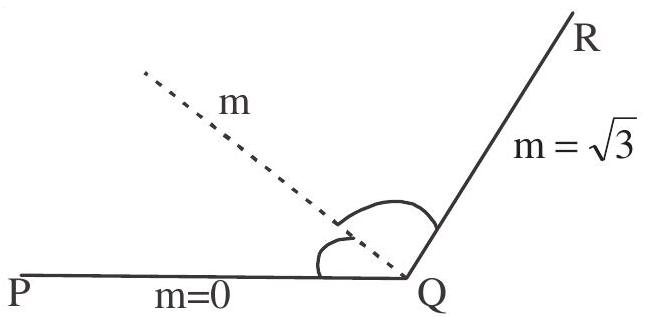
4. Let $\mathrm{P}(-1,0), \mathrm{Q}(0,0)$ and $\mathrm{R}(3,3 \sqrt{3})$ be three points. Then the equation of the bisector of the angle $\mathrm{PQR}$ is
(a) $\frac{\sqrt{3}}{2} x+y=0$
(b) $x+\sqrt{3} y=0$
(c) $\sqrt{3} \mathrm{x}+\mathrm{y}=0$
(d) $x+\frac{\sqrt{3}}{2} y=0$
Show Answer
Solution :
$ \frac{\sqrt{3}-m}{1+\sqrt{3 m}}=\frac{m}{1+0} $
$ \begin{aligned} \sqrt{3}-m=m+\sqrt{3} m^{2} \Rightarrow & \sqrt{3} m^{2}+2 m-\sqrt{3}=0 \\ & \sqrt{3} m^{2}+3 m-m-\sqrt{3}=0 \\ & (\sqrt{3} m-1)(3+\sqrt{3})=0 \\ & m=\frac{1}{\sqrt{3}},-\sqrt{3} \end{aligned} $
$y=-\sqrt{3} x$
$\sqrt{3} x+y=0$
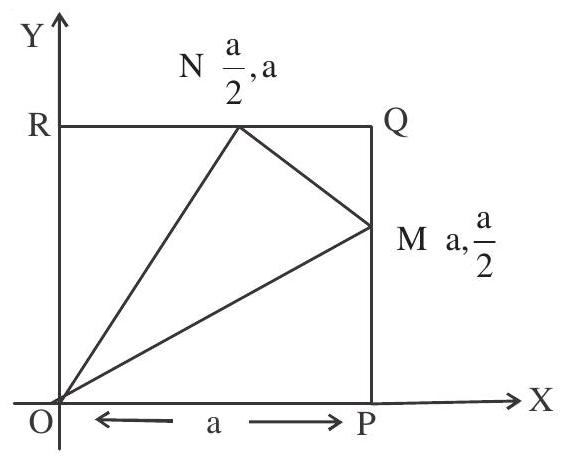
5. $\mathrm{OPQR}$ is a square and $\mathrm{M}, \mathrm{N}$ are the mid points of the sides $\mathrm{PQ}$ and $\mathrm{QR}$ respedively. If the ratio of the areas of the square and the triangle OMN is $\lambda: 6$, then $\frac{\lambda}{4}$ is equal to
(a) 2
(b) 4
(c) 12
(d) 16
Show Answer
Solution : ar. of square $=\mathrm{a}^{2}$
ar of $\Delta \mathrm{OMN}=\frac{1}{2}\left|\begin{array}{lll}0 & 0 & 1 \\ \mathrm{a} & \frac{\mathrm{a}}{2} & 1 \\ \frac{\mathrm{a}}{2} & \mathrm{a} & 1\end{array}\right|=\frac{1}{2} \cdot \frac{3 \mathrm{a}^{2}}{4}=\frac{3 \mathrm{a}^{2}}{8}$
$\frac{\mathrm{a}^{2}}{\frac{3 \mathrm{a}^{2}}{8}}=\frac{\lambda}{6} \Rightarrow \lambda=16$
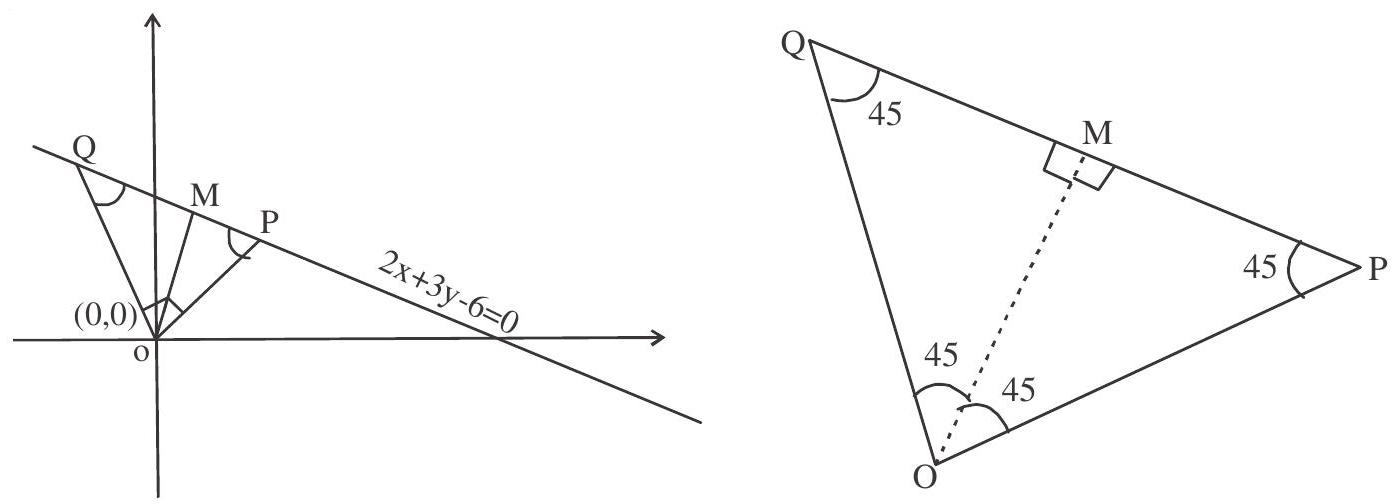
6. A pair of perpendicular straight lines drawn through the origin form an inosceles triangle with line $2 x+3 y=6$, then area of the triangle so formed is
(a) $\frac{36}{13}$
(b) $\frac{12}{17}$
(c) $\frac{13}{5}$
(d) $\frac{17}{13}$
Show Answer
Solution : $\mathrm{OM}=\left|\frac{-6}{\sqrt{4+9}}\right|=\frac{6}{\sqrt{13}}, \mathrm{PQ}=2 \times \frac{6}{\sqrt{13}}$, area od $\triangle \mathrm{OPQ}=\frac{1}{2} \times \frac{2 \times 6}{\sqrt{13}} \times \frac{6}{\sqrt{13}}=\frac{36}{13}$
7. Match the column
| Column I | Column II |
|---|---|
| (a) Two vertices of a triangle are $(5,-1)$ and $(-2,3)$ if orthocentre (p) (-4,-7) is origin then third vertex is | (p). $(-4, 7)$ |
| (b) A point on the line $x+y=4$ which lies at a unit distance from the line $4 x+3 y=10$, is | (q). $(-7, 11)$ |
| (c) Orthocentre of the triangle made by the lines $x+y-1=0, x-y+3=0,2 x+y=7$ is | (r). $(1, -2)$ |
| (d) If a,b,c are in A.P., then lines $a x+b y=c$ always Pass through | (s). $(-1, 2)$ |
Show Answer
Solution :
A - p ,B - q, C - s, D - s
 BETA
BETA


