HYPERBOLA- 8 (Practice Problems)
Practice problems
1. Equation of conjugate axis of hyperbola $x y-3 y-4 x+7=0$ is
(a) $x+y=7$
(b) $x+y=3$
(c) $\mathrm{x}-\mathrm{y}=7$
(d) None of these
Show Answer
Solution:
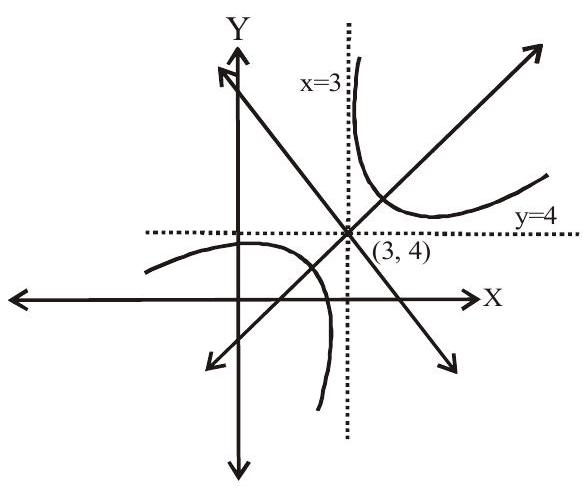
$ \begin{aligned} & x y-3 y-4 x+7=0 \\ & x y-3 y-4 x+12=5 \\ & (x-3)(y-4)=5 \end{aligned} $
Equation of asymptotes are $x-3=0$ and $y-4=0$ Since the hyperbola is rectangular hyperbola, axes are bisectors of asymptotes
Hence their slopes are $\pm 1$
$\therefore$ Equation of conjugate axis is
$ \begin{aligned} & y-4=-1(x-3) \\ & x+y=7 \end{aligned} $
Answer: (a)
2. If $S _{1}$ and $S _{2}$ are the foci of the hyperbola whose transverse axis length is 4 and conjugate axis length is $6, S _{3}$ and $\mathrm{S} _{4}$ are the foci of the conjugate hyperbola, then the area of the quadrilateral $\mathrm{S} _{1} \mathrm{~S} _{3} \mathrm{~S} _{2} \mathrm{~S} _{4}$ is
(a) 156
(b) 36
(c) 26
(d) None of these
Show Answer
Solution :
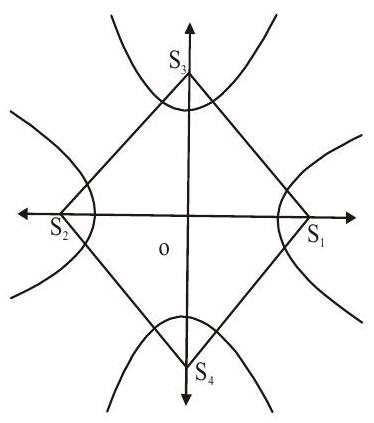
$\mathrm{S} _{1} \mathrm{~S} _{3} \mathrm{~S} _{2} \mathrm{~S} _{4}$ forms a square.
So required area $=4 \times$ area of ${ } _{\Delta} \mathrm{S} _{1} \mathrm{OS} _{3}=4 \times \frac{1}{2}$ ae $\times \mathrm{be} _{1}$
$ \begin{aligned} & =2 \mathrm{abee} _{1}=2.2 .3 . \mathrm{e} \mathrm{e} _{1} \\ & =12 \mathrm{ee} _{1} \end{aligned} $
Now e $=\sqrt{1+\frac{9}{4}}=\frac{\sqrt{13}}{2} \& \mathrm{e} _{1}=\sqrt{1+\frac{9}{4}}=\frac{\sqrt{13}}{2}$
Hence area $=12 \times \frac{\sqrt{13}}{2} \times \frac{\sqrt{13}}{2}=26$ sq.units
Answer: (c)
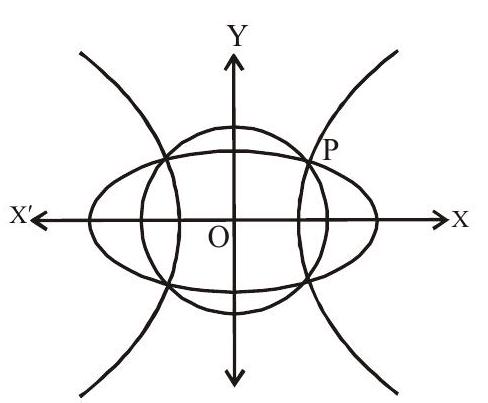
3. The ellipse $4 x^{2}+9 y^{2}=36$ and the hyperbola $a^{2} x^{2}-y^{2}=4$ intersect at right angles then the equation of the circle through the points of intersection of two conic is
(a) $x^{2}+y^{2}=25$
(c) $5\left(x^{2}+y^{2}\right)-3 x-4 y=0$
(b) $5\left(x^{2}+y^{2}\right)+3 x+4 y=0$
(d) $\left(x^{2}+y^{2}\right)=5$
Show Answer
Solution:
Since ellipse and hyperbola intersect orthogonally, they are confocal.
$ \mathrm{e}=\sqrt{1-\frac{4}{9}}=\frac{\sqrt{5}}{3} $
foci of ellipse $( \pm \sqrt{5}, 0)$
$(a)^{2}=a^{2}+b^{2}$
$ 5=\frac{4}{a^{2}}+4 \Rightarrow a=2 $
Let point of intersection in the first quadrant be $\mathrm{P}\left(\mathrm{x} _{1}, \mathrm{y} _{1}\right)$.
$\mathrm{P}$ lies on both the curves.
$4x _{1}^{2}+9 y _{1}^{2}=36 \quad \text { and } 4 x _{1}^{2}-y _{1}^{2}=4$
Adding these two, we get $8 \mathrm{x} _{1}{ }^{2}+8 \mathrm{y} _{1}{ }^{2}=40$
$ \mathrm{x} _{1}^{2}+\mathrm{y} _{1}^{2}=5 $
Equation of circle is $x^{2}+y^{2}=5$
4. If $\mathrm{e}$ is the eccentricity of the hyperbola $\frac{\mathrm{x}^{2}}{\mathrm{a}^{2}}-\frac{\mathrm{y}^{2}}{\mathrm{~b}^{2}}=1$ and $2 \theta$ is angle between the asymptotes then $\cos \theta=$
(a) $\frac{1}{\mathrm{e}}$
(b) $\frac{1-e}{e}$
(c) $\frac{1+\mathrm{e}}{\mathrm{e}}$
(d) None of these
Show Answer
Solution:
$ e=\sqrt{1+\frac{b^{2}}{a^{2}}} $
we know $2 \theta=2 \tan ^{-1}\left(\frac{\mathrm{b}}{\mathrm{a}}\right) \Rightarrow \tan \theta=\frac{\mathrm{b}}{\mathrm{a}}$
$ \mathrm{e}=\sqrt{1+\tan \theta^{2}}=\sec \theta \Rightarrow \cos \theta=\frac{1}{\mathrm{e}} $
Answer: (a)
5. From a point $p(1,2)$ pair of tangents are drawn to a hyperbola in which one tangent to each arm of hyperbola. Equation of asymptotes of hyperbola are $\sqrt{3} x-y+5=0$ and $\sqrt{3} x+y-1=0$ then eccentricity of hyperbola is
(a) $\sqrt{3}$
(b) $\frac{2}{\sqrt{3}}$
(c) $2$
(d) None of these
Show Answer
Solution:
Equation of asymptotes are
$\sqrt{3} \mathrm{x}-\mathrm{y}+5=0$
$-\sqrt{3} \mathrm{x}-\mathrm{y}+1=0$
$\therefore \mathrm{a} _{1} \mathrm{a} _{2}+\mathrm{b} _{1} \mathrm{~b} _{2}=-3+1<0$
$\therefore$ origin lies in acute angle and $\mathrm{P}(1,2)$ lies in obtuse angle.
$\therefore \mathrm{e}=\sec \theta$ where $2 \theta$ is the angle between asymptotes.
$2 \theta=\frac{\pi}{3} \Rightarrow \theta=\frac{\pi}{6}$

$ \mathrm{e}=\sec \frac{\pi}{6}=\frac{2}{\sqrt{3}} $
Answer: (b)
6. If a variable line has its intercepts on the coordinate axes $\mathrm{e}, \mathrm{e}^{\prime}$ where $\frac{\mathrm{e}}{2}, \frac{\mathrm{e}^{\prime}}{2}$ are the eccentricities of a hyperbola and its conjugate hyperbola, then the line always touches the circle $\mathrm{x}^{2}+\mathrm{y}^{2}=\mathrm{r}^{2}$, where $\mathrm{r}=$
(a) $4$
(b) $3$
(c) $2$
(d) Can not be decided
Show Answer
Solution:
Now $\frac{4}{\mathrm{e}^{2}}+\frac{4}{\left(\mathrm{e}^{\prime}\right)^{2}}=1 \Rightarrow 4=\frac{\mathrm{e}^{2}\left(\mathrm{e}^{\prime}\right)^{2}}{\mathrm{e}^{2}+\left(\mathrm{e}^{\prime}\right)^{2}}$
Line passing through the points $(e, 0)$ and $\left(0, e^{\prime}\right)$ is $e^{\prime} x+e y=e e^{\prime}$
It is a tangent to the circle $x^{2}+y^{2}=r^{2}$
$ \therefore\left|\frac{\mathrm{ee}^{\prime}}{\sqrt{\mathrm{e}^{2}+\left(\mathrm{e}^{\prime}\right)^{2}}}\right|=\mathrm{r} $
$2=\mathrm{r}$
Answer: (c)
7. If angle between asymptotes of hyperbola $\frac{x^{2}}{a^{2}}-\frac{y^{2}}{b^{2}}=1$ is $120^{\circ}$ and product of perpendiculars drawn from foci upon its any tangent is 9 , then locus of point of intersection of perpendicular tangents of the hyperbola can be
(a) $x^{2}+y^{2}=18$
(b) $\mathrm{x}^{2}+\mathrm{y}^{2}=6$
(c) $\mathrm{x}^{2}+\mathrm{y}^{2}=9$
(d) $\mathrm{x}^{2}+\mathrm{y}^{2}=3$
Show Answer
Solution:
$ \begin{aligned} & 2 \tan ^{-1} \frac{\mathrm{b}}{\mathrm{a}}=60^{\circ} \Rightarrow \frac{\mathrm{b}}{\mathrm{a}}=\frac{1}{\sqrt{3}} \\ & \mathrm{~b}^{2}=9 \\ & \therefore \mathrm{a}^{2}=27 \end{aligned} $
Required locus is director circle i.e. $\mathrm{x}^{2}+\mathrm{y}^{2}=27-9$
$ \mathrm{x}^{2}+\mathrm{y}^{2}=18 $
If $\frac{\mathrm{b}}{\mathrm{a}}=\tan 60^{\circ}=\sqrt{3}$
$\mathrm{a}^{2}=3$
Then equation of director circle is $\mathrm{x}^{2}+\mathrm{y}^{2}=3-9=-6$ which is not possible.
Answer: (a)
8. The equation of the transverse axis of the hyperbola
$(x-3)^{2}+(y+1)^{2}=(4 x+3 y)^{2}$ is
(a) $3 x-4 y=0$
(b) $4 x+3 y=0$
(c) $3 x-4 y=13$
(d) $4 x+3 y=9$
Show Answer
Solution:
$ \begin{aligned} & (x-3)^{2}+(y+1)^{2}=(4 x+3 y)^{2} \\ & (x-3)^{2}+(y+1)^{2}=25\left(\frac{4 x+3 y}{5}\right)^{2} \\ & \text { PS }=5 \mathrm{PM} \end{aligned} $
Directrix is $4 x+3 y=0$ and focus is $(3,-1)$
Equation of transverse axis is $y+1=\frac{3}{4}(x-3)$
$3x-4 y=13$
Answer: (c)
Practice questions
1. The equation of common tangents to the parabola $y^{2}=8 x$ and hyperbola $3 x^{2}-y^{2}=3$ is
(a) $x \pm 2 y-1=0$
(b) $x \pm 2 y+1=0$
(c) $2 \mathrm{x} \pm \mathrm{y}+1=0$
(d) $2 \mathrm{x} \pm \mathrm{y}-1=0$
Show Answer
Answer: (c)2. A tangent to the hyperbola $y=\frac{x+9}{x+5}$ passing through the origin is
(a) $x-2 y=0$
(b) $5 x-y=0$
(c) $5 \mathrm{x}+\mathrm{y}=0$
(d) $x+225 y=0$
Show Answer
Answer: (b)3. The equation of the common tangent to the curves $y^{2}=8 x$ and $x y=-1$ is
(a) $y=x+2$
(b) $y=2 x+1$
(c) $2 y=x+8$
(d) $3 y=9 x+2$
Show Answer
Answer: (a)4. Let $\mathrm{PQ}$ be a double ordinate of the hyperbola $\frac{\mathrm{x}^{2}}{\mathrm{a}^{2}}-\frac{\mathrm{y}^{2}}{\mathrm{~b}^{2}}=1$. If $\mathrm{O}$ be the centre of the hyperbola and $\mathrm{OPQ}$ is an equilateral triangle, then eccentricity e is
(a) $>\sqrt{3}$
(b) $>2$
(c) $>\frac{2}{\sqrt{3}}$
(d) None of these
Show Answer
Answer: (c)5. The difference between the length $2 \mathrm{a}$ of the transverse axis of a hyperbola of eccentricity e and the length of its latus rectum is
(a) $\mathrm{a}\left(2 \mathrm{e}^{2}-1\right)$
(b) $2 \mathrm{a}\left(\mathrm{e}^{2}-1\right)$
(c) $2 \mathrm{a}\left|3-\mathrm{e}^{2}\right|$
(d) $2 \mathrm{a}\left|2-\mathrm{e}^{2}\right|$
Show Answer
Answer: (d)6. The slopes of common tangents to the hyperbolas $\frac{\mathrm{x}^{2}}{9}-\frac{\mathrm{y}^{2}}{16}=1$ and $\frac{\mathrm{y}^{2}}{9}-\frac{\mathrm{x}^{2}}{16}=1$ are
(a) $\pm 2$
(b) $\pm \sqrt{2}$
(c) $\pm 1$
(d) None of these
Show Answer
Answer: (c)7. The two conics $\frac{y^{2}}{b^{2}}-\frac{x^{2}}{a^{2}}=1$ and $y^{2}=-\frac{b}{a} x$ intersect if $f$
(a) $0<\mathrm{b} \leq \frac{1}{2}$
(b) $0<\mathrm{a} \leq \frac{1}{2}$
(c) b $^{2}<\mathrm{a}^{2}$
(d) $b^{2}>a^{2}$
Show Answer
Answer: (a)8. The point on the hyperbola $\frac{x^{2}}{24}-\frac{y^{2}}{18}=1$ which is nearest to the line $3 x+2 y+1=0$ is
(a) $(-6,3)$
(b) $(3,-6)$
(c) $(-6,-3)$
(d) $(6,3)$
Show Answer
Answer: (d)9. If $(\operatorname{asec} \theta, b \tan \theta)$ and $(\operatorname{asec} \phi, b \tan \phi)$ be the coordinates of the ends of a focal chord of the hyperbola $\frac{\mathrm{x}^{2}}{\mathrm{a}^{2}}-\frac{\mathrm{y}^{2}}{\mathrm{~b}^{2}}=1$, then $\tan \frac{\theta}{2} \tan \frac{\phi}{2}=$
(a) $\frac{1+\mathrm{e}}{1-\mathrm{e}}$
(b) $\frac{1-\mathrm{e}}{1+\mathrm{e}}$
(c) $\frac{\mathrm{e}-1}{\mathrm{e}+1}$
(d) None of these
Show Answer
Answer: (b)10. If the latus rectum of a hyperbola through one focus subtends $60^{\circ}$ angle at the other focus, then its eccentricity e is
(a) $\sqrt{2}$
(b) $\sqrt{3}$
(c) $\sqrt{5}$
(d) $\sqrt{6}$
 BETA
BETA


