PARABOLA-10
Examples
1. If the chord of contact of tangent from a point $\mathrm{P}$ to the parabola $\mathrm{y}^{2}=4 \mathrm{ax}$ touches the parabola $\mathrm{x}^{2}=4$ by. The locus of $\mathrm{P}$ is
(a) Parabola
(b) Hyperbola
(c) ellipse
(d) Circle
Show Answer
Solution: Let the point $\mathrm{P}$ be $(\mathrm{h}, \mathrm{k})$ then equation of chord of contact is $\mathrm{ky}=2 \mathrm{a}(\mathrm{x}+\mathrm{h})…….(1)$
Now this chord is tangent of parabola $x^{2}=4$ by
$ x^{2}=4 b y $
Equation of tangent $\mathrm{xx} _{1}-2$ by $\mathrm{y} _{1}=2 by ……..(2)$
From (1) and (2) we get
$x_1=\frac{4 a b}{k}$ and $y_1=\frac{4 a b}{k}$
So, Equation of parabola becomes
$ \begin{aligned} & \frac{16 a^{2} b^{2}}{k^{2}} 4=\left(\frac{-a h}{k}\right)^{b} \\ & 4 a b=-h k \end{aligned} $
Locus of $(\mathrm{h}, \mathrm{k})$ is $\mathrm{xy}=-2 \mathrm{ab}$. i.e. Hyperbola.
Answer: b $\cdot x y=4 a b$
2. Let $\mathrm{P}$ and $\mathrm{Q}$ be points $(4,-4)$ and $(9,6)$ on the parabola $\mathrm{y}^{2}=4 \mathrm{a}(\mathrm{x}-\mathrm{b})$. $\mathrm{R}$ is a point on the parabola so that area is maximum, then
(a) $\angle \mathrm{PRQ}=90^{\circ}$
(b) the point $\mathrm{R}$ is $(4,4)$
(c) the point $\mathrm{R}$ is $\frac{1}{4}, 1$
(d) None of these
Show Answer
Solution: $(4,-4)$ lies on $y^{2}=4 a(x-b) \quad 16=4 a(4-b)$
$(9,6)$ lies on $\mathrm{y}^{2}=4 \mathrm{a}(\mathrm{x}-\mathrm{b}) \quad 36=4 \mathrm{a}(9-\mathrm{b})$
$ \begin{aligned} & \frac{16}{36}=\frac{4-b}{9-b} \quad b=0 \\ & y^{2}=4 x \end{aligned} $
Let $R$ be $\left(t^{2}, 2 t\right)$ on the Parabola thus
$ \begin{aligned} & \text { area } \quad=\frac{1}{2}\left|\begin{array}{ccc} 4& -4 & 1 \\ 9& 6 & 1 \\ t^{2} & 2 t & 1 \end{array}\right|=\frac{1}{2}\left|\left\{4(6-2 t)+4\left(9-t^{2}\right)+18 t-6 t^{2}\right\}\right| \\ & =\quad \frac{1}{2}\left|\left(24-8 t+36-4 t^{2}+18 t-6 t^{2}\right)\right|=\frac{1}{2}\left(-10 t^{2}+10 t+60\right) \end{aligned} $
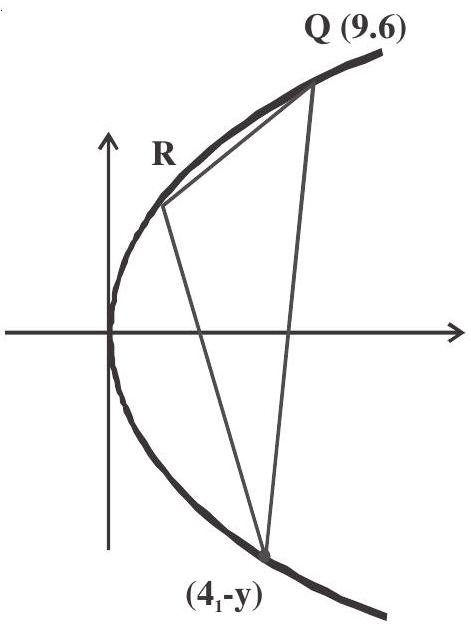
$=-5\left(\mathrm{t}^{2}-\mathrm{t}-6\right)=-5 \mathrm{t}-\frac{1}{2}^{2}+30+\frac{5}{4} \Rightarrow A=-5(t-1 / 2)^{2}+\frac{125}{4}$
Area is maximum when $\mathrm{t}=\frac{1}{2}$
Coordinates of $\mathrm{R} \frac{1}{4}, 1$
Answer: c
3. Minimum area of circle which touches the parabola’s $y=x^{2}+1$ and $y=x^{2}-1$ is
(a) $ \frac{9 \pi}{32}$ sq.unit
(b) $ \frac{\pi}{4}$ sq.unit
(c) $ \frac{7 \pi}{32}$ sq.unit
(d) $\frac{9 \pi}{16}$ sq.unit
Show Answer
Solution: $\mathrm{y}=\mathrm{x}^{2}+1$ and $\mathrm{y}^{2}=\mathrm{x}+1$ are symmetrical about $\mathrm{y}=\mathrm{x}$
tangent at point. $A$ and $B$ are parallel to the line $y=x$
$\mathrm{y}=\mathrm{x}^{2}+1$
$\frac{\mathrm{dy}}{\mathrm{dx}}=2 \mathrm{x}=1$
$\mathrm{x}=\frac{1}{2}$
$\mathrm{y}=\frac{5}{4}$ A $\frac{1}{2}, \frac{5}{4}$ B $\frac{5}{4}, \frac{1}{2}$
$\mathrm{AB}=\sqrt{\frac{1}{2}-\frac{5}{4}^{2}+\frac{5}{4}-\frac{1}{2}^{2}}=\frac{3 \sqrt{2}}{4}$
$ y^{2}=x-1 $
$\mathrm{y}=\frac{1}{2}$
$\mathrm{x}=\frac{5}{4} \quad \frac{\mathrm{m}^{2}}{4}$
Area of circle $=\pi \mathrm{r}^{2}=\pi{\frac{3 \sqrt{2}^{2}}{8}}^{2}=\frac{9 \pi}{32}$ sq.unit

Answer: a
4. The equation of the common tangents to the parabola $y=x^{2}$ and $y=-(x-2)^{2}$ is / are
(a) $y=4(x-1)$
(b) $y=0$
(c) $y=-4(x-1)$
(d) $y=-30 x-50$
Show Answer
Solution: Let $\mathrm{y}=\mathrm{mx}+\mathrm{c}$ is tangent to $\mathrm{y}=\mathrm{x}^{2}$
$\therefore \quad \mathrm{mx}+\mathrm{c}=\mathrm{x}^{2} \quad \mathrm{x}^{2}-\mathrm{mx}-\mathrm{c}=0$ has equal roots $\mathrm{m}^{2}+4 \mathrm{c}=0$
$\mathrm{y}=\mathrm{mx}-\quad$ is tangent to $\mathrm{y}=-(\mathrm{x}-2)^{2}$ also
$m x-\frac{m^{2}}{4}=-x^{2}+4 x-4$
$x^{2}+(m-4) x+4-\frac{m^{2}}{4}=0$ has equal roots
$ \therefore \quad(m-4)^{2}-4 $
$\mathrm{m}^{2}+16-8 \mathrm{~m}-16+\mathrm{m}^{2}=0$
$\mathrm{m}^{2}-4 \mathrm{~m}=0$
$\mathrm{m}=0,4$
Equation of tangent are $y=0$ and $y=4 x-4$
Answer: a, b
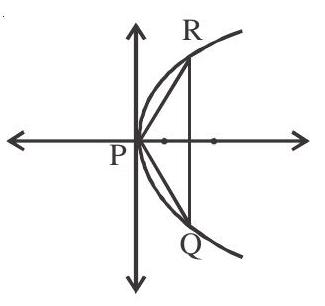
5. $(3,0)$ is the point from which three normals are drawn to the parabola $y^{2}=4 x$ which meet the parabola in the points $\mathrm{P}, \mathrm{Q}$ and $\mathrm{R}$ then
| Column I | Column II |
|---|---|
| i. Area of $\triangle \mathrm{PQR}$ | (a). $2$ |
| ii. Radius of circum circle of $\triangle \mathrm{PQR}$ | (b). $\frac{5}{2}, 4-\frac{m^2}{4}=0$ |
| iii. Centroid of $\triangle \mathrm{PQR}$ | (c). $\frac{5}{2},0$ |
| iv. Circum centre of $\triangle \mathrm{PQR}$ | (d) $\frac{2}{3}, 0$ |
Show Answer
Solution: Equation of normal is $y=m x-2 m-m^{3}$
It passes through $(3,0)$, so
Points are given by $\left(\mathrm{m}^{2},-2 \mathrm{~m}\right)$
$ \begin{aligned} & 3 \mathrm{~m}-2 \mathrm{~m}-\mathrm{m}^{3}=0 \\ & \mathrm{~m}\left(1-\mathrm{m}^{2}\right)=0 \\ & \mathrm{~m}=0,1,-1 \end{aligned} $
i.e. $\mathrm{P}(0,0), \mathrm{Q}(1,-2), \mathrm{R}(1,2)$
area of $\triangle \mathrm{PQR}=\frac{1}{2}\left|\begin{array}{ccc}0 & 0 & 1 \\ 1 & -2 & 1 \\ 1 & 2 & 1\end{array}\right|=2$ sq.units
$\mathrm{R}=\frac{\mathrm{abc}}{4 \Delta}=\frac{\sqrt{5} \cdot \sqrt{5} \cdot 4}{4 \cdot 2}=\frac{5}{2}$
Centroid $\triangle \mathrm{PQR}=\frac{2}{3}, 0$
Circum centre $\frac{5}{2},0$
Comprehension based Questions (Exampels 6 to 8)
Comprehension: 1
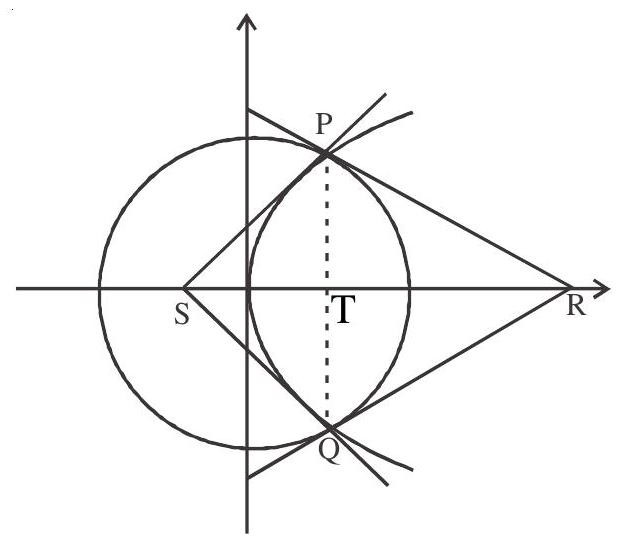
Consider the circle $\mathrm{x}^{2}+\mathrm{y}^{2}=9$ and the parabola $\mathrm{y}^{2}=8 \mathrm{x}$. They intersect at $\mathrm{P}$ and $\mathrm{Q}$ in the first and the fourth quadrants, respectively. Tangents to the circle at $P$ and $Q$ intersect the $x$-axis at $R$ and tangents to the parabola at $\mathrm{P}$ and $\mathrm{Q}$ intersect the $\mathrm{x}$-axis at $\mathrm{S}$.
6. The ratio of the area of the triangles $\mathrm{PQS}$ and $\mathrm{PQR}$ is
(a) $1: \sqrt{2}$
(b) $1: 2$
(c) $1: 4$
(d) $1: 8$
Show Answer
Solution: Point of intersection of circle & parabola
$\mathrm{x}^{2}+8 \mathrm{x}-9=0$
$(\mathrm{x}+9)(\mathrm{x}-1)=0$
$\mathrm{X}=1,-9$ (not possible)
$\mathrm{Y}= \pm \mathbf{2} \sqrt{2}$
$\mathrm{P}(1,2 \sqrt{2})$,
Q $(1,-2 \sqrt{2})$
Tangent to the parabola at $P$ is $2 \sqrt{2 y}=4(x+1)$
$\mathrm{S}(-1,0)$
Tangent to the circle at $P$ is $\quad x+2 \sqrt{2 y}=9$
$ \mathrm{R}(9, 0) $
$\frac{\operatorname{ar} \triangle \mathrm{PQS}}{\operatorname{ar} \triangle \mathrm{PQR}}=\frac{\frac{1}{2} \mathrm{xPQxST}}{\frac{1}{2} \mathrm{xPQxRT}}=\frac{\mathrm{ST}}{\mathrm{RT}}=\frac{2}{8}=\frac{1}{4}$
Answer: c
7. The radius of the circum circle of the triangle PRS is
(a) $5$
(b) $3 \sqrt{3}$
(c) $3 \sqrt{2}$
(d) $2 \sqrt{3}$
Show Answer
Solution: area $\triangle \mathrm{PRS}=\Delta=\frac{1}{2} \mathrm{xRR} \times \mathrm{PT}=\frac{1}{2} \times 10 \times 2 \sqrt{2}=10 \sqrt{2}$
$\mathrm{R}=\frac{\mathrm{abc}}{4 \Delta}=\frac{10 \cdot 6 \sqrt{2} \cdot 2 \sqrt{3}}{4 \cdot 10 \sqrt{2}}=3 \sqrt{3}$
Answer: b
8. The radius of the in circle of the triangle $\mathrm{PQR} $ is
(a) 4
(b) 3
(c) $\frac{8}{3}$
(d) 2
Show Answer
Solution: $\mathrm{r}=$
Answer: d
Comprehension based Questions (Exampels 9 to 11)
Comprehension: 2
If $y=x$ is tangent to the parabola $y=a x^{2}+c$
9. If $a=2$, then the value of $c$ is
(a) $\frac{1}{2}$
(b) $\frac{1}{4}$
(c) $\frac{1}{8}$
(d) $1$
10. If $(1,1)$ is point of contact then ’ $a$ ’ is
(a) $1$
(b) $\frac{1}{2}$
(c) $\frac{1}{3}$
(d) $\frac{1}{4}$
11. If $c=2$ then point of contact is
(a) $(4,4)$
(b) $(2,2)$
(c) $(8,8)$
(d) $\frac{1}{2}, \frac{1}{2}$
Show Answer
Solution:
9. $\mathrm{y}=\mathrm{ax}^{2}+\mathrm{c}$
$ \begin{aligned} & \frac{\mathrm{dy}}{\mathrm{dx}}=2 \mathrm{ax}=1 \Rightarrow x=\frac{1}{2 a} \text { Point of contact of the tangent is }\left(\frac{1}{2 \mathrm{a}}, \frac{1}{4 \mathrm{a}}+\mathrm{c}\right) \text { since it lies on } \mathrm{y}=\mathrm{x} \\ & \therefore \quad \text { thus } \mathrm{c}=\frac{1}{8} \text { for } \mathrm{a}=2 \end{aligned} $
Answer: c
10. If $(1,1)$ is point of contact then $a=\frac{1}{2}$
Answer: a
11. If $\mathrm{c}=2$, then point of contact is $\left(\frac{1}{2 \mathrm{a}}, \frac{1}{4 \mathrm{a}}+2\right)$
Since it lies on the line $y=x$,
$\frac{1}{2 a}=\frac{1}{4 a}+2 \Rightarrow a=\frac{1}{8}$
$\therefore \quad$ point of contact is $(4,4)$
Answer: b
Practice questions
1. The point $\mathrm{P}$ on the parabola $\mathrm{y}^{2}=4 \mathrm{ax}$ for which $|\mathrm{PR}-\mathrm{PQ}|$ is maximum, where $\mathrm{R}(-\mathrm{a}, 0), \mathrm{Q}(0, \mathrm{a})$ is
(a) $(4 a,-4 a)$
(b) $(4 a, 4 a)$
(c) $(a, 2 a)$
(d) $(\mathrm{a},-2 \mathrm{a})$
Show Answer
Answer: (c)2. The shortest distance between the parabola $y^{2}=4 x$ and the circle $x^{2}+y^{2}+6 x-12 y+20=0$ is
(a) $4 \sqrt{2}-5$
(b) $4 \sqrt{2}+5$
(c) $3 \sqrt{2}+5$
(d) $3 \sqrt{2}-5$
Show Answer
Answer: (a)3. If normals are drawn from a point $p(h, k)$ to the parabola $y^{2}=4 a x$, then the sum of the intercepts which the normals act off from the axis of the parabola is
(a) $4(\mathrm{~h}+0)$
(b) $3(\mathrm{~h}+\mathrm{c})$
(c) $2(\mathrm{~h}+\mathrm{a})$
(d) $(h+a)$
Show Answer
Answer: (c)4. If $a \neq 0$ and the line $2 p x+3 q y+4 r=0$ passes through the points of intersection of the parabolas $y^{2}=4 a x$ and $x^{2}=4 a y$, then
(a) $\mathrm{r}^{2}+(3 \mathrm{p}+2 \mathrm{q})^{2}=0$
(b) $ r^{2}+(2 p+3 q)^{2}=0$
(c) $ r^{2}+(3 p-2 q)^{2}=0$
(d) $ r^{2}+(2 p-2 q)^{2}=0$
Show Answer
Answer: (b)5. The equation of the tangent at the vertex of the parabola $x^{2}+4 x+2 y=0$ is
(a) $x=2$
(b) $\mathrm{x}=-2$
(c) $y=-2$
(d) $y=2$
Show Answer
Answer: (d)6. The common tangent to the parabolas $y^{2}=4 a x$ and $x^{2}=4 a x$ and $x^{2}=32 a y$ is
(a) $x+2 y-4 a=0$
(b) $x+2 y+4 a=0$
(c) $x-2 y+4 a=0$
(d) $x-2 y-4 a=0$
Show Answer
Answer: (b)7. The shortest distnae between the parabolas $y^{2}=4 x$ and $y^{2}=2 x-6$ is
(a) $\sqrt{5}$
(b) $2$
(c) $3$
(d) none of these
Show Answer
Answer: (a)8. The largest value of a for which the circle $x^{2}+y^{2}=a^{2}$ falls totally in the interior of the parabola $y^{2}=4(x+4)$ is
(a) 4
(b) $4 \sqrt{3}$
(c) $3 \sqrt{3}$
(d) $2 \sqrt{3}$
Show Answer
Answer: (d)Multiple choice questions with one or more than one correct answer.
9. Let $P\left(x _{1}, y _{1}\right)$ and $Q\left(x _{2}, y _{2}\right), y _{1}<0, y _{2}, 0$, be the end points of the latus rectum of the ellipse $x^{2}+4 y=4$. The equations of parabolas with latus rectum $\mathrm{PQ}$ are
(a) $x^{2}+2 \sqrt{3} y=3+\sqrt{3}$
(b) $x^{2}-2 \sqrt{3} y=3+\sqrt{3}$
(c) $x^{2}+2 \sqrt{3} y=3-\sqrt{3}$
(d) $x^{2}-2 \sqrt{3} y=3-\sqrt{3}$
Show Answer
Answer: (b, c)10. The tangent $\mathrm{PT}$ and the normal $\mathrm{PN}$ to the parabola $\mathrm{y}^{2}=4 \mathrm{ax}$ at a point $\mathrm{P}$ on it meet its axis at point $\mathrm{T}$ and N, respectively. The locus of the centroid of the triangle PTN is a parabola whose
(a) vertex is $\left(\frac{2 \mathrm{a}}{3}, 0\right)$
(b) directrix is $x=0$
(c) latus rectum is $\frac{2 \mathrm{a}}{3}$
(d) focus is $(a, 0)$
Show Answer
Answer: (a, d)Match the following :
11. Consider the parabola $\mathrm{y}^{2}=12 \mathrm{x}$
| Column I | Column II |
|---|---|
| A. Equation of tangent can be | p. $2 x+y-6=0$ |
| B. Equation of normal can be | q. $x-2 y-12=0$ |
| C. Equation of chord of contact w.r.t. any point on the directrix | r. $2 x-y=36$ |
| D. Equation of chord which subtends right angle at the vertex | s. $ 3 x-y+1=0$ |
Show Answer
Answer: A $\rarr$ s, B $\rarr$ r, C $\rarr$ p, D $\rarr$ qAssertion and Reasoning
12. Statement 1 : The curve $y=-\frac{x^{2}}{2}+x+1$ is symmetric with respect to the line $x=1$.
Statement 2 : A parabola is symmetric about its axis.
(A) Statement 1 is True, Statement 2 is True; Statement 2 is a correct explanations for statement 1.
(B) Statement 1 is True, statement 2 is true, statement 2 is not a correct explanation for statement 1 .
(C) Statement 1 is true, statement 2 is false.
(D) Statement 1 is false, statement 2 is true.
 BETA
BETA


