PARABOLA-9
Exercises
1. A tangent PT is drawn at the point $\mathrm{P}(16,16)$ to the parabola $\mathrm{y}^{2}=16 \mathrm{x}$. PT tangent intersect the $\mathrm{x}$-axis at $\mathrm{T}$. If $\mathrm{S}$ be the focus of the parabola, then $\angle \mathrm{TPS}$ is equal to
(a). $\tan ^{-1} \frac{1}{2}$
(b). $\frac{\pi}{4}$
(c). $\frac{1}{2} \tan ^{-1} \frac{1}{2}$
(d). $\tan ^{-1} \frac{3}{4}$
Show Answer
Solution: $\mathrm{ST}=4+\mathrm{AT}=16+4=20$
$\mathrm{PS}=4+16=20$
$\Delta$ TPS is isosceles triangle
$\tan 2 \theta=\frac{16-0}{16-4}=\frac{4}{3}=\frac{2 \tan \theta}{1-\tan ^{2} \theta}$
$2 \tan ^{2} \theta+3 \tan \theta-2=0$
$(2 \tan \theta-1)(\tan \theta+2)=0$
$\tan \theta=\frac{1}{2}, \quad \tan \theta=-2 \quad$ (Not possible)
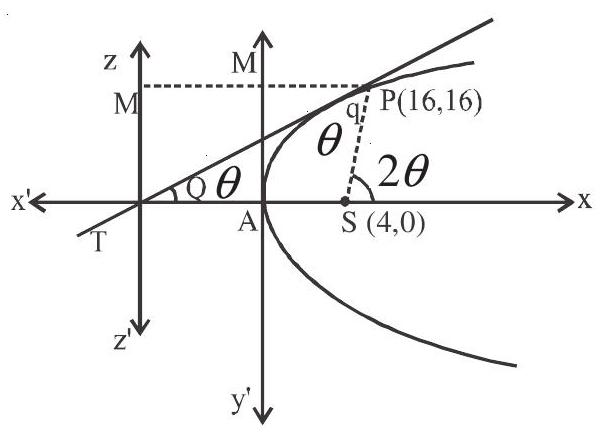
$\theta=\tan ^{-1} \frac{1}{2}\quad$ ( $\theta$ is acute angle)
Answer: a
2. If a, b, $c$ are distinct positive real numbers such that the parabolas $y^{2}=4 a x$ and $y^{2}$ $=4 \mathrm{c}(\mathrm{x}-\mathrm{b})$ will have a common normal, then
(a). $0<\frac{\mathrm{b}}{\mathrm{a}-\mathrm{c}}<1$
(b). $ \frac{b}{a-c}<0$
(c). $ 1<\frac{\mathrm{b}}{\mathrm{a}-\mathrm{c}}<2$
(d). $\frac{b}{a-c}>2$
Show Answer
Solution: Equation of normals are
$\begin{aligned} & y=m x-2 a m-a m^3……..(1) \\ & y=m(x-b)-2 c m-c m^3….(2)\end{aligned}$
Equation 1 and 2 are identical then
$ \begin{aligned} & -2 a m-a m^{3}=-b m-2 c m-c m^{3} \\ & 2 a+a m^{2}=b+2 c+c m^{2} \\ & (a-c) m^{2}=b+2(c-a) \\ & m^{2}=\frac{b}{a-c}-2 \\ & m= \pm \sqrt{\frac{b}{a-c}-2} \end{aligned} $
For $m$ be real $\frac{b}{a-c}>2$
Answer: d
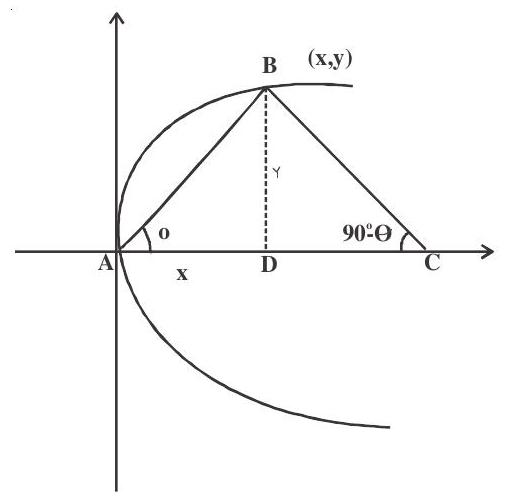
3. If $\mathrm{AB}$ be a chord of the parabola $\mathrm{y}^{2}=4 \mathrm{ax}$ with vertex at $\mathrm{A}$. $\mathrm{BC}$ is perpendicular to $\mathrm{AB}$ such that it meets the axis at $\mathrm{C}$. The projection of the $\mathrm{BC}$ on the axis of parabola is
(a). $2 \mathrm{a}$
(b). $4 \mathrm{a}$
(c). $8 \mathrm{a}$
(d). $16 \mathrm{a}$
Show Answer
Solution: Let coordinates of B be ( $\mathrm{x}, \mathrm{y})$
In $\triangle \mathrm{ABD}, \tan \theta=\frac{\mathrm{BD}}{\mathrm{AD}}=\frac{\mathrm{y}}{\mathrm{x}}$
In $\triangle \mathrm{BCD}, \tan (90-\theta)=\frac{\mathrm{BD}}{\mathrm{DC}}$
$\therefore \mathrm{DC}=\mathrm{y} \cdot \frac{\mathrm{y}}{\mathrm{x}}=\frac{4 \mathrm{ax}}{\mathrm{x}}=4 \mathrm{a}$
Answer: b
4. A circle is descirbed whose centre is the vertex and whose diameter is three-quarters of the latus rectum of the parabola $\mathrm{y}^{2}=4 \mathrm{ax}$. If $\mathrm{PQ}$ is the common-chord of the circle and the parabola and $\mathrm{L} _{1} \mathrm{~L} _{2}$ is the latus rectum, then the area of the trapezium $\mathrm{PL} _{1} \mathrm{~L} _{2} \mathrm{Q}$ is
(a). $\frac{2+\sqrt{2}}{2} a^{2}$
(b). $4 a^{2}$
(c). $2 \sqrt{2}^{2}$
(d). $3 \sqrt{2} \mathrm{a}^{2}$
Show Answer
Solution: Centre of circle $(0,0)$
diameter $=\frac{3}{4} \cdot 4 \mathrm{a}=3 \mathrm{a}$
$\mathrm{Eq}^{\mathrm{n}}$ of circle $\mathrm{x}^{2}+\mathrm{y}^{2}=\frac{9 \mathrm{a}^{2}}{4}…..(1)$
$\mathrm{Eq}^{\mathrm{n}}$ of parabola $\mathrm{y}^{2}=4 \mathrm{ax}……(2)$
coordinates of $\mathrm{P}$ and $\mathrm{Q}$, we get after solving (1) and (2).
$ \begin{aligned} x^{2}+4 a x=\frac{9 a^{2}}{4} & \\ (x+2 a)^{2}=\frac{5 a}{2}^{2} \quad x & =-2 a \pm \frac{5 a}{2} \\ & x=\frac{a}{2}, \frac{-9 a}{2}(\text { not possible }) \end{aligned} $
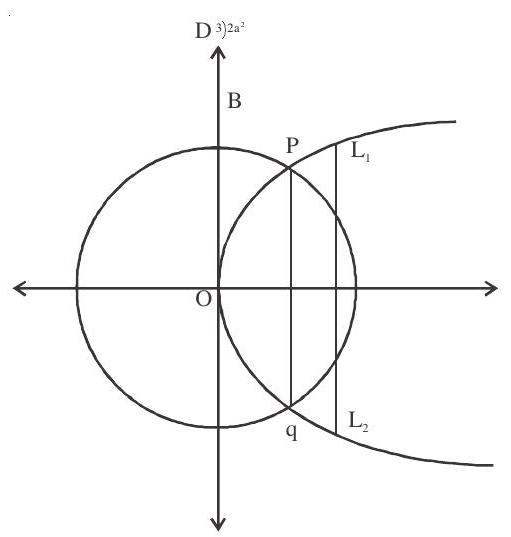 $P \frac{a}{2}, \sqrt{2} a, Q \frac{a}{2},-\sqrt{2} a \quad y= \pm \sqrt{2} a$
$\mathrm{PQ}=2 \sqrt{2} \mathrm{a}, \quad \mathrm{L} _{1} \mathrm{~L} _{2}=4 \mathrm{a}$
Area of trapezium $\quad=\frac{1}{2}\left(\mathrm{PQ}+\mathrm{L} _{1} \mathrm{~L} _{2}\right) \mathrm{x}$ distance between them.
$ \begin{aligned} & =\frac{1}{2}(2 \sqrt{2} a+4 a) \times a-\frac{a}{2} \\ & =\frac{(\sqrt{2}+2)}{2} a^{2} \end{aligned} $
Answer: a
5. From the point $(15,12)$ three normals ae drawn to the parabola $y^{2}=4 x$, then centroid of triangle formed by three co-normal points is
(a). $(5,0)$
(b). $(5,4)$
(c). $(9,0)$
(d). $\frac{26}{3}, 0$
Show Answer
Solution: Let equation of normal be $\mathrm{y}=-\mathrm{tx}+2 \mathrm{t}+\mathrm{t}^{3}$
It passes through $(15,12)$. So $12=-15 t+2 t+t^{3}$
$ \begin{aligned} & t^{3}-13 t-12=0 \\ & (t+1)(t+3)(t-4)=0 \\ & t=-1,-3,4 \end{aligned} $
Points are (at ${ }^{2}$, 2at) i.e. $(1,-2),(9,-6),(16,8)$
Centroid is $\frac{1+9+16}{3}, \frac{-2-6+8}{3}=\frac{26}{3}, 0$
Answer: d
6. Aray of light travels along a line $\mathrm{y}=4$ and strikes the surface of a curve $y^{2}=4(x+y)$ then equation of the line along reflected ray travel is
(a). $x+1=0$
(b). $\mathrm{y}-2=0$
(c). $\mathrm{x}=0$
(d). $\mathrm{x}-2=0$
Show Answer
Solution: $y^{2}-4 y=4 x$
$(\mathrm{y}-2)^{2}=4(\mathrm{x}+1)$
Focus $(0,2)$
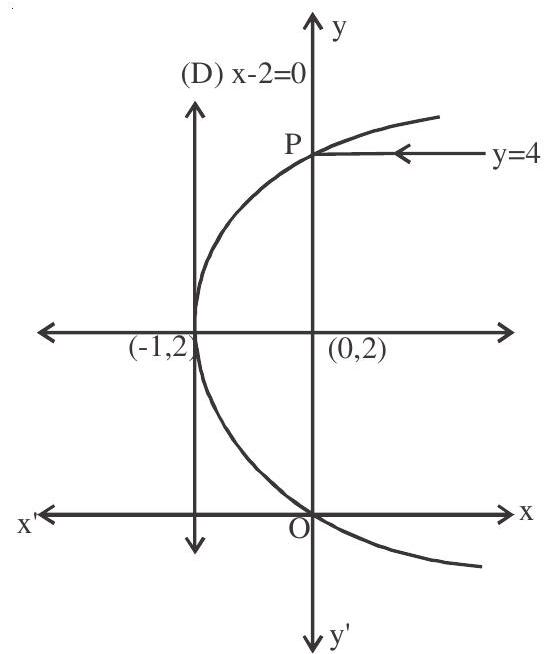
Incident ray is parallel to axis of the parabola, so reflected ray passes through focus $(0,2)$ i.e. $x=0$
Answer: c
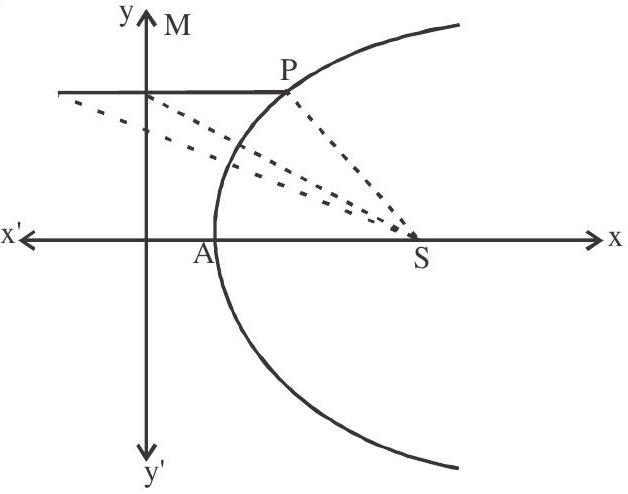
7. Let $\mathrm{P}$ be a point of the parabola $\mathrm{y}^{2}=3(2 \mathrm{x}-3)$ and $\mathrm{M}$ is the foot of perpendicular drawn from
Pon the directrix of the parabola, then length of each side of an equilateral triangle SMP, where S is focus of the parabola is
(a). 6
(b). 8
(c). 10
(d). 11
Show Answer
Solution: Equation of parabola is
$\mathrm{y}^{2}=6 \quad \mathrm{x}-\frac{3}{2}$
focus $S(3,0)$
equation of directrix $x=0$
P $\frac{3}{2}+\frac{3}{2} \mathrm{t}^{2}, 3 \mathrm{t}$
Coordinates of $\mathrm{M}(0,3 \mathrm{t})$
$\mathrm{MS}=\sqrt{9+9 \mathrm{t}^{2}}$
$\mathrm{MP}=\frac{3}{2}+\frac{3}{2} \mathrm{t}^{2}$, But MS $=\mathrm{MP}$
$9+9 \mathrm{t}^{2}=\frac{9}{4}+\frac{9}{4} \mathrm{t}^{2}+\frac{9}{4} \mathrm{t}^{2}$
$\mathrm{t}^{2}=3$
Length of side $=6$
Answer: a
Practice questions
1. The point $(2 a, a)$ lies inside the region bounded by the parabola $x^{2}=4 y$ and its latus rectum. Then
(a). $0<\mathrm{a} \leq 1$
(b). $ 0<\mathrm{a}<1$
(c). $0 \leq \mathrm{a} \leq 1$
(d). $ \mathrm{a}<1$
Show Answer
Answer: (b)2. Two perpendicular tangents to $y^{2}=4 a x$ always intersect on the line
(a). $x+a=0$
(b). $\mathrm{x}-\mathrm{a}=0$
(c). $x+2 a=0$
(d). $y+2 a=0$
Show Answer
Answer: (a)3. $\mathrm{C} _{1}: \mathrm{y}^{2}=8 \mathrm{x}$ and $\mathrm{C} _{2}: \mathrm{x}^{2}+\mathrm{y}^{2}=2$. Then
(a). $\mathrm{C} _{1}$ and $\mathrm{C} _{2}$ have only two common tangents which are mutually perpendicular
(b). $\mathrm{C} _{1}$ and $\mathrm{C} _{2}$ have two common tangents which are parallel to each other.
(c). does not have any common tangent.
(d). $\mathrm{C} _{1}$ and $\mathrm{C} _{2}$ have four common tangents.
Show Answer
Answer: (a)4. Two common tangents to the circle $x^{2}+y^{2}=2 a^{2}$ and $y^{2}=8 a x$ are
(a). $y=(x+a)$
(b). $x= \pm(y+2 a)$
(c). $y= \pm(x+2 a)$
(d). $x= \pm(y+a)$
Show Answer
Answer: (c)5. The number of points with integral coordinates that lie in the interior of the circle $x^{2}+y^{2}=16$ and the parabola $\mathrm{y}^{2}=4 \mathrm{x}$ are
(a). 6
(b). 8
(c). 10
(d). 12
Show Answer
Answer: (b)6. The vertex of the parabola $x^{2}+y^{2}-2 x y-4 x+4=0$ is at
(a). $\left(-\frac{1}{2},-\frac{1}{2}\right)$
(b). $(-1,-1)$
(c). $(1,1)$
(d). $\left(+\frac{1}{2}, \frac{1}{2}\right)$
Show Answer
Answer: (d)7. The length of the latus rectum of the parabola $2\left\{(x-a)^{2}+(y-a)^{2}\right\}=(x+y)^{2}$ is
(a). $\sqrt{2}$ a
(b). $ 2 \mathrm{a}$
(c). $ 2 \sqrt{2}$ a
(d). $3 \sqrt{2} \mathrm{a}$
Show Answer
Answer: (c)8. The point on $y^{2}=4 a x$ nearest to the focus is
(a). $(0,0)$
(b). $(\mathrm{a}, 2 \mathrm{a})$
(c). $(a,-2 a)$
(d). $\left(\frac{a}{4}, a\right)$
Show Answer
Answer: (a)9. The angle between the tangents drawn from the origin to the parabola $y^{2}=4 a(x-a)$ is
(a). $45^{\circ}$
(b). $60^{\circ}$
(c). $90^{\circ}$
(d). $\tan ^{-1} \frac{1}{2}$
Show Answer
Answer: (c)10. The circle $x^{2}+y^{2}+2 \lambda x=0, \lambda \varepsilon R$, touches the parabola $y^{2}=4 x$ externally. Then
(a). $\lambda>0$
(b). $\lambda<0$
(c). $\lambda>1$
(d). none of these
 BETA
BETA


