SEQUENCES AND SERIES - 7 (Sequences and Series - Problem Solving)
Some important Logarithmic and Exponential formulae
1. $\quad$ If $\mathrm{a}^{\mathrm{x}}=\mathrm{y}$, then $\mathrm{x}=\log _{\mathrm{a}} \mathrm{y}$
2. $\quad \log _{\mathrm{a}} \mathrm{a}=1 \& \log _{\mathrm{a}} 1=0$
3. $\quad \mathrm{a}^{\log _{\mathrm{a}} \mathrm{n}}=\mathrm{n}$
4. $\quad \log _{\mathrm{a}} \mathrm{mn}=\log _{\mathrm{a}} \mathrm{m}+\log _{\mathrm{a}} \mathrm{n}$
5. $\quad \log _{a}\left(\frac{m}{n}\right)=\log _{a} m-\log _{a} n$
6 $\quad \log _{\mathrm{a}} \mathrm{m}^{\mathrm{n}}=\mathrm{n} \log _{\mathrm{a}} \mathrm{m}$
7. $\quad \log _{\mathrm{b}} \mathrm{a}=\frac{\log _{\mathrm{c}} \mathrm{a}}{\log _{\mathrm{c}} \mathrm{b}}$
8. $\quad \log _{a^{n}} a^{m}=\frac{m}{n}$
9. $\quad \log _{\mathrm{b}} \mathrm{a}=\frac{1}{\log _{\mathrm{a}} \mathrm{b}}$
10. $\quad \log _{e}(1+x)=x-\frac{x^{2}}{2}+\frac{x^{3}}{3}-\frac{x^{4}}{4}+\ldots \ldots \ldots \ldots$
11. $\quad \log _{e}(1-x)=-x-\frac{x^{2}}{2}-\frac{x^{3}}{3}-\frac{x^{4}}{4}$
12. $\quad \log _{e}(1+x)(1-x)=\log _{e}\left(1-x^{2}\right)=-2\left(\frac{x^{2}}{2}+\frac{x^{4}}{4}+\frac{x^{6}}{6}+\ldots \ldots \ldots \ldots . ..\right)$
13. $\quad \log _{e}\left(\frac{1+x}{1-x}\right)=2\left(x+\frac{x^{3}}{3}+\frac{x^{5}}{5}+\ldots \ldots \ldots \ldots \ldots \ldots . . . .\right.$.
14. $\quad \log _{\mathrm{e}} 2=1-\frac{1}{2}+\frac{1}{3}-\frac{1}{4}……..$
15. $\quad \mathrm{e}^{\mathrm{x}}=1+\frac{\mathrm{x}}{1 !}+\frac{\mathrm{x}^{2}}{2 !}+\frac{\mathrm{x}^{3}}{3 !}+………$
16. $\quad \mathrm{e}^{\mathrm{x}}+\mathrm{e}^{-\mathrm{x}}=2\left(1+\frac{\mathrm{x}^{2}}{2 !}+\frac{\mathrm{x}^{4}}{4 !}+\ldots \ldots \ldots \ldots\right)$
17. $\quad e^{x}-e^{-x}=2\left(\frac{x}{1 !}+\frac{x^{3}}{3 !}+\frac{x^{5}}{5 !} \ldots \ldots \ldots \ldots . ..\right)$
18. $\quad \mathrm{e}=1+\frac{1}{1 !}+\frac{1}{2 !}+\frac{1}{3 !}+………$
$\quad\mathrm{e}$ is an irrational number $\&$ it lies between $2 \& 3 . \mathrm{e} \cong 2.7183$
19. $\quad a^{y}=e^{y \log _{e} a}=1+y\left(\log _{e} a\right)+\frac{y^{2}}{2 !}\left(\log _{e} a\right)^{2}+\frac{y^{3}}{3 !}\left(\log _{e} a\right)^{3}+………$
20. $\quad \log _{2} \log _{2} \sqrt{\sqrt{\sqrt{\sqrt{\ldots \ldots \ldots \ldots \ldots . . . \sqrt{2}}}}}=\mathrm{n}$ where $\mathrm{n}$ is the number of square roots
21. $\quad \mathrm{a}^{\sqrt{\log _{\mathrm{a}} \mathrm{b}}}=\mathrm{b}^{\sqrt{\log _{\mathrm{b}} \mathrm{a}}}$
Vn-Method
(i) To find the sum of series of the form
$\frac{1}{\mathrm{a} _{1} \mathrm{a} _{2} \ldots \ldots \ldots \ldots \mathrm{a} _{\mathrm{r}}}+\frac{1}{\mathrm{a} _{2} \mathrm{a} _{3} \ldots \ldots \ldots \ldots \mathrm{a} _{\mathrm{r}+1}}+\ldots \ldots \ldots \ldots \ldots \ldots+\frac{1}{\mathrm{a} _{\mathrm{n}} \mathrm{a} _{\mathrm{n}+1} \ldots \ldots \ldots \ldots \mathrm{a} _{\mathrm{n}+\mathrm{r}-1}}$ where $\mathrm{a} _{1}, \mathrm{a} _{2}$,
$\left( \text { Here }T_{n}=\frac{1}{a _{n} a _{n+1} \ldots \ldots \ldots \ldots a _{n+r-1}}\right)$
……..are in A.P. Let $V _{n}=\frac{1}{a _{n+1} a _{n+2} \ldots \ldots \ldots . a _{n+r-1}}$ (avoiding first term for $V _{n}$ ie $a _{n}$ in $T _{n}$ )
$\mathrm{T} _{\mathrm{n}}=\frac{-1}{\mathrm{~d}(\mathrm{r}-1)}\left(\mathrm{V} _{\mathrm{n}}-\mathrm{V} _{\mathrm{n}-1}\right)=\frac{1}{\mathrm{~d}(\mathrm{r}-1)}\left(\mathrm{V} _{\mathrm{n}-1}-\mathrm{V} _{\mathrm{n}}\right)$
put $\mathrm{n}=1,2,3 \ldots \ldots \ldots \ldots . . \mathrm{n}$ and add to get $\mathrm{S} _{\mathrm{n}}$.
$\mathrm{S} _{\mathrm{n}}=\mathrm{T} _{1}+\mathrm{T} _{2}+\ldots \ldots . \mathrm{T} _{\mathrm{n}}=\frac{1}{\mathrm{~d}(\mathrm{r}-1)}\left(\mathrm{V} _{0}-\mathrm{V} _{\mathrm{n}}\right)$
$ =\frac{1}{d(r-1)}\left(\frac{1}{a _{1} a _{2} \ldots \ldots . a _{r-1}}-\frac{1}{a _{n+1} a _{n+2} \ldots \ldots a _{n+r-1}}\right) $
Eg. (a) $\quad \frac{1}{1.2 .3}+\frac{1}{2.3 .4}+\ldots \ldots \ldots \ldots \ldots+\frac{1}{n(n+1)(n+2)}=\frac{1}{1 .(3-1)}\left(\frac{1}{1.2}-\frac{1}{(n+1)(n+2)}\right)$
$=\frac{1}{4}-\frac{1}{2(\mathrm{n}+1)(\mathrm{n}+2)}$
(b) $\quad \frac{1}{1 \cdot 2 \cdot 3.4}+\frac{1}{2 \cdot 3 \cdot 4.5}+\ldots \ldots \ldots . \frac{1}{\mathrm{n}(\mathrm{n}+1)(\mathrm{n}+2)(\mathrm{n}+3)}$
$ =\frac{1}{1 .(4-1)}\left(\frac{1}{1.2 \cdot 3}-\frac{1}{(n+1)(n+2)(n+3)}\right) $
(ii) Summation of series of the form $\mathrm{a} _{1} \mathrm{a} _{2} \ldots \ldots \mathrm{a} _{\mathrm{r}}+\mathrm{a} _{2} \mathrm{a} _{3} \ldots \ldots . \mathrm{a} _{\mathrm{r}+1}+$. $\mathrm{a} _{1}, \mathrm{a} _{2} \ldots . .$. are in A.P
Here $T _{n}=a _{n} a _{n+1} \cdots \cdots \ldots . a _{n+r-1}$
Let $V _{n}{ } _{n}=a _{n} a _{n+1} \cdots \ldots \ldots \ldots \ldots a _{n-r+1} a _{n-r}\left(\right.$ Take one term extra in $T _{n}$ for $\left.V _{n}\right)$
$\mathrm{T} _{\mathrm{n}}=\frac{1}{(\mathrm{r}+1) \mathrm{d}}\left(\mathrm{V} _{\mathrm{n}}-\mathrm{V} _{\mathrm{n}-1}\right)$.
Put $\mathrm{n}=1,2,3 \ldots \ldots .$. and add to get $\mathrm{S} _{\mathrm{n}}$
$S _{n}=T _{1}+T _{2}+\ldots \ldots \ldots \ldots+T _{n}=\frac{1}{d(r+1)}\left(V _{n}-V _{0}\right)=\frac{1}{d(r+1)}\left(a _{n} a _{n+1} \ldots \ldots \ldots . a _{n+r}-a _{0} a _{1} a _{2} \ldots \ldots \ldots \ldots a _{r}\right)$ where $\mathrm{a} _{0}=\mathrm{a} _{1}-\mathrm{d}$
Eg (a) $\quad 1.2+2.3+\ldots \ldots \ldots \ldots \ldots \ldots . .+\mathrm{n}(\mathrm{n}+1)=\frac{1}{1 .(2+1)}((\mathrm{n}+1)(\mathrm{n}+2)-0.1 .2)=\frac{\mathrm{n}(\mathrm{n}+1)(\mathrm{n}+2)}{3}$
(b) $\quad 1.2 .3 .4+2.3 .4 .5+$ $+\mathrm{n}(\mathrm{n}+1)(\mathrm{n}+2)(\mathrm{n}+3)$
$ \begin{aligned} & =\frac{1}{1 .(4+1)}(\mathrm{n}(\mathrm{n}+1)(\mathrm{n}+2)(\mathrm{n}+3)(\mathrm{n}+4)-0 \cdot 1 \cdot 2 \cdot 3 \cdot 4) \\ & =\frac{1}{5} \mathrm{n}(\mathrm{n}+1)(\mathrm{n}+2)(\mathrm{n}+3)(\mathrm{n}+4) \end{aligned} $
Solved examples
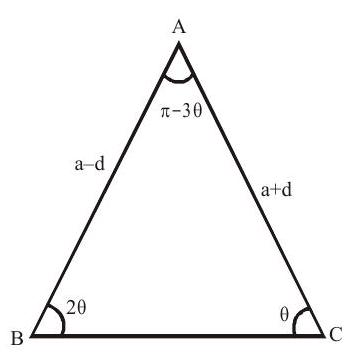
1. If the sides of a triangle are in A.P and the greatest angle of the triangle is double the smallest, then the ratio of sides of the triangle is
(a) $3: 4: 5$
(b) $4: 5: 6$
(c) $5: 6: 7$
(d) None of these
Show Answer
Solution :
Applying sine rule, we have
$\frac{\mathrm{a}-\mathrm{d}}{\sin \theta}=\frac{\mathrm{a}}{\sin (\pi-3 \theta)}=\frac{\mathrm{a}+\mathrm{d}}{\sin 2 \theta}$
$\Rightarrow \frac{\mathrm{a}-\mathrm{d}}{\sin \theta}=\frac{\mathrm{a}}{3 \sin \theta-4 \sin ^{3} \theta}=\frac{\mathrm{a}+\mathrm{d}}{2 \sin \theta \cos \theta}$
$\Rightarrow \frac{\mathrm{a}-\mathrm{d}}{1}=\frac{\mathrm{a}}{3-4 \sin ^{2} \theta}=\frac{\mathrm{a}+\mathrm{d}}{2 \cos \theta}$ gives $\cos \theta=\frac{\mathrm{a}+\mathrm{d}}{2(\mathrm{a}-\mathrm{d})}$
Also, $3-4 \sin ^{2} \theta=\frac{a}{a-d}$
$\Rightarrow 3-4\left(1-\cos ^{2} \theta\right)=\frac{a}{a-d}$ gives $-1+\left(\frac{a+d}{a-d}\right)^{2}=\frac{a}{a-d}$
$\Rightarrow \frac{4 \mathrm{ad}}{\mathrm{a}-\mathrm{d}}=\mathrm{a} \Rightarrow 4 \mathrm{ad}=\mathrm{a}^{2}-\mathrm{ad}$ gives $\mathrm{a}=5 \mathrm{~d}$
$\therefore$ sides $\mathrm{a}-\mathrm{d}: \mathrm{a}: \mathrm{a}+\mathrm{d}$
$5 \mathrm{~d}-\mathrm{d}: 5 \mathrm{~d}: 5 \mathrm{~d}+\mathrm{d}=4: 5: 6$
Answer: (b)
2. The sum of
$\frac{3}{1.2} \cdot \frac{1}{2}+\frac{4}{2.3}\left(\frac{1}{2}\right)^{2}+\frac{5}{3.4} \cdot\left(\frac{1}{2}\right)^{3}+\ldots \ldots \ldots \ldots . . \mathrm{n}$ terms is
(a) $1-\frac{1}{(\mathrm{n}+1) 2^{\mathrm{n}}}$
(b) $1-\frac{1}{\mathrm{n} \cdot 2^{\mathrm{n}-1}}$
(c) $1+\frac{1}{(\mathrm{n}+1) 2^{\mathrm{n}}}$
(d) None of these
Show Answer
Solution :
$\mathrm{T} _{\mathrm{n}}=\frac{\mathrm{n}+2}{\mathrm{n} \cdot(\mathrm{n}+1)} \cdot \frac{1}{2^{\mathrm{n}}}=\left(\frac{2}{\mathrm{n}}-\frac{1}{\mathrm{n}+1}\right) \cdot \frac{1}{2^{\mathrm{n}}}$
$\Rightarrow \mathrm{T} _{\mathrm{n}}=\frac{1}{\mathrm{n} \cdot 2^{\mathrm{n}-1}}-\frac{1}{(\mathrm{n}+1) \cdot 2^{\mathrm{n}}}$
Putting $\mathrm{n}=1,2,3,…………,n$
$\therefore \mathrm{T} _{1}=\frac{1}{1.2^{0}}-\frac{1}{2.2^{1}}$
$\mathrm{T} _{2}=\frac{1}{2.2^{1}}-\frac{1}{3.2^{2}}$
$\mathrm{T} _{3}=\frac{1}{3.2^{2}}-\frac{1}{4.3^{2}}$
$\hspace{1cm}.$
$\hspace{1cm}.$
$\hspace{1cm}.$
$\mathrm{T} _{\mathrm{n}}=\frac{1}{\mathrm{n} \cdot 2^{\mathrm{n}-1}}-\frac{1}{(\mathrm{n}+1) 2^{\mathrm{n}}}$
Adding , $\mathrm{T} _{1}+\mathrm{T} _{2}+\mathrm{T} _{3}+\ldots \ldots \ldots+\mathrm{T} _{\mathrm{n}}=\mathrm{S} _{\mathrm{n}}$
$\mathrm{S} _{\mathrm{n}}=1-\frac{1}{(\mathrm{n}+1) 2^{\mathrm{n}}}$
Answer: (a)
3. Coefficient of $x^{49}$ in the expansion of $(x-1)(x-3)(x-5)……….(x-99)$ is
(a) $-99^{2}$
(b) $1$
(c) $-2500$
(d) None of these
Show Answer
Solution :
$(\mathrm{x}-1)(\mathrm{x}-3)(\mathrm{x}-5)…….. (x-99)$
$=\mathrm{x}^{50}-\mathrm{S} _{1} \mathrm{x}^{49}+\mathrm{S} _{2} \mathrm{x}^{48}……..$
$\therefore$ Coefficient of $\mathrm{x}^{49}$ is $-\mathrm{S}_{1}$
$=\quad-(1+3+5+\ldots \ldots+99)=-\frac{50}{2}(1+99)=-50^{2}=-2500$
Answer: (c)
4. The coefficients of $x^{15}$ in the product
$(1-\mathrm{x})(1-2 \mathrm{x})\left(1-2^{2} \mathrm{x}\right) ………\left(1-2^{15} x\right)$ is
(a) $2^{105}-2^{121}$
(b) $2^{121}-2^{105}$
(c) $2^{120}-2^{104}$
(d) None of these
Show Answer
Solution :
$(1-\mathrm{x})(1-2 \mathrm{x})\left(1-2^{2} \mathrm{x}\right)$.
$=(-1)^{16}(\mathrm{x}-1)(2 \mathrm{x}-1)\left(2^{2} \mathrm{x}-1\right)$ $\left(2^{15} \mathrm{x}-1\right)$
$=2^{1} .2^{2} .2^{3} \ldots \ldots \ldots \ldots \ldots \ldots . .2^{15}(x-1)\left(x-\frac{1}{2}\right)\left(x-\frac{1}{2^{2}}\right) \ldots \ldots \ldots . .\left(x-\frac{1}{2^{15}}\right)$
$=2^{120} \cdot(\mathrm{x}-1)\left(\mathrm{x}-\frac{1}{2}\right)\left(\mathrm{x}-\frac{1}{2^{2}}\right) \ldots \ldots \ldots . .\left(\mathrm{x}-\frac{1}{2^{15}}\right)$
$\therefore$ coeff of $\mathrm{x}^{15}$ is $-2^{120}\left\{1+\frac{1}{2}+\frac{1}{2^{2}}+\ldots .+\frac{1}{2^{15}}\right\}$
$=-2^{120} \cdot 1 \frac{\left\{1-\frac{1}{2^{16}}\right\}}{1-\frac{1}{2}}=-2^{121}\left(1-\frac{1}{2^{16}}\right)=2^{105}-2^{121}$
Answer: (a)
5. The sum to $2 \mathrm{n}$ terms of the series
$\frac{3}{4}+\frac{7}{4}+\frac{15}{16}+\frac{31}{16}+\frac{63}{64}+\frac{127}{64}+………..$ is
(a) $3 \mathrm{n}-\frac{2}{3}\left(1-\frac{1}{4^{\mathrm{n}}}\right)$
(b) $3 \mathrm{n}-\frac{10}{21}\left(1-\frac{1}{4^{\mathrm{n}}}\right)$
(c) $3 n-\frac{13}{21} \frac{1}{4^{n}}$
(d) None of these
Show Answer
Solution :
Given expression
$ \begin{aligned} & =\left(1-\frac{1}{4}\right)+\left(2-\frac{1}{4}\right)+\left(1-\frac{1}{16}\right)+\left(2-\frac{1}{16}\right)+\ldots \ldots \ldots \ldots \ldots \ldots \ldots . . . .2 \mathrm{n} \text { terms } \\ & =3 n-2\left(\frac{1}{4}+\frac{1}{16}+\ldots \ldots \ldots . . n \text { terms }\right) \\ & =3 n-2 \frac{1}{4} \frac{\left(1-\frac{1}{4^{\mathrm{n}}}\right)}{1-\frac{1}{4}} \\ & =3 n-\frac{2}{3}\left(1-\frac{1}{4^{\mathrm{n}}}\right) \end{aligned} $
Answer: (a)
6. The sum to $\mathrm{n}$ terms of the series
$\frac{1}{1-\frac{1}{4}}+\frac{1}{(1+3)-\frac{1}{4}}+\frac{1}{(1+3+5)-\frac{1}{4}}+\ldots \ldots \ldots \infty$
(a) $\frac{2 \mathrm{n}}{2 \mathrm{n}+1}$
(b) $\frac{4 n}{2 n+1}$
(c) $\frac{2}{2 \mathrm{n}+1}$
(d) None
Show Answer
Solution :
$\mathrm{T} _{\mathrm{n}}=\frac{1}{(1+3+5+\ldots \ldots \ldots \ldots+\mathrm{n} \text { terms })}=\frac{1}{\mathrm{n}^{2}-\frac{1}{4}}$
$=\frac{1}{\left(n+\frac{1}{2}\right)\left(n-\frac{1}{2}\right)}=\frac{\left(n+\frac{1}{2}\right)-\left(n-\frac{1}{2}\right)}{\left(n-\frac{1}{2}\right)\left(n+\frac{1}{2}\right)}$
$\mathrm{T} _{\mathrm{n}}=2\left\{\frac{1}{2 \mathrm{n}-1}-\frac{1}{2 \mathrm{n}+1}\right\}$
$\therefore \mathrm{T} _{1}=2\left(\frac{1}{1}-\frac{1}{3}\right)$
$\mathrm{T} _{2}=2\left(\frac{1}{3}-\frac{1}{5}\right)$
$\mathrm{T} _{\mathrm{n}}=2\left(\frac{1}{2 \mathrm{n}-1}-\frac{1}{2 \mathrm{n}+1}\right)$
Adding, $\mathrm{S} _{\mathrm{n}}=\mathrm{T} _{1}+\mathrm{T} _{2}+\ldots \ldots \ldots \ldots+\mathrm{T} _{\mathrm{n}}=2\left(1-\frac{1}{2 \mathrm{n}+1}\right)=\frac{4 \mathrm{n}}{2 \mathrm{n}+1}$
Answer: (b)
7. The sum of the series
$\frac{1}{1.3}+\frac{2}{1.3 .5}+\frac{3}{1.3 .5 .7}+………$ $\infty$ is
(a) $1$
(b) $\frac{1}{2}$
(c) $\frac{3}{2}$
(d) None
Show Answer
Solution :
$T _{n}=\frac{n}{1.3 .5 \ldots \ldots \ldots \ldots . .(2 n-1)(2 n+1)}$ $=\frac{1}{2}\left\{\frac{2 n+1-1}{1.3 .5 \ldots \ldots \ldots \ldots . .(2 n-1)(2 n+1)}\right\}$
$=\frac{1}{2}\left\{\frac{1}{1.3 .5 \ldots \ldots \ldots(2 n-1)}-\frac{1}{1.3 .5 \ldots \ldots \ldots .(2 n+1)}\right\}$
$\therefore \mathrm{T} _{1}=\frac{1}{2}\left(\frac{1}{1}-\frac{1}{1.3}\right)$
$\mathrm{T} _{2}=\frac{1}{2}\left(\frac{1}{1.3}-\frac{1}{1.3 .5}\right)$
$\hspace{1cm}.$
$\hspace{1cm}.$
$\hspace{1cm}.$
$\mathrm{T} _{\mathrm{n}}=\frac{1}{2}\left(\frac{1}{1.3 .5 \ldots . .(2 \mathrm{n}-1)}-\frac{1}{1.3 .5 \ldots .(2 \mathrm{n}+1)}\right)$
$\mathrm{S} _{\mathrm{n}}=\frac{1}{2}\left(1-\frac{1}{1.3 .5 \ldots .(2 \mathrm{n}-1)(2 \mathrm{n}+1)}\right)$
$\therefore \mathrm{S} _{\infty}=\frac{1}{2}(1-0)=\frac{1}{2}$
Answer: (b)
Practice questions
1. Let $S _{1}, S _{2}, \ldots \ldots \ldots \ldots . . .$ be squares such that for each $n \geq 1$ the length of a side of $S _{n}$ equals the length of a diagonal of $\mathrm{S} _{\mathrm{n}+1}$. If the length of a side of $\mathrm{S} _{1}$ is $10 \mathrm{~cm}$, then for which of the following values of $\mathrm{n}$ is the area of $\mathrm{S} _{\mathrm{n}}$ less than $1 \mathrm{sq} . \mathrm{cm}$.
(a) 7
(b) 8
(c) 9
(d) 10
Show Answer
Answer: (b, c, d)2. If $\mathrm{a}, \mathrm{b}, \mathrm{c}$ are is A.P and $\mathrm{a}^{2}, \mathrm{~b}^{2}, \mathrm{c}^{2}$ are in H.P, then $\mathrm{b}^{2}=$
(a) $\frac{\mathrm{ca}}{2}$
(b) $2 \mathrm{ca}$
(c) $\frac{-\mathrm{ca}}{2}$
(d) $-2 \mathrm{ca}$.
Show Answer
Answer: (c)3. Let the $\mathrm{HM} \& \mathrm{GM}$ of two positive numbers $\mathrm{a} \& \mathrm{~b}$ be in the ratio $4: 5$ then $\mathrm{a}: \mathrm{b}$ is
(a) $1: 2$
(b) $2: 3$
(c) $3: 4$
(d) $1: 4$
Show Answer
Answer: (d)4. If $\cos (x-y), \cos x, \cos (x+y)$ are in H.P., then the value of $\cos x \sec \frac{y}{2}$ is
(a) $\pm 1$
(b) $\pm \frac{1}{\sqrt{2}}$
(c) $\pm \sqrt{2}$
(d) $\pm \sqrt{3}$
Show Answer
Answer: (c)5. If $x \& y$ are positive real numbers and $m, n$ are positive integers, then the minimum value of $\frac{x^{m} y^{n}}{\left(1+x^{2 m}\right)\left(1+y^{2 n}\right)}$ is
(a) $2$
(b) $\frac{1}{4}$
(c) $\frac{1}{2}$
(d) $1$
Show Answer
Answer: (b)6. There are two numbers $\mathrm{a} \& \mathrm{~b}$ whose product is 192 and the quotient of A.M. by H.M. of their greatest common divisor and least common multiple is $\frac{169}{48}$. The smaller of $\mathrm{a} \& \mathrm{~b}$ is
(a) 2
(b) 4
(c) 6
(d) 12
Show Answer
Answer: (b, d)7. Consider the sequence $1,2,2,3,3,3,………$ where n occurs $n$ times. The number that occurs as $2007^{\text {th }}$ term is
(a) 61
(b) 62
(c) 63
(d) 64
Show Answer
Answer: (c)8. Read the following paragraph and answer the questions.
Let $A _{1}, G _{1}, H _{1}$ denote the A.M., G.M., H.M of two distinct positive numbers.
For $n \geq 2$, let $A _{n-1}$ and $H _{n-1}$ have A.M., G.M., H.M as $A _{n}, G _{n}, H _{n}$ respectively.
(i) Which of the following statements is correct?
(a) $\mathrm{G} _{1}>\mathrm{G} _{2}>\mathrm{G} _{3}>………….$
(b) $\mathrm{G} _{1}<\mathrm{G} _{2}<\mathrm{G} _{3}<………….$
(c) $\mathrm{G} _{1}=\mathrm{G} _{2}=\mathrm{G} _{3}=………….$.
(d) $\mathrm{G} _{1}<\mathrm{G} _{3}<\mathrm{G} _{5}………….$. and $\mathrm{G} _{2}>\mathrm{G} _{4}>\mathrm{G} _{6}>………….$.
Show Answer
Answer: (c)(ii) Which are of the following statement is correct?.
(a) $\mathrm{A} _{1}>\mathrm{A} _{2}>\mathrm{A} _{3}>………….$.
(b) $\mathrm{A} _{1}<\mathrm{A} _{2}<\mathrm{A} _{3}<………….$
(c) $\mathrm{A} _{1}>\mathrm{A} _{3}>\mathrm{A} _{5}>………….$ and $\mathrm{A} _{2}<\mathrm{A} _{4}<\mathrm{A} _{6}<………..$
(d) $\mathrm{A} _{1}<\mathrm{A} _{3}<\mathrm{A} _{5}<………….$ and $\mathrm{A} _{2}>\mathrm{A} _{4}>\mathrm{A} _{6}>………..$
Show Answer
Answer: (a)(iii) Which are of the following statement is correct?
(a) $\mathrm{H} _{1}>\mathrm{H} _{2}>\mathrm{H} _{3}>………….$
(b) $\mathrm{H} _{1}<\mathrm{H} _{2}<\mathrm{H} _{3}<………….$
(c) $\mathrm{H} _{1}>\mathrm{H} _{3}>\mathrm{H} _{5}>………….$ and $\mathrm{H} _{2}<\mathrm{H} _{4}<\mathrm{H} _{6}<………..$
(d) $\mathrm{H} _{1}<\mathrm{H} _{3}<\mathrm{H} _{5}<………….$ and $\mathrm{H} _{2}>\mathrm{H} _{4}>\mathrm{H} _{6}>………..$
Show Answer
Answer: (b)9. If $x, y, z>0$ and $x+y+z=1$, the $\frac{x y z}{(1-x)(1-y)(1-z)}$ is necessarily
(a) $\geq 8$
(b) $\leq \frac{1}{8}$
(c) $<\frac{1}{8}$
(d) None of these
Show Answer
Answer: (b)10. Match the following:
| Column I | Column II |
|---|---|
| (a) 3 numbers a,b, c between $2 \& 18$ such that | (p) $\mathrm{G}-\mathrm{L}=4$ |
| (i) $a+b+c=25$ | (q) $\left[\frac{\mathrm{G}}{\mathrm{L}}\right]=4$ |
| (ii) 2, a, b are consecutive terms of an A.P. | (r) $\mathrm{G}-\mathrm{L}=7$ |
| (iii) b, c, 18 are consecutive terms of a G.P. | (s) $\left\lceil\frac{\mathrm{G}}{\mathrm{L}}\right\rceil=3$ |
| $\text { If } \mathrm{G}=\max \{\mathrm{a}, \mathrm{b}, \mathrm{c}\} \& \mathrm{~L}=\min \{\mathrm{a}, \mathrm{b}, \mathrm{c}\} \text { then } $ | $(\mathrm{t}) \left[\frac{\mathrm{G}}{\mathrm{L}}\right]+\left\lceil\frac{\mathrm{G}}{\mathrm{L}}\right\rceil=3$ |
| (b) 3 numbers $a, b, c$ are in G.P. Such that | |
| (i) $a+b+c=70$ | |
| (ii) $4 \mathrm{a}, 5 \mathrm{~b}, 4 \mathrm{c}$ are is A.P. | |
| If $\mathrm{G}=\operatorname{Max}\{\mathrm{a}, \mathrm{b}, \mathrm{c}\}$ and $\mathrm{L}=\operatorname{Min}\{\mathrm{a}, \mathrm{b}, \mathrm{c}\}$, then |
Show Answer
Answer: a $\rarr$ r, s; b $\rarr$ q11. The coefficient of $\mathrm{x}^{203}$ is the expansion of $(\mathrm{x}-1)\left(\mathrm{x}^{2}-2\right)\left(\mathrm{x}^{3}-3\right)$ … $\left(\mathrm{x}^{20}-20\right)$ is
(a) $-35$
(b) $21$
(c) $13$
(d) $25$
Show Answer
Answer: (c)12. Read the following passage and answer the questions :-
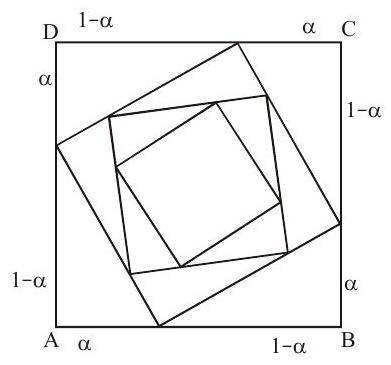
Let $A B C D$ be a unit square and $0<\alpha<1$. Each side of the square is divided in the ratio $\alpha: 1-\alpha$, as shown in the figure. These points are connected to obtain another square. The sides of new square are divided in the ratio $\alpha: 1-\alpha$ and points are joined to obtain another square. The process is continued indefinitely.
Let $a _{n}$ denote the length of side and $A _{n}$ the area of the nth square
(i) The value of $\alpha$ for which $\sum _{n=1}^{\infty} A _{n}=\frac{8}{3}$ is
(a) $1 / 3,2 / 3$
(b) $1 / 4,3 / 4$
(c) $1 / 5,4 / 5$
(d) $1 / 2$
Show Answer
Answer: (b)(ii) The value of $\alpha$ for which side of $n^{\text {th }}$ square equals the diagonals of $(n+1)$ th square is
(a) $1 / 3$
(b) $1 / 4$
(c) $1 / 2$
(d) $1 / \sqrt{2}$
Show Answer
Answer: (c)(iii) If $a=1 / 4$ and $P _{n}$ denotes the perimeter of the $n^{\text {th }}$ square then $\sum _{n=1}^{\infty} P _{n}$ equals
(a) $8 / 3$
(b) $32 / 3$
(c) $16 / 3$
(d) $\frac{8}{3}(4+\sqrt{10})$
 BETA
BETA


