Complex Numbers And Quadratic Equations - Quadratic Equations (Location of Roots) (Lecture-03)
Let $f(\mathrm{x})=\mathrm{ax}^{2}+\mathrm{bx}+\mathrm{c}, \mathrm{a}, \mathrm{b}, \mathrm{c} \in \mathrm{R}, \mathrm{a} \neq 0$ and $\alpha, \beta(\alpha<\beta)$ be the roots of $f(\mathrm{x})=0$. Let $\mathrm{k} _{1}, \mathrm{k} _{2}$ be two real numbers such that $\mathrm{k} _{1}<\mathrm{k} _{2}$
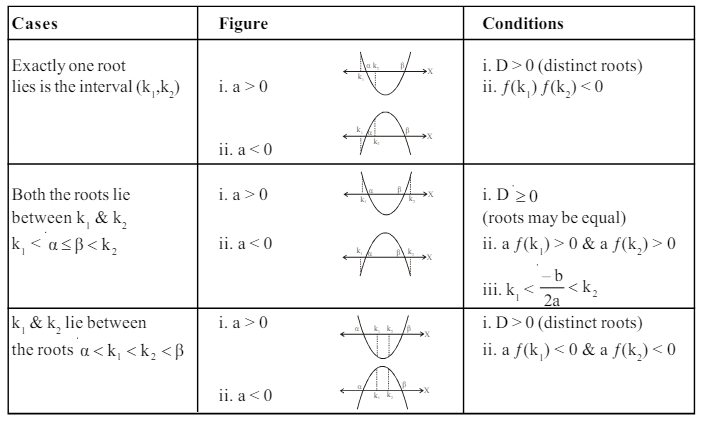
Logarithmic Equations
If we have an equation of the form as $\log _{\mathrm{a}} f(\mathrm{x})=\mathrm{b}$ where $\mathrm{a}>0, \mathrm{a} \neq 1$ can be written as $f(\mathrm{x})=\mathrm{a}^{\mathrm{b}}$ when $f(\mathrm{x})>0$.
Logarithmic Inequalities
| For $\mathrm{a}>1$ | For $0<\mathrm{a}<1$ |
|---|---|
| $0<\mathrm{x}<\mathrm{y}$ and $\log _{\mathrm{a}} \mathrm{x}<\log _{\mathrm{a}} \mathrm{y}$ are equivalent | $0<\mathrm{x}<\mathrm{y}$ and $\log _{\mathrm{a}} \mathrm{x}>\log _{\mathrm{a}} \mathrm{y}$ are equivalent |
| $\log _{\mathrm{a}} \mathrm{x}<\mathrm{p}$ $\Rightarrow 0<\mathrm{x}<\mathrm{a}^{\mathrm{p}}$ | $\log _{\mathrm{a}} \mathrm{x}<\mathrm{p}$ $\Rightarrow \mathrm{x}>\mathrm{a}^{\mathrm{P}}$ |
| $\log _{a} x>p$ $\Rightarrow x>a^{p}$ | $\log _{\mathrm{a}} \mathrm{x}>\mathrm{p}$ $\Rightarrow 0<\mathrm{x}<\mathrm{a}^{\mathrm{P}}$ |
Descartes Rule of signs
The maximum number of positive real roots of a polynomial equation $f(\mathrm{x})=0$ is the number of changes of signs from positive to negative and negative to positive.
The maximum number of negative real roots of a polynomial equation $f(\mathrm{x})=0$ is the number of changed signs from positive to negative and negative to positive in $f(-\mathrm{x})=0$
Solved examples
1. The values of $m$ for which exactly one root of $x^{2}-2 m x+m^{2}-1=0$ lies in the interval $(-2,4)$ is
(a) $(-3,-1) \cup(3,5)$
(b) $(-3,-1)$
(c) $(3,5)$
(d) none
Show Answer
Solution: $\mathrm{D}>0$ $\hspace {2.8 cm} f(-2) f(4)<0$
$\begin{array}{ll} (-2 m)^2-4 \cdot 1 .\left(m^2-1\right)>0 & \left(4+4 m+m^2-1\right)\left(16-8 m+m^2-1\right)<0 \\ 4>0 & \left(m^2+4 m+3\right)\left(m^2-8 m+3\right) \\ \Rightarrow m \in R \ldots \ldots .(1) & (m+1)(m+3)(m-3)(m-5)<0 \\ & \Rightarrow m \in(-3,-1) \cup(3,5)\end{array}$
From $(1)$ and $(2), \mathrm{m} \in(-3,-1) \cup(3,5)$
Answer: a
2. The values of a for which both the rootes of the equation $4 x^{2}-2 x+a=0$ lie in the interval $(-1,1)$ is.
(a) $(-2, \infty)$
(b) $\left(-\infty, \dfrac{1}{4}\right]$
(c) $\left(-2, \dfrac{1}{4}\right]$
(d) none
Show Answer
Solution:
$\begin{array}{lll} \mathrm{D} \geq 0 & \text { a. } f(-1)>0 & \text { a. } f(1)>0 \\ (-2)^2-4 \cdot 4 \cdot \mathrm{a} \geq 0 & 4 \cdot(4+2+\mathrm{a})>0 & 4 \cdot(4-2+\mathrm{a})>0 \\ 4 \mathrm{a}-1 \leq 0 & \mathrm{a}+6>0 & \mathrm{a}>-2 \\ \\ \mathrm{a} \leq \frac{1}{4} \quad-(1) & \mathrm{a}>-6-(2) & \mathrm{a} \in(-2, \infty) \quad-(3) \end{array}$
From (1),(2) and (3), $\mathrm{a} \in\left(-2, \dfrac{1}{4}\right]$
Answer: c
3. The all possible values of a for which one root of the equation $(a-5) x^{2}-2 a x+a-4=0$ is smaller than 1 and the other greater than 2 is
(a) $[5,24)$
(b) $(5,24]$
(c) $(5,24)$
(d) none of these
Show Answer
Solution: $\mathrm{D} \geq 0 \hspace{2.8 cm} (\mathrm{a}-5) f(1)<0 \hspace{2.8 cm}(\mathrm{a}-5) f(2)<0$
$\begin{array}{lll} (-2 a)^2-4(a-5)(a-4) \geq 0 & (a-5)(a-5-2 a+a-4)<0 & (a-5)(4(a-5)-4 a+a-4)<0 \\ \Rightarrow 9 a-20 \geq 0 & (a-5)(-a)<0 & \Rightarrow(a-5)(a-24)<0 \\ \\ a \geq \frac{20}{9}-(1) & a>5 \quad-(2) & \Rightarrow 5<a<24-(3) \end{array}$
From (1), (2), and (3) $a \in(5,24)$
Answer: c
4. If $a, b, c \in R$ and the equation $x^{2}+(a+b) x+c=0$ has no real roots, then
(a) $\mathrm{c}(\mathrm{a}+\mathrm{b}+\mathrm{c})>0$
(b) $\mathrm{c}+(\mathrm{a}+\mathrm{b}+\mathrm{c}) \mathrm{c}>0$
(c) $c-(a+b-c) c>0$
(d) $\mathrm{c}(\mathrm{a}+\mathrm{b}-\mathrm{c})>0$
Show Answer
Solution:
$\begin{array}{ll} f(0)>0 \Rightarrow \mathrm{c}>0 & f(0)<0 \Rightarrow \mathrm{c}>0 \\ f(1)>0 \Rightarrow 1+\mathrm{a}+\mathrm{b}+\mathrm{c}>0 & f(1)<0 \Rightarrow 1+\mathrm{a}+\mathrm{b}+\mathrm{c}<0 \\ f(-1)>0 \Rightarrow 1-(\mathrm{a}+\mathrm{b})+\mathrm{c}>0 & f(-1)<0 \\ \therefore f(0) . f(1)>0 \text { and } f(0) . f(-1)>0 & \Rightarrow 1-(\mathrm{a}+\mathrm{b})+\mathrm{c}<0 \\ \text { gives } \mathrm{b} \text { and } \mathrm{c} & \therefore f(0) f(1)>0 \text { and } f(0) . f(-1)>0 \\ & \text { gives (b) and (c) } \end{array}$
Answer: b and c
EXERCISE
1. The values of a for which $2 x^{2}-2(2 a+1) x+a(a+1)=0$ may have one root less than $a$ and other root greater than a are given by
(a) $1>\mathrm{a}>0$
(b) $-1<\mathrm{a}<0$
(c) $\mathrm{a} \geq 0$
(d) $\mathrm{a}>0$ & $\mathrm{a}<-1$
Show Answer
Answer: d2. The value of a for which the equation $\left(1-a^{2}\right) x^{2}+2 a x-1=0$ has roots belonging to $(0,1)$ is
(a) $\mathrm{a}>\dfrac{1+\sqrt{5}}{2}$
(b) $\mathrm{a}>2$
(c) $\dfrac{1+\sqrt{5}}{2}<\mathrm{a}<2$
(d) $\mathrm{a}>\sqrt{2}$
Show Answer
Answer: b3. If $a, b, c, x, y, z, \in R$ be such that $(a+b+c)^{2}=3\left(a b+b c+c a-x^{2}-y^{2}-z^{2}\right)$, then
(a) $\mathrm{a}=\mathrm{b}=\mathrm{c}=0=\mathrm{x}=\mathrm{y}=\mathrm{z}$
(b) $x=y=z=0, a=b=c$
(c) $\mathrm{a}=\mathrm{b}=\mathrm{c}=0 ; \mathrm{x}=\mathrm{y}=\mathrm{z}$
(d) $x=y=z=a=b=c$
Show Answer
Answer: b4. Number of positive integers $n$ for which $n^{2}+96$ is a perfect square is
(a) 8
(b) 12
(c) 4
(d) infinite
Show Answer
Answer: c5. The curve $y=(\lambda+1) x^{2}+2$ intersects the curve $y=\lambda x+3$ is exactly one point, if $\lambda$ equals
(a) $\{-2,2\}$
(b) $\{1\}$
(c) $\{-2\}$
(d) $\{2\}$
Show Answer
Answer: c6. A quadratic equation whose product of roots $x _{1}$ & $x _{2}$ is equal to 4 and satisfying the relation $\dfrac{\mathrm{x} _{1}}{\mathrm{x} _{1}-1}+\dfrac{\mathrm{x} _{2}}{\mathrm{x} _{2}-1}=2$ is
(a) $x^{2}-2 x+4=0$
(b) $x^{2}+2 x+4=0$
(c) $x^{2}+4 x+4=0$
(d) $x^{2}-4 x+4=0$
Show Answer
Answer: a7. If $a, b, c, d \in R$, then the equation $\left(x^{2}+a x-3 b\right)\left(x^{2}-c x+3 b\right)\left(x^{2}-d x+2 b\right)=0$ has
(a) 6 real roots
(b) at least 2 real roots
(c) 4 real roots
(d) 3 real roots
Show Answer
Answer: b8. Suppose $\mathrm{P}, \mathrm{Q}, \mathrm{R}$ are defined as $\mathrm{P}=\mathrm{a}^{2} \mathrm{~b}+\mathrm{ab}^{2}-\mathrm{a}^{2} \mathrm{c}-\mathrm{ac}^{2}, \mathrm{Q}=\mathrm{b}^{2} \mathrm{c}+\mathrm{bc}^{2}-\mathrm{a}^{2} \mathrm{~b}-\mathrm{ab}^{2}$ & $\mathrm{R}=\mathrm{a}^{2} \mathrm{c}+\mathrm{ac}^{2}-\mathrm{b}^{2} \mathrm{c}-$ $\mathrm{bc}^{2}$, where $\mathrm{a}>\mathrm{b}>\mathrm{c}$ and the equation $\mathrm{Px}^{2}+\mathrm{Qx}+\mathrm{R}=0$ has equal roots, then $\mathrm{a}, \mathrm{b}, \mathrm{c}$ are in
(a) A.P
(b) G.P
(c) H.P
(d) AGP
Show Answer
Answer: c9. If $a(p+q)^{2}+2 a b p q+c=0$ & $a(p+r)^{2}+2 a b p r+c=0(a \neq 0)$ then
(a) $\mathrm{qr}=\mathrm{p}^{2}$
(b) $\mathrm{qr}=\mathrm{p}^{2}+\dfrac{\mathrm{c}}{\mathrm{a}}$
(c) $\mathrm{qr}=-\mathrm{p}^{2}$
(d) none of these
Show Answer
Answer: b10. $x^{2}-x y+y^{2}-4 x-4 y+16=0$ represents
(a) point
(b) a circle
(c) a pair of straight line
(d) none of these
Show Answer
Answer: a11. If the roots of the equation $a x^{2}+b x+c=0$ are of the form $\dfrac{k+1}{k}$ & $\dfrac{k+2}{k+1}$, then $(a+b+c)^{2}$ is equal to
(a) $2 b^{2}-a c$
(b) $\sum \mathrm{a}^{2}$
(c) $b^{2}-4 a c$
(d) $b^{2}-2 a c$
Show Answer
Answer: c12. Read the passage and answer the following questions:-
$\mathrm{a} f(\mu)<0$ is the necessary and sufficient condition for a particular real number $\mu$ to the between the roots of a quadratic equation $f(\mathrm{x})=0$, where $f(\mathrm{x})=\mathrm{ax}^{2}+\mathrm{bx}+\mathrm{c}$. Again if $f\left(\mu _{1}\right) f\left(\mu _{2}\right)<0$, then exactly one of the roots will lie between $\mu _{1}$ & $\mu _{2}$
i. If $|\mathrm{b}|>|\mathrm{a}+\mathrm{c}|$, then
(a) One root of $f(\mathrm{x})=0$ is positive, the other is negative.
(b) Exactly one of the roots of $f(x)=0$ lies in $(-1,1)$.
(c) 1 lies between the roots of $f(x)=0$.
(d) Both the roots of $f(\mathrm{x})=0$ are less than 1
ii. If $\mathrm{a}(\mathrm{a}+\mathrm{b}+\mathrm{c})<0<(\mathrm{a}+\mathrm{b}+\mathrm{c}) \mathrm{c}$, then
(a) one root is less than 0 , the other is greater than 1 .
(b) Exactly one of the roots lies in $(0,1)$
(c) Both the roots lie in $(0,1)$
(d) At least one of the roots lies in $(0,1)$
iii. If $(a+b+c) c<0<a(a+b+c)$, then
(a) one root is less than 0 , the other is greater than 1
(b) one root lies in $(-\infty, 0)$ and the other in $(0,1)$
(c) both roots lie in $(0,1)$
(d) one root lies in $(0,1)$ and other in $(1, \infty)$
Show Answer
Answer: (i) b (ii) a (iii) b13. Match the following:-
| Column I | Column II | ||
|---|---|---|---|
| (Number of positive integers for which) | |||
| a. | One root is positive and the other is negative for the equation $(\mathrm{m}-2) \mathrm{x}^{2}-(8-2 \mathrm{~m}) \mathrm{x}-(8-3 \mathrm{~m})=0$ | (p) | 0 |
| b. | Exactly one root of the equation $\mathrm{x}^{2}-\mathrm{m}(2 \mathrm{x}-8)-15=0$ lies in the interval $(0,1)$ | (q) | infinite |
| c. | The equation $x^{2}+2(m+1) x+9 m-5=0$ has both roots negative | (r) | 1 |
| d. | The equation $\mathrm{x}^{2}+2(\mathrm{~m}-1) \mathrm{x}+\mathrm{m}+5=0$ has both roots lying on either sides of 1 | (s) | 2 |
Show Answer
Answer: $\mathrm{a} \rightarrow \mathrm{r} ; \mathrm{b} \rightarrow \mathrm{r} ; \mathrm{c} \rightarrow \mathrm{q} ; \mathrm{d} \rightarrow \mathrm{p};$14. If $\alpha, \beta$ are the roots of $375 x^{2}-25 x-2=0 & S _{n}=\alpha^{n}+\beta^{n}$, then the value of $\dfrac{1}{3\left(\lim _{n \rightarrow \infty} \sum\limits _{r=1}^{n} S _{r}\right)}$ is…..
Show Answer
Answer: 415. If $x, y, z$ are distinct positive number such that $x+\dfrac{1}{y}=y+\dfrac{1}{z}=z+\dfrac{1}{x}$, then $x y z=$.
 BETA
BETA


