Coordinate Geometry-i - Straight Line (Lecture-02)
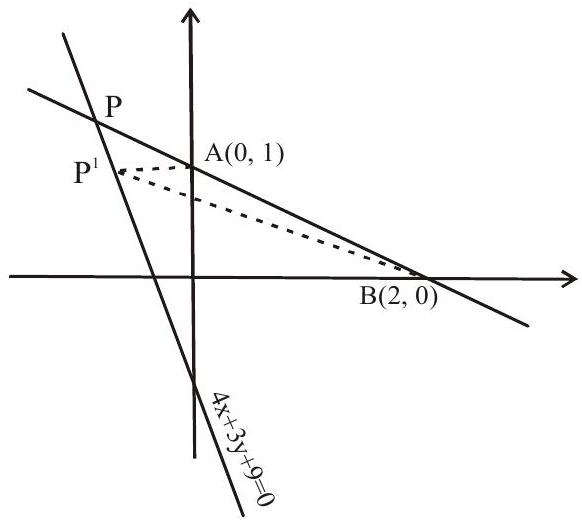
8. Consider the points $\mathrm{A}(0,1)$ and $\mathrm{B}(2,0)$ and $\mathrm{P}$ be a point on the line $4 \mathrm{x}+3 \mathrm{y}+9=0$. Coordinates of $\mathrm{P}$ such that $|\mathrm{PA}-\mathrm{PB}|$ is maximum are
(a) $\left(\dfrac{-12}{5}, \dfrac{17}{5}\right)$
(b) $\left(\dfrac{-18}{5}, \dfrac{13}{5}\right)$
(c) $\left(\dfrac{31}{7}, \dfrac{31}{7}\right)$
(d) $(0,0)$
Show Answer
Solution: $|\mathrm{PA}-\mathrm{PB}| \leq \mathrm{AB}$
Thus |PA-PB| is max. if points A,B,P are collinear. Equation of $A B$ is $y-1=\dfrac{0-1}{2-1}(x-0) \Rightarrow x+2 y-$ $2=0$
Hence solving $x+2 y=2=0$ & $4 x+3 y+9=0$ we get $\left(-\dfrac{84}{5}, \dfrac{13}{5}\right)$
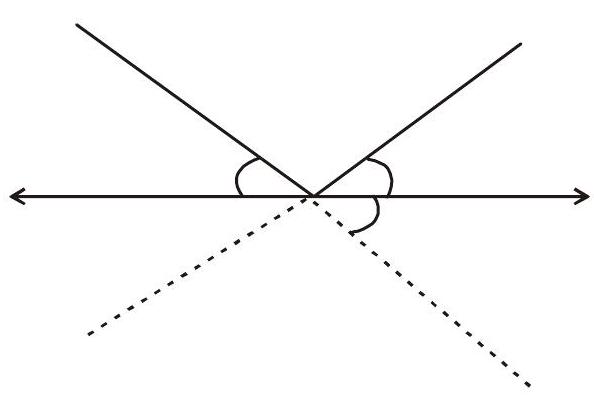
9. A light ray coming along the line $3 x+4 y=5$ gets reflected from the line $a x+b y=1$ and goes along the line $5 x-12 y=10$. Then
(a) $\mathrm{a}=\dfrac{64}{115}, \mathrm{~b}=\dfrac{112}{15}$
(b) $\mathrm{a}=\dfrac{14}{15}, \mathrm{~b}=\dfrac{-8}{115}$
(c) $\mathrm{a}=\dfrac{64}{115}, \mathrm{~b}=\dfrac{-8}{115}$
(d) $\mathrm{a}=\dfrac{64}{15}, \mathrm{~b}=\dfrac{14}{15}$
Show Answer
Solution: $a x+b y=1$ will be one of the bisectors of the lines given $\dfrac{3 \mathrm{x}+4 \mathrm{y}-5}{5}= \pm\left(\dfrac{5 \mathrm{x}-12 \mathrm{y}-10}{13}\right)$
$\Rightarrow 64 x-8 y=115 \quad$ or $\quad 14 x+112 y=15$ On comparing with $a x+b y=1$, we get
$\mathrm{a}=\dfrac{64}{115}, \mathrm{~b}=\dfrac{-8}{115} \quad$ or $\quad \mathrm{a}=\dfrac{14}{15}, \mathrm{~b}=\dfrac{112}{15}$
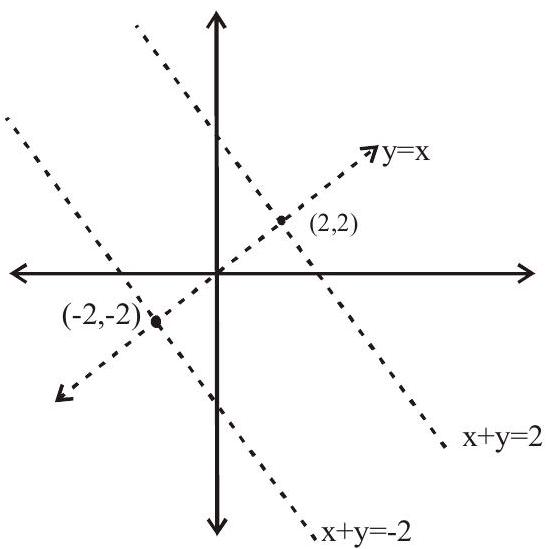
10. If the point $(a, a)$ is placed in between the lines $|x+y|=4$, then a is
(a) $[-2,0]$
(b) $[0,2]$
(c) $(-2,2)$
(d) $[-2,2]$
Show Answer
Solution: $\mathrm{x}+\mathrm{y}=4$
$\mathrm{x}+\mathrm{y}=-4$
& $\mathrm{pt}(2,2)$ & $(-2,-2)$ lies on these lines
Then pt. (a,a) lies between the lines then $\mathrm{a}>-2$ and $\mathrm{a}<2$ ie. $-2<\mathrm{a}<2$.
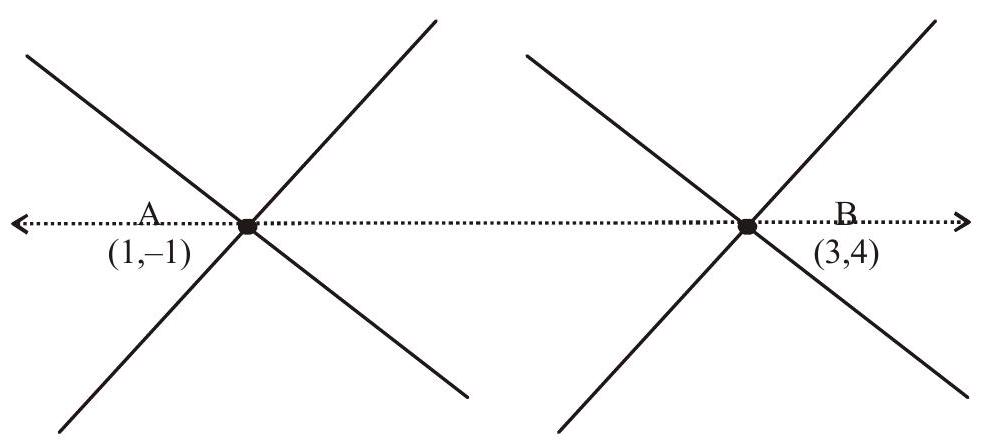
11. Consider the family of lines $5x+3y-2+\lambda_{1}(3 x-y-4)=0$ and $x-y+1+\lambda_{2}(2 x-y-2)=0$. The equation of a straight line that belongs to both the families is____________________________.
Show Answer
Solution:
$\begin{gathered} 5x+3 y=2 \\ 3x-y=4 \\ \hline x=1 \\ y=-1 \end{gathered}$
$\begin{gathered} x-y=-1 \\ 2x-y=2 \\ \hline x=3 \\ y=4 \end{gathered}$
Equation of a line belongs to both families passes through A and B is
$\begin{aligned} & y+1=\dfrac{4+1}{3-1}(x-1) \\ & y+1=\dfrac{5}{2}(x-1) \\ & 5 x-2 y-7=0 \end{aligned}$
12. If $\mathrm{x} _{1}, \mathrm{x} _{2}, \mathrm{x} _{3}$ as well as $\mathrm{y} _{1}, \mathrm{y} _{2}, \mathrm{y} _{3}$ are in G.P. with same common ratio then the points $\mathrm{P}\left(\mathrm{x} _{1}\right.$, $\left.\mathrm{y} _{1}\right), \mathrm{Q}\left(\mathrm{x} _{2}, \mathrm{y} _{2}\right)$ and $\mathrm{R}\left(\mathrm{x} _{3}, \mathrm{y} _{3}\right)$
(a) lie on a straight line
(b) lie on an ellipse
(c) lie on a circle
(d) are vertices of a triangle.
Show Answer
Solution: Let $\quad \mathrm{x} _{1}=\mathrm{a}, \mathrm{x} _{2}=\mathrm{ar}, \mathrm{x} _{3}=\mathrm{ar}^{2}$
$\mathrm{y} _{1}=\mathrm{b}, \mathrm{y} _{2}=\mathrm{br}, \mathrm{y} _{3}=\mathrm{br}^{2}$
Now $\dfrac{\mathrm{y} _{2}-\mathrm{y} _{1}}{\mathrm{x} _{2}-\mathrm{x} _{1}}=\dfrac{\mathrm{b}}{\mathrm{a}}$ & $\dfrac{\mathrm{y} _{3}-\mathrm{y} _{2}}{\mathrm{x} _{3}-\mathrm{x} _{2}}=\dfrac{\mathrm{b}}{\mathrm{a}}$
slope of $\mathrm{PQ}=$ slope of $\mathrm{QR}$
Hence pts $\mathrm{P}, \mathrm{Q}, \mathrm{R}$ are collinear.
Answer : a
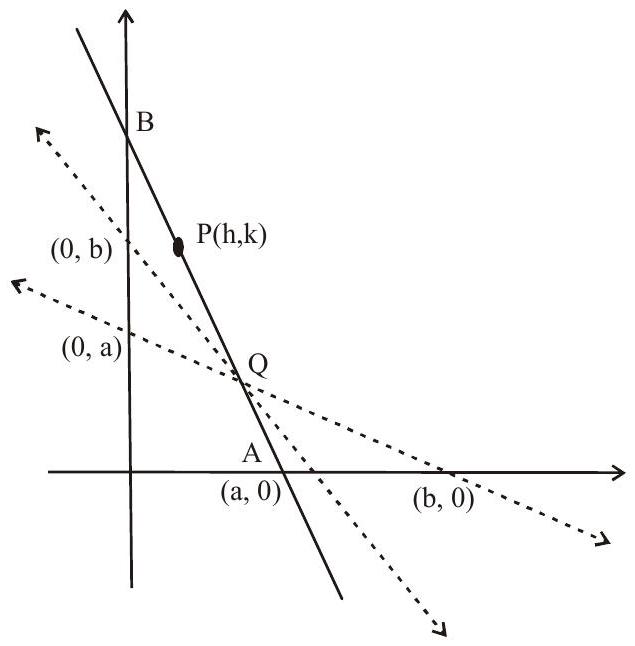
13. A variable straight line is drawn through the point of intersection of the straight lines $\dfrac{x}{a}+\dfrac{y}{b}=1$ and $\dfrac{x}{b}+\dfrac{y}{a}=1$ and meets the coordinate axes at $A$ and $B$, find the locus of the midpoint of $A B$.
Show Answer
Solution: Let mid pt. of $\mathrm{AB}$ be $(\mathrm{h}, \mathrm{k})$.
Intersection pt. of given lines is $\left(\dfrac{a b}{a+b}, \dfrac{a b}{a+b}\right)$
$P$ is mid pt. of $A B \Rightarrow \quad A(2 h, 0)$ & $B(0,2 k)$.
Now A,B and $Q$ are collinear $\Rightarrow\left|\begin{array}{ccc}2 h & 0 & 1 \\ 0 & 2 k & 1 \\ \dfrac{a b}{a+b} & \dfrac{a b}{a+b} & 1\end{array}\right|=0$
$\Rightarrow \quad 4 \mathrm{hk}-\dfrac{2 \mathrm{hab}}{\mathrm{a}+\mathrm{b}}-\dfrac{2 \mathrm{kab}}{\mathrm{a}+\mathrm{b}}=0$
$\Rightarrow \quad 2 \mathrm{xy}(\mathrm{a}+\mathrm{b})=\mathrm{ab}(\mathrm{x}+\mathrm{y})$.
Exercise
1. Orthocenter of triangle with vertices $(0,0),(3,4)$ and $(4,0)$ is
(a) $\left(3, \dfrac{5}{4}\right)$
(b) $(3,12)$
(c) $\left(3, \dfrac{3}{4}\right)$
(d) $(3,9)$
Show Answer
Answer: c2. Area of the triangle formed by the line $x+y=3$ and angle bisectors of the pairs of straight lines $x^{2}-y^{2}+2 y=1$ is
(a) 2 sq.units
(b) 4 sq.units
(c) 6sq.units
(d) 8 sq.units
Show Answer
Answer: a3. Let $\mathrm{O}(0,0), \mathrm{P}(3,4), \mathrm{Q}(6,0)$ be the vertices of the triangle OPQ. The point $\mathrm{R}$ inside the ${ } _{\Delta} \mathrm{OPQ}$ is such that the triangle $\mathrm{OPR}, \mathrm{PQR}, \mathrm{OQR}$ are of equal area. The coordinates of $\mathrm{R}$ are
(a) $\left(\dfrac{4}{3}, 3\right)$
(b) $\left(3, \dfrac{2}{3}\right)$
(c) $\left(3, \dfrac{4}{3}\right)$
(d) $\left(\dfrac{4}{3}, \dfrac{2}{3}\right)$
Show Answer
Answer: c4. Consider three points $\mathrm{P}(-\sin (\beta-\alpha),-\cos \beta), \mathrm{Q}(\cos (\beta-\alpha), \sin \beta)$ and $\mathrm{R}(\cos (\beta-\alpha+\theta)$, $\sin (\beta-\theta))$, where $0<\alpha, \beta, \theta<\dfrac{\pi}{4}$. Then
(a) $\mathrm{P}$ lies on the line segment $\mathrm{RQ}$.
(b) $\mathrm{Q}$ lies on the line segment PR.
(c) $\mathrm{R}$ lies on the line segment $\mathrm{QP}$.
(d) P, Q, R are non-collinear.
Show Answer
Answer: d5. The locus of the orthocenter of the triangle formed by the lines $(1+p) x-p y+p(1+p)=0$, $(1+q) x-q y+(1+q) q=0$ and $y=0$, where $p \neq q$, is
(a) a hyperbola
(b) a parabola
(c) an ellipse
(d) a straight line.
Show Answer
Answer: d6. Let points $\mathrm{A}(1,1)$ and $\mathrm{B}(2,3)$. Coordinates of the point $\mathrm{P}$ such that $|\mathrm{PA}-\mathrm{PB}|$ is minimum are
(a) $\left(2, \dfrac{3}{2}\right)$
(b) $ \left (0, \dfrac{11}{4}\right)$
(c) $(11,3)$
(d) $\left(\dfrac{3}{2}, 0\right)$
Show Answer
Answer: b7. The line $x+7 y=14$ is rotated through an angle $\dfrac{\pi}{4}$ in the anticlock wise direction about the point $(0,2)$. The equation of the line in its new position is
(a) $3 \mathrm{x}-4 \mathrm{y}+8=0$
(b) $3 x-4 y-8=0$
(c) $4 x+3 y+8=0$
(d) None of these
Show Answer
Answer: a8. If one diagonal of a square is the portion of the line $\dfrac{x}{a}+\dfrac{y}{b}=1$ intercepted by the axes, then the extremities of the other diagonal of the square are
(A) $\left(\dfrac{a+b}{2}, \dfrac{a-b}{2}\right)$
(b) $\left(\dfrac{a-b}{2}, \dfrac{a+b}{2}\right)$
(c) $\left(\dfrac{\mathrm{a}-\mathrm{b}}{2}, \dfrac{\mathrm{b}-\mathrm{a}}{2}\right)$
(d) $\left(\dfrac{a+b}{2}, \dfrac{b-a}{2}\right)$
Show Answer
Answer: c9. The image of $\mathrm{P}(\mathrm{a}, \mathrm{b})$ in the line $\mathrm{y}=-\mathrm{x}$ is $\mathrm{Q}$ and the image of $\mathrm{Q}$ in the line $\mathrm{y}=\mathrm{x}$ is $\mathrm{R}$, then the midpoint of PR is
(a) $(\mathrm{a}-\mathrm{b}, \mathrm{b}+\mathrm{a})$
(b) $\left(\dfrac{a+b}{2}, \dfrac{b+a}{2}\right)$
(c) $(\mathrm{a}-\mathrm{b}, \mathrm{b}-\mathrm{a})$
(d) $(0,0)$
Show Answer
Answer: d10. Let $\mathrm{ABC}$ be a triangle. Let $\mathrm{A}$ be the point $(1,2), \mathrm{y}=\mathrm{x}$ is the perpendicular bisector of $\mathrm{AB}$ and $\mathrm{x}-2 \mathrm{y}+1=0$ is the angle bisector of $\angle \mathrm{C}$. If equation of $\mathrm{BC}$ is given by $\mathrm{ax}+\mathrm{by}-5=0$, then $\mathrm{a}+\mathrm{b}$ is
(a) 1
(b) 2
(c) 3
(d) 4
 BETA
BETA


