Matrices And Determinants - Properties and Evaluation of Determinants (Lecture-01)
DETERMINANTS
Minors & cofactors of elements of a determinant.
It we delete the row and column passing through the element $\mathrm{a} _{\mathrm{i}}$, the determinant thus obtained is called the minor of $a _{i j}$ denoted by $M _{i j}$ and cofactor of $a _{i j}$ is $(-1)^{i+j} M _{i j}$ and is denoted by $A _{i j}$ or $C _{i j}$.
Note :
If all the elements in a row (or column), except one element, are zeros the determinant reduces to a determinant of an order less by one.
$\operatorname{Eg}:\left|\begin{array}{ccc}5 & 0 & 0 \\ 7 & 3 & -2 \\ 1 & 5 & 4\end{array}\right|=5\left|\begin{array}{cc}3 & -2 \\ 5 & 4\end{array}\right|$
Also a determinant can be replaced by a determinant of higher order by one.
Eg: $\left|\begin{array}{cc}3 & 2 \\ 8 & -5\end{array}\right|=\left|\begin{array}{ccc}1 & 0 & 0 \\ 0 & 3 & 2 \\ 0 & 8 & -5\end{array}\right|$
Singular or non singular matrix :
A square matrix A is said to be non-singular if $|\mathrm{A}| \neq 0$, and is said to be singular if $|\mathrm{A}|=0$
Properties of determinants
For a square matrix A,
(i) If a row (column) is a zero vector, then $|\mathrm{A}|=0$
(ii) If any two rows (columns) are proportional, then $|\mathrm{A}|=0$
(iii) If the rows & columns are interchanged, then $|\mathrm{A}|$ remains the same i.e. $|\mathrm{A}|=\left|\mathrm{A}^{\mathrm{T}}\right|$
(iv) If any two rows (columns) are interchanged, value of $|\mathrm{A}|$ differ by a negative sign.
(v) $\quad\left|\begin{array}{ccc}\mathrm{ka} & \mathrm{kb} & \mathrm{kc} \\ \mathrm{p} & \mathrm{q} & \mathrm{r} \\ \mathrm{u} & \mathrm{v} & \mathrm{w}\end{array}\right|=\mathrm{k}\left|\begin{array}{ccc}\mathrm{a} & \mathrm{b} & \mathrm{c} \\ \mathrm{p} & \mathrm{q} & \mathrm{r} \\ \mathrm{u} & \mathrm{v} & \mathrm{w}\end{array}\right|$
(vi) If A is a square matrix of order $n$, then $|\mathrm{kA}|=\mathrm{k}^{\mathrm{n}}|\mathrm{A}|$
(vii) $\left|\begin{array}{ccc}\mathrm{a} _{1}+\mathrm{a} _{2} & \mathrm{~b} _{1}+\mathrm{b} _{2} & \mathrm{c} _{1}+\mathrm{c} _{2} \\ \mathrm{p} & \mathrm{q} & \mathrm{r} \\ \mathrm{u} & \mathrm{v} & \mathrm{w}\end{array}\right|=\left|\begin{array}{ccc}\mathrm{a} _{1} & \mathrm{~b} _{1} & \mathrm{c} _{1} \\ \mathrm{p} & \mathrm{q} & \mathrm{r} \\ \mathrm{u} & \mathrm{v} & \mathrm{w}\end{array}\right|+\left|\begin{array}{ccc}\mathrm{a} _{2} & \mathrm{~b} _{2} & \mathrm{c} _{2} \\ \mathrm{p} & \mathrm{q} & \mathrm{r} \\ \mathrm{u} & \mathrm{v} & \mathrm{w}\end{array}\right|$
(viii) If a scalar multiple of any row (column) is added to another row (column) then $|\mathrm{A}|$ is unchanged.
i.e. $\left|\begin{array}{ccc}\mathrm{a} & \mathrm{b} & \mathrm{c} \\ \mathrm{p} & \mathrm{q} & \mathrm{r} \\ \mathrm{u} & \mathrm{v} & \mathrm{w}\end{array}\right|=\left|\begin{array}{ccc}\mathrm{a}+\lambda \mathrm{p} & \mathrm{b}+\lambda \mathrm{q} & \mathrm{c}+\lambda \mathrm{r} \\ \mathrm{p} & \mathrm{q} & \mathrm{r} \\ \mathrm{u} & \mathrm{v} & \mathrm{w}\end{array}\right|$
(ix) The sum of the products of elements of any row (column) of a determinant with the cofactors of the corresponding elements of any other row (column) is zero
If, A = $\left[\begin{array}{lll} a_{11} & a_{12} & a_{13} \\ a_{21} & a_{22} & a_{23} \\ a_{31} & a_{32} & a_{33} \end{array}\right] \text {, then } a_{11} C_{21}+a_{12} C_{22}+a_{13} C_{23}=0$
(x) The sum of the products of elements of any row (or column) of a determinant with the cofactors of the corresponding elements of same row is $|\mathrm{A}|$
i.e. $\mathrm{a} _{11} \mathrm{C} _{11}+\mathrm{a} _{12} \mathrm{C} _{12}+\mathrm{a} _{13} \mathrm{C} _{13}=|\mathrm{A}|$.
(xi) If r rows (columns) become identical when ’ $a$ ’ is substituted for $\mathrm{x}$, then $(\mathrm{x}-\mathrm{a})^{r-1}$ is a factor of the given determinant.
$\operatorname{Eg}: \operatorname{Let} A(x)=\left|\begin{array}{ccc}x-2 & x-3 & x-4 \\ x-3 & x-5 & 2 x-8 \\ x-4 & x-6 & 3 x-10\end{array}\right|$
Put $x=1$
$\Delta=\left|\begin{array}{lll}-1 & -2 & -3 \\ -2 & -4 & -6 \\ -3 & -5 & -7\end{array}\right|=0$
$\left(\mathrm{R} _{1} \& \mathrm{R} _{2}\right.$ are proportional)
(xii) If $\mathrm{A}=\operatorname{diag}\left(\mathrm{a} _{11}, \mathrm{a} _{22}, \ldots \ldots \ldots \ldots \ldots \ldots . . \mathrm{a} _{\mathrm{nn}}\right)$ then
$|A|=a _{11} a _{22} \ldots \ldots \ldots \ldots a _{n n}$
(xiii) $\quad|\mathrm{AB}|=|\mathrm{A}||\overrightarrow{\mathrm{B}}|=|\mathrm{BA}|=\left|\mathrm{AB}^{\mathrm{T}}\right|=\left|\mathrm{A}^{\mathrm{T}} \mathrm{B}\right|=\left|\mathrm{A}^{\mathrm{T}} \mathrm{B}^{\mathrm{T}}\right|$
(xiv) Let $\Delta(x)=\left|\begin{array}{lll}a(x) & b(x) & c(x) \\ p(x) & q(x) & r(x) \\ u(x) & v(x) & w(x)\end{array}\right|$, then
$\dfrac{d}{d x} \Delta(x)=\left|\begin{array}{ccc}a^{1}(x) & b^{1}(x) & c^{1}(x) \\ p(x) & q(x) & r(x) \\ u(x) & v(x) & w(x)\end{array}\right|+\left|\begin{array}{ccc}a(x) & b(x) & c(x) \\ p^{1}(x) & q^{1}(x) & r^{1}(x) \\ u(x) & v(x) & w(x)\end{array}\right|+\left|\begin{array}{ccc}a(x) & b(x) & c(x) \\ p(x) & q(x) & r(x) \\ u^{1}(x) & v^{1}(x) & w^{1}(x)\end{array}\right|$
(xv) Product of determinants of same order
$\begin{aligned} & \left|\begin{array}{lll} a _{1} & b _{1} & c _{1} \\ a _{2} & b _{2} & c _{2} \\ a _{3} & b _{3} & c _{3} \end{array}\right| \times\left|\begin{array}{lll} \alpha _{1} & \beta _{1} & \gamma _{1} \\ \alpha _{2} & \beta _{2} & \gamma _{2} \\ \alpha _{3} & \beta _{3} & \gamma _{3} \end{array}\right| \\ & =\left|\begin{array}{lll} a _{1} \alpha _{1}+b _{1} \beta _{1}+c _{1} \gamma _{1} & a _{1} \alpha _{2}+b _{1} \beta _{2}+c _{1} \gamma _{2} & a _{1} \alpha _{3}+b _{1} \beta _{3}+c _{1} \gamma _{3} \\ a _{2} \alpha _{1}+b _{2} \beta _{1}+c _{2} \gamma _{1} & a _{2} \alpha _{2}+b _{2} \beta _{2}+c _{2} \gamma _{2} & a _{2} \alpha _{3}+b _{2} \beta _{3}+c _{2} \gamma _{3} \\ a _{3} \alpha _{1}+b _{3} \beta _{1}+c _{3} \gamma _{1} & a _{3} \alpha _{2}+b _{3} \beta _{2}+c _{3} \gamma _{2} & a _{3} \alpha _{3}+b _{3} \beta _{3}+c _{3} \gamma _{3} \end{array}\right| \end{aligned}$
Multiplication can also be performed row by column ; column by row or column by column as required in the problem.
(xvi) $\left|\mathrm{A}^{\mathrm{n}}\right|=|\mathrm{A}|^{\mathrm{n}}$
(xvii) Determinant of a skew symmetric matrix of odd order is zero
Use of Determinants :
(i) Area of triangle whose vertices are $\left(\mathrm{x} _{1}, \mathrm{y} _{1}\right)\left(\mathrm{x} _{2}, \mathrm{y} _{2}\right)\left(\mathrm{x} _{3}, \mathrm{y} _{3}\right)$ is given by
$\Delta=\dfrac{1}{2}\left|\begin{array}{lll}\mathrm{x} _{1} & \mathrm{y} _{1} & 1 \\ \mathrm{x} _{2} & \mathrm{y} _{2} & 1 \\ \mathrm{x} _{3} & \mathrm{x} _{3} & 1\end{array}\right|$
(ii) If $a _{1} x+b _{1} y+c _{1}=0, a _{2} x+b _{2} y+c _{2}=0 \& a _{3} x+b _{3} y+c _{3}=0$ are the sides of a triangle, the area of the triangle is given by
$\Delta=\dfrac{1}{2 \mathrm{C} _{1} \mathrm{C} _{2} \mathrm{C} _{3}}\left|\begin{array}{lll}\mathrm{a} _{1} & \mathrm{~b} _{1} & \mathrm{c} _{1} \\ \mathrm{a} _{2} & \mathrm{~b} _{2} & \mathrm{c} _{2} \\ \mathrm{a} _{3} & \mathrm{~b} _{3} & \mathrm{c} _{3}\end{array}\right|^{2}$ where $\mathrm{C} _{1}, \mathrm{C} _{2}, \mathrm{C} _{3}$ are the cofactor of $\mathrm{c} _{1}, \mathrm{c} _{2} \& \mathrm{c} _{3}$ respectively in $\left|\begin{array}{lll}\mathrm{a} _{1} & \mathrm{~b} _{1} & \mathrm{c} _{1} \\ \mathrm{a} _{2} & \mathrm{~b} _{2} & \mathrm{c} _{2} \\ \mathrm{a} _{3} & \mathrm{~b} _{3} & \mathrm{c} _{3}\end{array}\right|$
(ii) $\quad \mathrm{ax}^{2}+2 \mathrm{hxy}+\mathrm{by}^{2}+2 \mathrm{gx}+2 \mathrm{fy}+\mathrm{c}=0$ represents a pair of straight lines, then
$a b c+2 f g h-a f^{2}-b^{2}-c^{2}=\left|\begin{array}{lll}a & h & g \\ h & b & f \\ g & f & c\end{array}\right|=0$
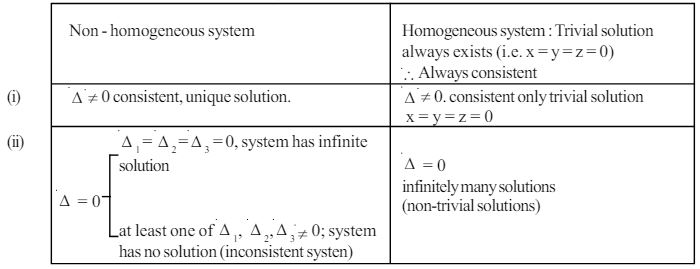
Cramer’s rule for solving simultaneous linear equations
Consider the system of equations
$\mathrm{a} _{1} \mathrm{x}+\mathrm{b} _{1} \mathrm{y}+\mathrm{c} _{1} \mathrm{z}=\mathrm{d} _{1}$
$\mathrm{a} _{2} \mathrm{x}+\mathrm{b} _{2} \mathrm{y}+\mathrm{c} _{2} \mathrm{z}=\mathrm{d} _{2}$
$\mathrm{a} _{3} \mathrm{x}+\mathrm{b} _{3} \mathrm{y}+\mathrm{c} _{3} \mathrm{z}=\mathrm{d} _{3}$
Here $\Delta=\left|\begin{array}{lll}\mathrm{a} _{1} & \mathrm{~b} _{1} & \mathrm{c} _{1} \\ \mathrm{a} _{2} & \mathrm{~b} _{2} & \mathrm{c} _{2} \\ \mathrm{a} _{3} & \mathrm{~b} _{3} & \mathrm{c} _{3}\end{array}\right|$,
$\Delta _{1}=\left|\begin{array}{lll}\mathrm{d} _{1} & \mathrm{~b} _{1} & \mathrm{c} _{1} \\ \mathrm{~d} _{2} & \mathrm{~b} _{2} & \mathrm{c} _{2} \\ \mathrm{~d} _{3} & \mathrm{~b} _{3} & \mathrm{c} _{3}\end{array}\right|$
$\Delta _{2}=\left|\begin{array}{lll}\mathrm{a} _{1} & \mathrm{~d} _{1} & \mathrm{c} _{1} \\ \mathrm{a} _{2} & \mathrm{~d} _{2} & \mathrm{c} _{2} \\ \mathrm{a} _{3} & \mathrm{~d} _{3} & \mathrm{c} _{3}\end{array}\right|$
$\Delta _{3}=\left|\begin{array}{lll}\mathrm{a} _{1} & \mathrm{~b} _{1} & \mathrm{~d} _{1} \\ \mathrm{a} _{2} & \mathrm{~b} _{2} & \mathrm{~d} _{2} \\ \mathrm{a} _{3} & \mathrm{~b} _{3} & \mathrm{~d} _{3}\end{array}\right|$
By cramer’s rule,
$\mathrm{x}=\dfrac{\Delta _{1}}{\Delta}, \mathrm{y}=\dfrac{\Delta _{2}}{\Delta}, \mathrm{z}=\dfrac{\Delta _{3}}{\Delta}$
In the above system, if $\mathrm{d} _{1}=\mathrm{d} _{2}=\mathrm{d} _{3}=0$, it is called a homogeneous system.
Solved Examples
1. The value of the determinant
$\left|\begin{array}{lll} \cos (\mathrm{A}-\mathrm{P}) & \cos (\mathrm{A}-\mathrm{Q}) & \cos (\mathrm{A}-\mathrm{R}) \\ \cos (\mathrm{B}-\mathrm{P}) & \cos (\mathrm{B}-\mathrm{Q}) & \cos (\mathrm{B}-\mathrm{R}) \\ \cos (\mathrm{C}-\mathrm{P}) & \cos (\mathrm{C}-\mathrm{Q}) & \cos (\mathrm{C}-\mathrm{R}) \end{array}\right| \text { is }$
(a) 0
(b) 1
(c) $\sin 2 \mathrm{~A} \sin 2 \mathrm{~B} \sin 2 \mathrm{C}$
(d) None of these
Show Answer
None of these
Solution :
We can write the given determinant as the product of two determinants
$\left|\begin{array}{ccc}\cos (\mathrm{A}-\mathrm{P}) & \cos (\mathrm{A}-\mathrm{Q}) & \cos (\mathrm{A}-\mathrm{R}) \\ \cos (\mathrm{B}-\mathrm{P}) & \cos (\mathrm{B}-\mathrm{Q}) & \cos (\mathrm{B}-\mathrm{R}) \\ \cos (\mathrm{C}-\mathrm{P}) & \cos (\mathrm{C}-\mathrm{Q}) & \cos (\mathrm{C}-\mathrm{R})\end{array}\right|=\left|\begin{array}{lll}\cos \mathrm{A} & \sin \mathrm{A} & 0 \\ \cos \mathrm{B} & \sin \mathrm{B} & 0 \\ \cos \mathrm{C} & \sin \mathrm{C} & 0\end{array}\right|\left|\begin{array}{ccc}\cos \mathrm{P} & \sin \mathrm{P} & 0 \\ \cos \mathrm{Q} & \sin \mathrm{Q} & 0 \\ \cos \mathrm{R} & \sin \mathrm{R} & 0\end{array}\right|=0$
Answer: (a)
2. If $\left|\begin{array}{lll} \left(a _{1}-b _{1}\right)^{2} & \left(a _{1}-b _{2}\right)^{2} & \left(a _{1}-b _{3}\right)^{2} \\ \left(a _{2}-b _{1}\right)^{2} & \left(a _{2}-b _{2}\right)^{2} & \left(a _{2}-b _{3}\right)^{2} \\ \left(a _{3}-b _{1}\right)^{2} & \left(a _{3}-b _{2}\right)^{2} & \left(a _{3}-b _{3}\right)^{2} \end{array}\right|=k\left(a _{1}-a _{2}\right)\left(a _{2}-a _{3}\right)\left(a _{3}-a _{1}\right)\left(b _{1}-b _{2}\right)\left(b _{2}-b _{3}\right)\left(b _{3}-b _{1}\right) \text {, then } k$
is equal to
(a) 1
(b) 2
(c) 4
(d) 8
Show Answer
Solution :
The given determinant can be written as
$\left|\begin{array}{lll}\mathrm{a} _{1}{ }^{2} & -2 \mathrm{a} _{1} & 1 \\ \mathrm{a} _{2}{ }^{2} & -2 \mathrm{a} _{2} & 1 \\ \mathrm{a} _{3}{ }^{2} & -2 \mathrm{a} _{3} & 1\end{array}\right| \times\left|\begin{array}{lll}1 & \mathrm{~b} _{1} & \mathrm{~b} _{1}{ }^{2} \\ 1 & \mathrm{~b} _{2} & \mathrm{~b} _{2}{ }^{2} \\ 1 & \mathrm{~b} _{3} & \mathrm{~b} _{3}{ }^{2}\end{array}\right|$
$=-2\left|\begin{array}{lll}\mathrm{a} _{1}{ }^{2} & \mathrm{a} _{1} & 1 \\ \mathrm{a} _{2}{ }^{2} & \mathrm{a} _{2} & 1 \\ \mathrm{a} _{3}{ }^{2} & \mathrm{a} _{3} & 1\end{array}\right| \times\left|\begin{array}{lll}1 & \mathrm{~b} _{1} & \mathrm{~b} _{1}{ }^{2} \\ 1 & \mathrm{~b} _{2} & \mathrm{~b} _{2}{ }^{2} \\ 1 & \mathrm{~b} _{3} & \mathrm{~b} _{3}{ }^{2}\end{array}\right|$
$=2\left|\begin{array}{lll}1 & \mathrm{a} _{1} & \mathrm{a} _{1}{ }^{2} \\ 1 & \mathrm{a} _{2} & \mathrm{a} _{2}{ }^{2} \\ 1 & \mathrm{a} _{3} & \mathrm{a} _{3}{ }^{2}\end{array}\right| \times\left|\begin{array}{lll}1 & \mathrm{~b} _{1} & \mathrm{~b} _{1}{ }^{2} \\ 1 & \mathrm{~b} _{2} & \mathrm{~b} _{2}{ }^{2} \\ 1 & \mathrm{~b} _{3} & \mathrm{~b} _{3}{ }^{2}\end{array}\right|$
$=2\left(\mathrm{a} _{1}-\mathrm{a} _{2}\right)\left(\mathrm{a} _{2}-\mathrm{a} _{3}\right)\left(\mathrm{a} _{3}-\mathrm{a} _{1}\right)\left(\mathrm{b} _{1}-\mathrm{b} _{2}\right)\left(\mathrm{b} _{2}-\mathrm{b} _{3}\right)\left(\mathrm{b} _{3}-\mathrm{b} _{1}\right) ;$ comparing $\mathrm{k}=2$
Answer: (b)
3. If the value of determinant $\left|\begin{array}{lll}\mathrm{a} & 1 & 1 \\ 1 & \mathrm{~b} & 1 \\ 1 & 1 & \mathrm{c}\end{array}\right|$ is positive, then
(a) abc $>1$
(b) abc $>-8$
(c) abc $<-8$
(d) $a b c>-2$
Show Answer
Solution :
$\begin{aligned} & \Delta=\left|\begin{array}{lll}\mathrm{a} & 1 & 1 \\ 1 & \mathrm{~b} & 1 \\ 1 & 1 & \mathrm{c}\end{array}\right|=\mathrm{abc}-(\mathrm{a}+\mathrm{b}+\mathrm{c})+2>0 \ & \Rightarrow a b c+2>\mathrm{a}+\mathrm{b}+\mathrm{c}\end{aligned}$
$a b c+2>3(a b c)^{\dfrac{1}{3}}\left(\because \dfrac{a+b+c}{3}>(a b c)^{\dfrac{1}{3}}\right)$
$\Rightarrow \quad x^{3}+2>3 x$ where $x=(a b c)^{\dfrac{1}{3}}$
$\mathrm{x}^{3}-3 \mathrm{x}+2>0 \quad \Rightarrow \quad(\mathrm{x}-1)^{2}(\mathrm{x}+2)>0 \Rightarrow \mathrm{x}>-2$
$(a b c)^{\dfrac{1}{3}}>-2 \quad \Rightarrow \quad a b c>-8$
Answer: (b)
4. If $\alpha, \beta$ and $\gamma$ are such that $\alpha+\beta+\gamma=0$, then $\left|\begin{array}{ccc}1 & \cos \gamma & \cos \beta \\ \cos \gamma & 1 & \cos \alpha \\ \cos \beta & \cos \alpha & 1\end{array}\right|$ is equal to
(a) $\cos \alpha \cos \beta \cos \gamma$
(b) $\cos \alpha+\cos \beta+\cos \gamma$
(c) 1
(d) None of these
Show Answer
Solution :
Let $\alpha=\mathrm{B}-\mathrm{C}, \beta=\mathrm{C}-\mathrm{A}, \gamma=\mathrm{A}-\mathrm{B}$
Solution :
$\therefore\left|\begin{array}{ccc}1 & \cos (\mathrm{A}-\mathrm{B}) & \cos (\mathrm{C}-\mathrm{A}) \\ \cos (\mathrm{A}-\mathrm{B}) & 1 & \cos (\mathrm{B}-\mathrm{C}) \\ \cos (\mathrm{C}-\mathrm{A}) & \cos (\mathrm{B}-\mathrm{C}) & 1\end{array}\right|=\left|\begin{array}{ccc}\cos \mathrm{A} & \sin \mathrm{A} & 0 \\ \cos \mathrm{B} & \sin \mathrm{B} & 0 \\ \cos \mathrm{C} & \sin \mathrm{C} & 0\end{array}\right|\left|\begin{array}{ccc}\cos \mathrm{A} & \sin \mathrm{A} & 0 \\ \cos \mathrm{B} & \sin \mathrm{B} & 0 \\ \cos \mathrm{C} & \sin \mathrm{C} & 0\end{array}\right|=0$
Answer: (d)
5. If $\Delta=\left|\begin{array}{ccc}\cos \alpha & -\sin \alpha & 1 \\ \sin \alpha & \cos \alpha & 1 \\ \cos (\alpha+\beta) & -\sin (\alpha+\beta) & 1\end{array}\right|$, then $\Delta \in$
(a) $[1-\sqrt{2}, 1+\sqrt{2}]$
(b) $[-1,1]$
(c) $[-\sqrt{2}, \sqrt{2}]$
(d) None of these
Show Answer
Solution :
Apply $R _{3} \rightarrow R _{3}-\left(\cos \beta . R _{1}+\sin \beta . R _{2}\right.$
$\left|\begin{array}{ccc}\cos \alpha & -\sin \alpha & 1 \\ \sin \alpha & \cos \alpha & 1 \\ 0 & 0 & 1+\sin \beta-\cos \beta\end{array}\right|=1+\sin \beta-\cos \beta$
$\therefore \Delta \in\lfloor 1-\sqrt{2}, 1+\sqrt{2}\rfloor$
Answer: (a)
Exercise
1. If $\mathrm{D} _{\mathrm{k}}=\left|\begin{array}{ccc}1 & \mathrm{n} & \mathrm{n} \\ 2 \mathrm{k} & \mathrm{n}^{2}+\mathrm{n}+2 & \mathrm{n}^{2}+\mathrm{n} \\ 2 \mathrm{k}-1 & \mathrm{n}^{2} & \mathrm{n}^{2}+\mathrm{n}+2\end{array}\right|$ and $\sum\limits _{\mathrm{k}=1}^{\mathrm{n}} \mathrm{D} _{\mathrm{k}}=48$, then $\mathrm{n}$ equals
(a) 4
(b) 6
(c) 8
(d) 10
Show Answer
Answer: d2. If $f(x)=\left|\begin{array}{ccc}\sin x & \operatorname{cosec} x & \tan x \\ \sec x & x \sin x & x \tan x \\ x^{2}-1 & \cos x & x^{2}+1\end{array}\right|$, then $\int _{-a}^{a}|f(x)| d x=$
(a) 1
(b) -1
(c) $2 \mathrm{a}$
(d) 0
Show Answer
Answer: d3. If $\mathrm{A}, \mathrm{B}, \mathrm{C}$ are the angles of $\triangle \mathrm{ABC}$, then $\left|\begin{array}{lll}\sin ^{2} \mathrm{~A} & \cot \mathrm{A} & 1 \\ \sin ^{2} \mathrm{~B} & \cot \mathrm{B} & 1 \\ \sin ^{2} \mathrm{C} & \cot \mathrm{C} & 1\end{array}\right|=$
(a) $\dfrac{\mathrm{a}^{2}+\mathrm{b}^{2}+\mathrm{c}^{2}}{4 \Delta}$
(b) $\dfrac{a^{2}+b^{2}+c^{2}}{4 R^{2} \Delta}$
(c) $\dfrac{a^{2}+b^{2}+c^{2}}{16 R^{2} \Delta}$
(d) 0
Show Answer
Answer: d4. A triangle has vertices $A _{i}\left(x _{i}, y _{i}\right)$ for $i=1,2,3$. Then the determinant
$\Delta=\left|\begin{array}{lll}\mathrm{x} _{2}-\mathrm{x} _{3} & \mathrm{y} _{2}-\mathrm{y} _{3} & \mathrm{y} _{1}\left(\mathrm{y} _{2}-\mathrm{y} _{3}\right)+\mathrm{x} _{1}\left(\mathrm{x} _{2}-\mathrm{x} _{3}\right) \\ \mathrm{x} _{3}-\mathrm{x} _{1} & \mathrm{y} _{3}-\mathrm{y} _{1} & \mathrm{y} _{2}\left(\mathrm{y} _{3}-\mathrm{y} _{1}\right)+\mathrm{x} _{2}\left(\mathrm{x} _{3}-\mathrm{x} _{1}\right) \\ \mathrm{x} _{1}-\mathrm{x} _{2} & \mathrm{y} _{2}-\mathrm{y} _{2} & \mathrm{y} _{3}\left(\mathrm{y} _{1}-\mathrm{y} _{2}\right)+\mathrm{x} _{3}\left(\mathrm{x} _{1}-\mathrm{x} _{2}\right)\end{array}\right|=0$ means
(a) the medians for triangle $\mathrm{A} _{1} \mathrm{~A} _{2} \mathrm{~A} _{3}$ are concurrent
(b) the triangle $\mathrm{A} _{1} \mathrm{~A} _{2} \mathrm{~A} _{3}$ is right angled at $\mathrm{A} _{3}$
(b) the triangle $\mathrm{A} _{1} \mathrm{~A} _{2} \mathrm{~A} _{3}$ equilateral triangle
(b) altitudes of the triangle $\mathrm{A} _{1} \mathrm{~A} _{2} \mathrm{~A} _{3}$ are concurrent
Show Answer
Answer: d5. Let $\left\{\mathrm{D} _{1}, \mathrm{D} _{2}, \mathrm{D} _{3}\right.$……………..$D _{n}$}be the set of all third order determinants that can be formed with the distinct nonzero real numbers $\mathrm{a} _{1}, \mathrm{a} _{2}, \ldots \ldots \ldots . \mathrm{a} _{9}$, then
(a) $\sum\limits _{\mathrm{i}=1}^{\mathrm{n}} \mathrm{D} _{\mathrm{i}}=1$
(b) $\sum\limits _{i=1}^{n} D _{i}=0$
(c) $\mathrm{D} _{\mathrm{i}}=\mathrm{D} _{\mathrm{i}} \forall \mathrm{i} \& \mathrm{j}$
(d) None of these
Show Answer
Answer: b6. If the value of $\left|\begin{array}{ccc}(-1)^{n} a & (-1)^{n+1} b & (-1)^{n+2} c \\ a+1 & b-1 & c+1 \\ a-1 & b+1 & c-1\end{array}\right|+\left|\begin{array}{ccc}a & a+1 & a-1 \\ -b & b-1 & b+1 \\ c & c+1 & c-1\end{array}\right|$ is zero, then the value of $n$ is
(a) any even integer
(b) any odd integer
(c) any positive integer
(d) zero
Show Answer
Answer: b7. $\Delta _{1}=\left|\begin{array}{lll}y^{5} z^{6}\left(z^{3}-y^{3}\right) & x^{4} z^{6}\left(x^{3}-z^{3}\right) & x^{4} y^{5}\left(y^{3}-x^{3}\right) \\ y^{2} z^{3}\left(y^{6}-z^{6}\right) & x z^{3}\left(z^{6}-x^{6}\right) & x y^{2}\left(x^{6}-y^{6}\right) \\ y^{2} z^{3}\left(z^{3}-y^{3}\right) & x z^{3}\left(x^{3}-z^{3}\right) & x y^{2}\left(y^{3}-x^{3}\right)\end{array}\right|$ and
$\Delta _{2}=\left|\begin{array}{lll}x & y^{2} & z^{3} \\ x^{4} & y^{5} & z^{6} \\ x^{7} & y^{8} & z^{9}\end{array}\right|$ then $\Delta _{1} \Delta _{2}$ is equal to
(a) $\Delta _{2}{ }^{3}$
(b) $\Delta _{2}{ }^{2}$
(c) $\Delta _{2}{ }^{4}$
(d) $\Delta _{2}{ }^{5}$
Show Answer
Answer: a8. Match the following :
| Column I | Column II | ||
|---|---|---|---|
| (a) | If $\mathrm{r}>1, \mathrm{M} _{\mathrm{r}}=\left|\begin{array}{ll}\mathrm{r}-1 & \dfrac{1}{\mathrm{r}} \\ 1 & \dfrac{1}{(\mathrm{r}-1)^{2}}\end{array}\right|$ | (p) | 2 |
| then $\lim \limits _{n \rarr \infty}$ $(\mid M_2 \mid $+ $\mid M_3 \mid $ + $\mid M_4 \mid $ $\ldots$+ $\mid M_n \mid $ $)^{log_e n}$ is | (q) | 4 | |
| (b) | If $\mathrm{A}=\left[\begin{array}{cc}3 & 1 \\ -1 & 1\end{array}\right], \mathrm{C}=\left(\mathrm{BAB}^{-1}\right)\left(\mathrm{B}^{-1} \mathrm{~A}^{\mathrm{T}} \mathrm{B}\right)$ then $\sqrt{|\mathrm{C}|}=$ | (r) | 1 |
| (c) | If $\mathrm{A}=\left[\begin{array}{cc}1 & 1 \\ -1 & 1\end{array}\right]$ and $\mathrm{A} _{4}=-\lambda \mathrm{I} _{1}$ then $\lambda=$ | (s) | 3 |
Show Answer
Answer: $\mathrm{a} \rightarrow \mathrm{r} ; \mathrm{b} \rightarrow \mathrm{q} ; \mathrm{c} \rightarrow \mathrm{q}$9. If $\mathrm{p}+\mathrm{q}+\mathrm{r}=\mathrm{a}+\mathrm{b}+\mathrm{c}=0$ then the value of $\left|\begin{array}{lll}\mathrm{pa} & \mathrm{qb} & \mathrm{rc} \\ \mathrm{qc} & \mathrm{ra} & \mathrm{pb} \\ \mathrm{rb} & \mathrm{pc} & \mathrm{qa}\end{array}\right|$ is
(a) 0
(c) 1
(b) $a p+b q+c r$
(d) None of these
Show Answer
Answer: a10. $\quad\left|\begin{array}{ccc}\mathrm{bc} & \mathrm{ca} & \mathrm{ab} \\ \mathrm{p} & \mathrm{q} & \mathrm{r} \\ 1 & 1 & 1\end{array}\right|=$…………….where $\mathrm{a}, \mathrm{b}, \mathrm{c} \text { are respectively the } \mathrm{p}^{\text {th }}, \mathrm{q}^{\text {th }}, \mathrm{r}^{\text {th }}$ terms of an H.P.
(a) 0
(b) 1
(c) -1
(d) None of these
Show Answer
Answer: a11. Suppose $f(\mathrm{x})$ is a function satisfying the following conditions :
(i) $f(0)=2, f(1)=1$
(ii) fhas minimum at $x=5 / 2$ and
(iii) for all $\mathrm{x}, f^{1}(\mathrm{x})=\left|\begin{array}{ccc}2 \mathrm{ax} & 2 \mathrm{ax}-1 & 2 \mathrm{ax}+\mathrm{b}+1 \\ \mathrm{~b} & \mathrm{~b}-1 & -1 \\ 2(\mathrm{ax}+\mathrm{b}) & 2 \mathrm{ax}+2 \mathrm{~b}+1 & 2 \mathrm{ax}+\mathrm{b}\end{array}\right|$ where $\mathrm{a}, \mathrm{b}$ are constants, then $f(\mathrm{x})=$
(a) 0
(b) constant $\forall x$
(c) $\dfrac{1}{4}\left(x^{2}-5 x+2\right)$
(d) None of these
Show Answer
Answer: d12. Let $\Delta=\left|\begin{array}{ccc}-b c & b^{2}+b c & c^{2}+b c \\ a^{2}+a c & -a c & c^{2}+a c \\ a^{2}+a b & b^{2}+a b & -a b\end{array}\right|$ and the equation $\mathrm{px}^{3}+\mathrm{qx}^{2}+r x+s=0$ has roots $a, b, c$ where $a, b, c \in R^{+}$
(i) The value of $\Delta$ is
(a) $\leq \dfrac{9 \mathrm{r}^{2}}{\mathrm{p}^{2}}$
(b) $\geq \dfrac{27 \mathrm{~s}^{2}}{\mathrm{p}^{2}}$
(c) $\leq \dfrac{27 \mathrm{~s}^{3}}{\mathrm{p}^{3}}$
(d) None of these
(ii) The value of $\Delta$ is
(a) $\dfrac{\mathrm{r}^{2}}{\mathrm{p}^{2}}$
(b) $\dfrac{\mathrm{r}^{3}}{\mathrm{p}^{3}}$
(c) $\dfrac{-\mathrm{s}}{\mathrm{p}}$
(d) None of these
(iii) If $\Delta=27$ and $a^{2}+b^{2}+c^{2}=2$, then
(a) $3 p+2 q=0$
(c) $3 \mathrm{p}+\mathrm{q}=0$
(b) $4 p+3 q=0$
(d) None of these
Show Answer
Answer: (i) b (ii) b (iii) c13. If $\mathrm{p} \lambda^{4}+\mathrm{q} \lambda^{3}+\mathrm{r} \lambda^{2}+\mathrm{s} \lambda+\mathrm{t}=\left|\begin{array}{ccc}\lambda^{2}+3 \lambda & \lambda-1 & \lambda+3 \\ \lambda^{2}+1 & 2-\lambda & \lambda-3 \\ \lambda^{2}-3 & \lambda+4 & 3 \lambda\end{array}\right|$, then $\mathrm{p}=$
(a) -5
(b) -4
(c) -3
(d) -2
Show Answer
Answer: b14.* If $g(x)=\left|\begin{array}{lll}a^{-x} & e^{x \log _{c} a} & x^{2} \\ a^{-3 x} & e^{3 \log _{c} a} & x^{4} \\ a^{-5 x} & e^{5^{x \log _{c} a}} & 1\end{array}\right|$, then
(a) graph of $\mathrm{g}(\mathrm{x})$ is symmetric about origin
(b) graph of $\mathrm{g}(\mathrm{x})$ is symmetric about $\mathrm{Y}$ axis
(c) $\left(\dfrac{\mathrm{d}^{4} \mathrm{~g}(\mathrm{x})}{\mathrm{dx}^{4}}\right) _{\mathrm{x}=0}=0$
(d) $f(\mathrm{x})=\mathrm{g}(\mathrm{x}) \log _{\mathrm{e}}\left(\dfrac{\mathrm{a}-\mathrm{x}}{\mathrm{a}+\mathrm{x}}\right)$ is an odd function
Show Answer
Answer: a, c15.* If $f(\alpha, \beta)=\left|\begin{array}{ccc}\cos \alpha & -\sin \alpha & 1 \\ \sin \alpha & \cos \alpha & 1 \\ \cos (\alpha+\beta) & -\sin (\alpha+\beta) & 1\end{array}\right|$ then
(a) $f(300,200)=f(400,200)$
(c) $f(100,200)=f(200,200)$
(b) $f(200,400)=f(200,600)$
(d) None of these
 BETA
BETA


