Welcome to SATHEE !
Select from 'Menu' to explore our services, or ask SATHEE to get started. Let's embark on this
journey of growth together! 🌐📚🚀🎓
I'm relatively new and can sometimes make mistakes. If you notice
any error, such as an incorrect solution, please use the thumbs down icon to aid my learning.
To begin your journey now, click on
Frequency of revolution of electron in n orbit of hydrogen atom
1
Average
Electron orbital frequency
2019
Bohr’s Model and the spectra of the Hydrogen atom
Wavelength of Balmer series of hydrogen atom
1
Average
Balmer series calculations
2018
Bohr’s Model and the spectra of the Hydrogen atom
Wavelength of the radiations emitted from hydrogen atom and de-broglie wavelength/Series limit frequency of Lyman and P -fund series
2
Difficult (1) Average (1)
De Broglie wavelength, Spectral series limits
2017
-
-
-
-
-
Related Video
Study Notes: Energy Levels and Spectral Series in Atoms
Table of Contents
Introduction to Atomic Energy Levels
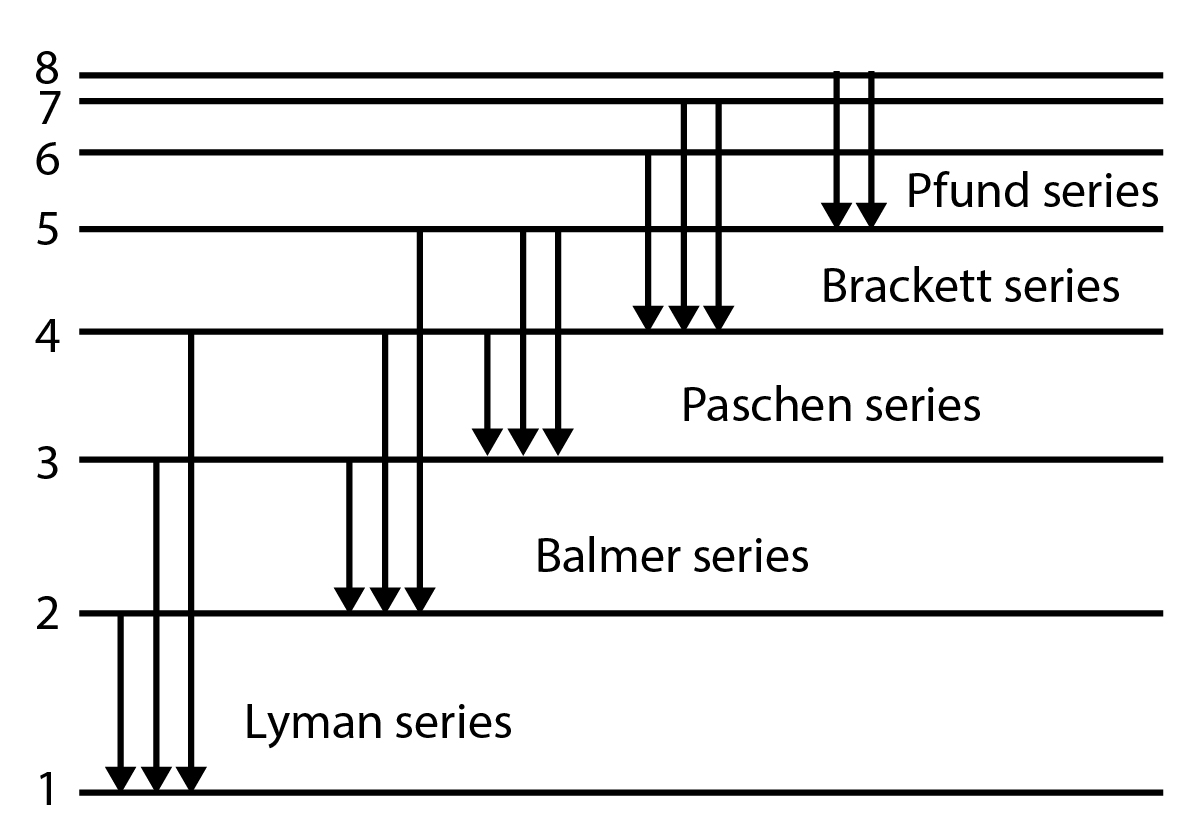
Spectral Series in Hydrogen Atoms
Lyman Series
Balmer Series
Paschen Series
Brackett Series
Pfund Series
Energy and Frequency of Emitted Radiation
Summary and Key Concepts
1. Introduction to Atomic Energy Levels
Atoms have discrete energy levels that electrons can occupy. When an electron transitions from a higher energy level to a lower one, it emits a photon of specific energy and wavelength. These transitions form spectral series, which are categorized based on the final energy level of the electron.
2. Spectral Series in Hydrogen Atoms
2.1 Lyman Series
Description: Transitions to the n=1 energy level.
Region: Ultraviolet
Formula:
$$
\dfrac{1}{\lambda} = R \left( \dfrac{1}{1^2} - \dfrac{1}{n^2} \right)
$$
where $ n = 2, 3, 4, \dots $
Examples:
Transition from $ n=2 $ to $ n=1 $: Lyman alpha
Transition from $ n=3 $ to $ n=1 $: Lyman beta
2.2 Balmer Series
Description: Transitions to the n=2 energy level.
Region: Visible Light
Formula:
$$
\dfrac{1}{\lambda} = R \left( \dfrac{1}{2^2} - \dfrac{1}{n^2} \right)
$$
where $ n = 3, 4, 5, \dots $
Examples:
Transition from $ n=3 $ to $ n=2 $: Balmer alpha
Transition from $ n=4 $ to $ n=2 $: Balmer beta
2.3 Paschen Series
Description: Transitions to the n=3 energy level.
Region: Infrared
Formula:
$$
\dfrac{1}{\lambda} = R \left( \dfrac{1}{3^2} - \dfrac{1}{n^2} \right)
$$
where $ n = 4, 5, 6, \dots $
2.4 Brackett Series
Description: Transitions to the n=4 energy level.
Region: Infrared
Formula:
$$
\dfrac{1}{\lambda} = R \left( \dfrac{1}{4^2} - \dfrac{1}{n^2} \right)
$$
where $ n = 5, 6, 7, \dots $
2.5 Pfund Series
Description: Transitions to the n=5 energy level.
Region: Far Infrared
Formula:
$$
\dfrac{1}{\lambda} = R \left( \dfrac{1}{5^2} - \dfrac{1}{n^2} \right)
$$
where $ n = 6, 7, 8, \dots $
3. Energy and Frequency of Emitted Radiation
3.1 Energy Difference Between Levels
Formula:
$$
\Delta E = E_2 - E_1 = R c h Z^2 \left( \dfrac{1}{n_1^2} - \dfrac{1}{n_2^2} \right)
$$
where:
$ R $: Rydberg constant
$ c $: speed of light
$ h $: Planck’s constant
$ Z $: atomic number
$ n_1 $: final energy level
$ n_2 $: initial energy level
3.2 Frequency of Emitted Radiation
Formula:
$$
\nu = \dfrac{\Delta E}{h} = R c Z^2 \left( \dfrac{1}{n_1^2} - \dfrac{1}{n_2^2} \right)
$$
Explanation: The frequency of the emitted photon corresponds to the energy difference between the two levels.
4. Summary and Key Concepts
4.1 Key Concepts
Energy Levels: Electrons in atoms occupy specific energy levels.
Spectral Series: Transitions between energy levels produce photons of specific wavelengths.
Regions of Emission:
Ultraviolet: Lyman Series
Visible Light: Balmer Series
Infrared: Paschen, Brackett, and Pfund Series
Energy and Frequency Relationship: Energy difference determines the frequency of the emitted radiation.
##### An $\alpha$-particle of energy 5 MeV is scattered through $180^{\circ}$ by a fixed uranium nucleus. The distance of the closest approach is of the order of
1. [ ] $1 \AA$
2. [ ] $10^{-10} \mathrm{cm}$
3. [x] $10^{-12} \mathrm{cm}$
4. [ ] $10^{-15} \mathrm{cm}$
##### To explain theory of hydrogen atom, Bohr considered
1. [ ] quantisation of linear momentum
2. [x] quantisation of angular momentum
3. [ ] quantisation of angular frequency
4. [ ] quantisation of energy
##### For the Bohr's first orbit of circumference $2 \pi r$, the de-Broglie wavelength of revolving electron will be
1. [x] $2 \pi r$
2. [ ] $\pi r$
3. [ ] $\dfrac{1}{2 \pi r}$
4. [ ] $\dfrac{1}{4 \pi r}$
##### Which of the following transitions in hydrogen atoms emit photons of highest frequency?
1. [ ] $n=2$ to $n=6$
2. [x] $n=6$ to $n=2$
3. [ ] $n=2$ to $n=1$
4. [ ] $n=1$ to $n=2$
##### in the Bohr's model of the hydrogen atom, let $r, V$ and $E$ represents the radius of the orbit, the speed of electron and the total energy of the electron, respectively. Which of the following quantities is proportional to the quantum number $n$ ?
1. [ ] $E / V$
2. [ ] $I / E$
3. [x] vr
4. [ ] $r E$
##### The ratio of the kinetic energy to the energy of an electron in a Bohr's orbit is
1. [x] -1
2. [ ] 2
3. [ ] $1: 2$
4. [ ] None of these
##### If the atom ${ } _{100} \mathrm{Fm}^{257}$ follows the Bohr's model and the radius of last orbit of ${ } _{100} \mathrm{Fm}^{257}$ is $n$ times the Bohr's radius, then find the value of $n$ ?
1. [ ] 100
2. [ ] 200
3. [ ] 4
4. [x] $1 / 4$
##### Taking the Bohr's radius as $a _{0}=53 \mathrm{pm}$, the radius of $\mathrm{Li}^{2+}$ ion in its ground state, on the basis of Bohr's model, will be about
1. [ ] 53 pm
2. [ ] 27 pm
3. [x] 18 pm
4. [ ] 13 pm
##### In a hypothetical Bohr's hydrogen atom, the mass of the electron is doubled. The energy $E _{0}$ and radius $r _{0}$ of the first orbit will be ( $a _{0}$ is the Bohr radius)
1. [x] $E _{0}=-27.2 \mathrm{eV} ; r _{0}=a _{0} / 2$
2. [ ] $E _{0}=-27.2 \mathrm{eV} ; r _{0}=a _{0}$
3. [ ] $E _{0}=-13.6 \mathrm{eV} ; r _{0}=a _{0} / 2$
4. [ ] $E _{0}=-13.6 \mathrm{eV} ; r _{0}=a _{0}$
##### As an electron makes a transition from an excited state to the ground state of a hydrogen like atom/ion $\rightarrow$ JEE Main 2015
1. [x] its kinetic energy increases but potential energy and total energy decrease
2. [ ] kinetic energy, potential energy and total energy decrease
3. [ ] kinetic energy decreases, potential energy increases but total energy remains same
4. [ ] kinetic energy and total energy decrease but potential ènergy increases
The Ministry of Education has launched the SATHEE initiative in association with IIT Kanpur to provide free guidance for competitive exams. SATHEE offers a range of resources, including reference video lectures, mock tests, and other resources to support your preparation.
Please note that participation in the SATHEE program does not guarantee clearing any exam or admission to any institute.


 BETA
BETA



