Application Of Derivatives Ques 100
100. If $S$ is a square of unit area. Consider any quadrilateral which has one vertex on each side of $S$. If $a, b, c$ and $d$ denote the length of the sides of the quadrilateral, then prove that $2 \leq a^{2}+b^{2}+d^{2} \leq 4$.
$(1997,5$ M)
Show Answer
Solution:
Formula:
Maxima and Minima of functions of one variable :
- Let the square $S$ is to be bounded by the lines $x= \pm 1 / 2$ and $y= \pm 1 / 2$.
We have, $\quad (a^{2}=x_{1}-\frac{1}{2})^{2}+(\frac{1}{2}-y_{1})^{2}$
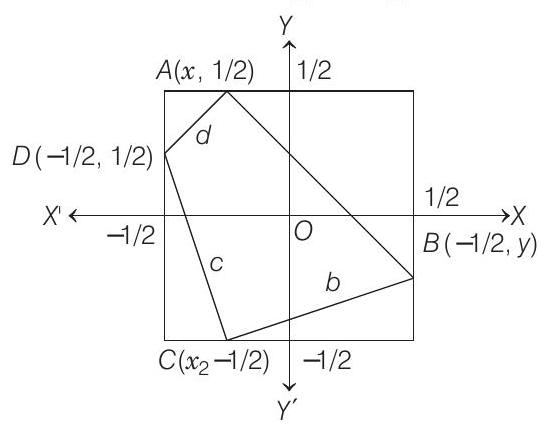
$ =x_{1}^{2}-y_{1}^{2}-x_{1}-y_{1}+\frac{1}{2} $
Similarly, $\quad b^{2}=x_{2}^{2}-y_{1}^{2}-x_{2}+y_{1}+\frac{1}{2}$
$ c^{2}=x_{2}^{2}-y_{2}^{2}+x_{2}+y_{2}+\frac{1}{2} $
$ d^{2}=x_{1}^{2}-y_{2}^{2}+x_{1}-y_{2}+\frac{1}{2} $
$\therefore \quad a^{2}+b^{2}+c^{2}+d^{2}=2\left(x_{1}^{2}+y_{1}^{2}+x_{2}^{2}+y_{2}^{2}\right)+2$
Therefore, $0 \leq x_{1}^{2}, x_{2}^{2}, y_{1}^{2}, y_{2}^{2} \leq \frac{1}{4}$
$ \begin{array}{lc} & 0 \leq x_{1}^{2}+x_{2}^{2}+y_{1}^{2}+y_{2}^{2} \leq 1 \\ \Rightarrow & 0 \leq 2\left(x_{1}^{2}+x_{2}^{2}+y_{1}^{2}+y_{2}^{2}\right) \leq 2 \\ \text { But } & 2 \leq 2\left(x_{1}^{2}+x_{2}^{2}+y_{1}^{2}+y_{2}^{2}\right)+2 \leq 4 \end{array} $
Alternate Solution
$ c^{2}=x_{2}^{2}+y_{2}^{2} ……(i) $
$ \begin{aligned} b^{2} & =\left(1-x_{2}\right)^{2}+y_{1}^{2} ……(ii) \\ a^{2} & =\left(1-y_{1}\right)^{2}+\left(1-x_{1}\right)^{2} ……(iii) \\ d^{2} & =x_{1}^{2}+\left(1-y_{2}\right)^{2} ……(iv) \end{aligned} $
On adding Eqs. (i), (ii), (iii) and (iv), we get
$a^{2}+b^{2}+c^{2}+d^{2}=\left{x_{1}^{2}+\left(1-x_{1}\right)^{2}\right}+\left{y_{1}^{2}+\left(1-y_{1}\right)^{2}\right}$
$ +\left{x_{2}^{2}+\left(1-x_{2}\right)^{2}\right}+\left{y_{2}^{2}+\left(1-y_{2}\right)^{2}\right} $
where $x_{1}, y_{1}, x_{2}, y_{2}$ all vary in the interval $[0,1]$.
Now, consider the function $y=x^{2}+(1-x)^{2}, 0 \leq x \leq 1$ differentiating $\Rightarrow \frac{d y}{d x}=2 x-2(1-x)$. For maximum or $\operatorname{minimum} \frac{d y}{d x}=0$.
$\Rightarrow \quad 2 x-2(1-x)=0 \Rightarrow 2 x-2+2 x=0$
$\Rightarrow \quad 4 x=2 \quad \Rightarrow \quad x=1 / 2$
Again
$ \frac{d^{2} y}{d x^{2}}=2+2=4 $
Hence, $y$ is minimum at $x=\frac{1}{2}$ and its minimum value is $1 / 4$. Clearly, value is maximum when $x=1$.
$\therefore$ Minimum value of $a^{2}+b^{2}+c^{2}+d^{2}=\frac{1}{2}+\frac{1}{2}+\frac{1}{2}+\frac{1}{2}=2$ and maximum value is $1+1+1+1=4$
 BETA
BETA


