Application Of Derivatives Ques 102
102. Let $(h, k)$ be a fixed point, where $h>0, k>0$. A straight line passing through this point cuts the positive directions of the coordinate axes at the points $P$ and $Q$. Find the minimum area of the $\triangle O P Q, O$ being the origin.
(1995, 5M)
Show Answer
Answer:
Correct Answer: 102.$2hk$
Solution:
Formula:
Maxima and Minima of functions of one variable :
- Let equation of any line through the point $(h, k)$ is
$ y-k=m(x-h) ……(i) $
For this line to intersect the positive direction of two axes, $m=\tan \theta<0$, since the angle in anti-clockwise direction from $X$-axis becomes obtuse.
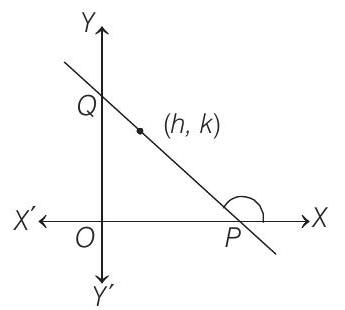
The line (i) meets $X$-axis at $P (\quad h-\frac{k}{m}, 0)$ and $Y$-axis at $Q(0, k-m h)$.
Let $\quad A=$ area of $\triangle O P Q=\frac{1}{2} O P \cdot O Q$
$ \begin{aligned} & =\frac{1}{2} (h-\frac{k}{m})(k-m h) \\ & =\frac{1}{2} (\frac{m h-k}{m}(k-m h))=-\frac{1}{2 m}(k-m h)^{2} \\ & =-\frac{1}{2 \tan \theta}(k-h \tan \theta)^{2} \quad[\because m=\tan \theta] \\ & =-\frac{1}{2 \tan \theta}\left(k^{2}+h^{2} \tan ^{2} \theta-2 h k \tan \theta\right) \\ & =\frac{1}{2}\left(2 k h-k^{2} \cot \theta-h^{2} \tan \theta\right) \end{aligned} $
$\Rightarrow \quad \frac{d A}{d \theta}=\frac{1}{2}\left[-k^{2}\left(-\operatorname{cosec}^{2} \theta\right)-h^{2} \sec ^{2} \theta\right]$
$=\frac{1}{2}\left[k^{2} \operatorname{cosec}^{2} \theta-h^{2} \sec ^{2} \theta\right]$
To obtain minimum value of $A, \frac{d A}{d \theta}=0$
$\Rightarrow \quad k^{2} \operatorname{cosec}^{2} \theta-h^{2} \sec ^{2} \theta=0$
$\Rightarrow \quad \frac{k^{2}}{\sin ^{2} \theta}=\frac{h^{2}}{\cos ^{2} \theta} \Rightarrow \frac{k^{2}}{h^{2}}=\tan ^{2} \theta$
$\Rightarrow \quad \tan \theta= \pm \frac{k}{h}$
$\because \quad \tan \theta<0, k>0, h>0$ [given]
Therefore, $\tan \theta=-\frac{k}{h}$ (only possible value).
Now, $\frac{d^{2} A}{d \theta^{2}}=\frac{1}{2}\left[-2 k^{2} \operatorname{cosec}^{2} \theta \cot \theta-2 h^{2} \sec ^{2} \theta \tan \theta\right]$
$ =-\left[k^{2}\left(1+\cot ^{2} \theta\right) \cot \theta+h^{2}\left(1+\tan ^{2} \theta\right) \tan \theta\right] $
$\Rightarrow \quad \frac{d^{2} A}{d \theta^{2}}{ }_{\tan \theta=-k / h}=-k^{2} 1+\frac{h^{2}}{k^{2}} \quad \frac{-h}{k}$
$ +h^{2} 1+\frac{k^{2}}{h^{2}} \quad \frac{-k}{h} $
$=k^{2} \frac{k^{2}+h^{2}}{k^{2}} \quad \frac{h}{k}+h^{2} \frac{h^{2}+k^{2}}{h^{2}} \quad \frac{k}{h}$
$=\frac{\left(k^{2}+h^{2}\right) h}{k}+\frac{\left(h^{2}+k^{2}\right)(k)}{h}$
$=\left(k^{2}+h^{2}\right) \frac{h}{k}+\frac{k}{h}>0$
$[\because h, k>0]$
Therefore, $A$ is least when $\tan \theta=-k / h$. Also, the least value of $A$ is
$ \begin{aligned} A & =\frac{1}{2} 2 h k-k^{2} \frac{-h}{k}-h^{2} \frac{-k}{h} \\ & =\frac{1}{2}[2 h k+k h+k h]=2 h k \end{aligned} $
 BETA
BETA


