Application Of Derivatives Ques 71
71. The total number of local maxima and local minima of the function $f(x)=\begin{array}{cc}(2+x)^{3}, & -3<x \leq-1 \\ x^{\frac{2}{3}}, & -1<x<2\end{array}$ is
(2008, 3M)
0
1
2
3
Show Answer
Answer:
Correct Answer: 71.(d)
Solution:
Formula:
Maxima and Minima of functions of one variable :
- Given, $\quad f(x)=\begin{array}{cc}(2+x)^{3}, & \text { if }-3<x \leq-1 \\ x^{2 / 3} & \text { if }-1<x<2\end{array}$
$\Rightarrow \quad f^{\prime}(x)=\begin{array}{ll}3(x+2)^{2}, & \text { if }-3<x \leq-1 \\ \frac{2}{3} x^{-\frac{1}{3}} & , \text { if }-1<x<2\end{array}$
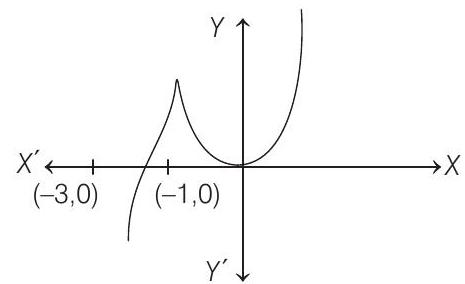
Clearly, $f^{\prime}(x)$ changes its sign at $x=-1$ from $+\mathrm{ve}$ to $-\mathrm{ve}$ and so $f(x)$ has local maxima at $x=-1$.
Also, $f^{\prime}(0)$ does not exist but $f^{\prime}(0^{+})<0$. It can only be inferred that $f(x)$ has a possibility of a $\operatorname{minima}$ at $x=0$. Hence, the given function has one local maxima at $x=-1$ and one local minima at $x=0$.
 BETA
BETA


