Application Of Derivatives Ques 89
89. If $f(x)=\begin{aligned} & 3 x^{2}+12 x-1,-1 \leq x \leq 2 \\ & 37-x, \quad 2<x \leq 3\end{aligned}$, then
(1993, 3M)
(a) $f(x)$ is increasing on $[-1,2]$
(b) $f(x)$ is continuous on $[-1,3]$
(c) $f^{\prime}(2)$ does not exist
(d) $f(x)$ has the maximum value at $x=2$
Show Answer
Answer:
Correct Answer: 89.(a, b, c, d)
Solution:
Formula:
Maxima and Minima of functions of one variable :
- For $-1 \leq x \leq 2$, we have
$ \begin{aligned} f(x) & =3 x^{2}+12 x-1 \\ \Rightarrow \quad f^{\prime}(x) & =6 x+12>0, \forall-1 \leq x \leq 2 \end{aligned} $
Hence, $f(x)$ is increasing in $[-1,2]$.
Again, function is an algebraic polynomial, therefore it is continuous at $x \in(-1,2)$ and $(2,3)$.
For continuity at $x=2$,
$ \begin{aligned} \lim _{x \rightarrow 2^{-}} f(x) & =\lim _{x \rightarrow 2^{-}}\left(3 x^{2}+12 x-1\right) \\ & =\lim _{h \rightarrow 0}\left[3(2-h)^{2}+12(2-h)-1\right] \\ & =\lim _{h \rightarrow 0}\left[3\left(4+h^{2}-4 h\right)+24-12 h-1\right] \\ & =\lim _{h \rightarrow 0}\left(12+3 h^{2}-12 h+24-12 h-1\right) \\ & =\lim _{h \rightarrow 0}\left(3 h^{2}-24 h+35\right)=35 \end{aligned} $
and $\quad \lim _{x \rightarrow 2^{+}} f(x)=\lim _{x \rightarrow 2^{+}}(37-x)$
$ =\lim _{h \rightarrow 0}[37-(2+h)]=35 $
and $\quad f(2)=3 \cdot 2^{2}+12 \cdot 2-1=12+24-1=35$
Therefore, $\mathrm{LHL}=\mathrm{RHL}=f(2) \Rightarrow$ function is continuous at $x=2 \Rightarrow$ function is continuous in $-1 \leq x \leq 3$.
$ \begin{aligned} & \text { Now, } R f^{\prime}(2)=\lim _{x \rightarrow 2^{+}} \frac{f(x)-f(2)}{x-2} \\ & =\lim _{h \rightarrow 0} \frac{f(2+h)-f(2)}{h} \\ & =\lim _{h \rightarrow 0} \frac{37-(2+h)-\left(3 \times 2^{2}+12 \times 2-1\right)}{h} \\ & =\lim _{h \rightarrow 0} \frac{-h}{h}=-1 \\ & \text { and } L f^{\prime}(2)=\lim _{x \rightarrow 2^{-}} \frac{f(x)-f(2)}{x-2}=\lim _{h \rightarrow 0} \frac{f(2-h)-f(2)}{-h} \end{aligned} $
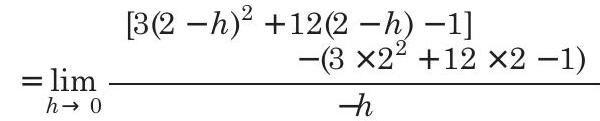
$ \begin{aligned} & =\lim _{h \rightarrow 0} \frac{\left[12+3 h^{2}-12 h+24-12 h-1\right]-35}{-h} \\ & =\lim _{h \rightarrow 0} \frac{3 h^{2}-24 h+35-35}{-h} \\ & =\lim _{h \rightarrow 0} \frac{3 h-24}{-1}=24 \end{aligned} $
Since, $R f^{\prime}(2) \neq L f^{\prime}(2), f^{\prime}(2)$ does not exist.
Again, $f(x)$ is an increasing in $[-1,2]$ and is decreasing in $(2,3)$, it shows that $f(x)$ has a maximum value at $x=2$. Therefore, options (a), (b), (c), (d) are all correct.
 BETA
BETA


