Straight Line And Pair Of Straight Lines Ques 85
- Two sides of a rhombus are along the lines, $x-y+1=0$ and $7 x-y-5=0$. If its diagonals intersect at $(-1,-2)$, then which one of the following is a vertex of this rhombus?
(2016 Main)
(a) $(-3,-9)$
(b) $(-3,-8)$
(c) $\frac{1}{3},-\frac{8}{3}$
(d) $-\frac{10}{3},-\frac{7}{3}$
Show Answer
Answer:
Correct Answer: 85.(c)
Solution:
As the given lines $x-y+1=0$ and $7 x-y-5=0$ are not parallel, therefore they represent the adjacent sides of a rhombus.
On solving $x-y+1=0$ and $7 x-y-5=0$, we get $x=1$ and $y=2$. Thus, one of the vertices is $A(1,2)$.
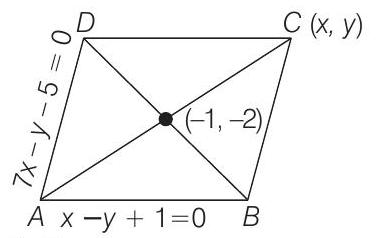
$(1,2)$
Let the coordinate of point $C$ be $(x, y)$.
$$ \begin{aligned} & \text { Then, } & -1 & =\frac{x+1}{2} \text { and }-2=\frac{y+2}{2} \\ \Rightarrow & & x+1 & =-2 \text { and } y=-4-2 \\ \Rightarrow & & x & =-3 \\ \text { and } & & y & =-6 \end{aligned} $$
Hence, coordinates of $C=(-3,-6)$
Note that, vertices $B$ and $D$ will satisfy $x-y+1=0$ and $7 x-y-5=0$, respectively.
Since, option (c) satisfies $7x - y - 5 = 0$, therefore coordinate of vertex $D$ is $\left(\frac{1}{3}, \frac{-8}{3}\right)$.
 BETA
BETA


