Laws Of Motion Ques 27
- In the figure masses $m_{1}, m_{2}$ and $M$ are $20 \mathrm{~kg}, 5 \mathrm{~kg}$ and $50 \mathrm{~kg}$ respectively. The coefficient of friction between $M$ and ground is zero. The coefficient of friction between $m_{1}$ and $M$ and that between $m_{2}$ and ground is 0.3 . The pulleys and the strings are massless. The string is perfectly horizontal between $P_{1}$ and $m_{1}$ and also between $P_{2}$ and $m_{2}$. The string is perfectly vertical between $P_{1}$ and $P_{2}$. An external horizontal force $F$ is applied to the mass $M$. (Take $g=10 \mathrm{~m} / \mathrm{s}^{2}$.)
$(2000,10 M)$
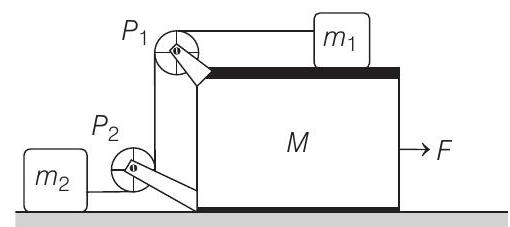
(a) Draw a free body diagram of mass $M$, clearly showing all the forces.
(b) Let the magnitude of the force of friction between $m_{1}$ and $M$ be $f_{1}$ and that between $m_{2}$ and ground be $f_{2}$. For a particular force $F$ it is found that $f_{1}=2 f_{2}$. Find $f_{1}$ and $f_{2}$. Write equations of motion of all the masses. Find $F$, tension in the string and accelerations of the masses.
Show Answer
Answer:
Correct Answer: 27.(b) $f_{1}=30 \mathrm{~N}, f_{2}=15 \mathrm{~N}, F=60 \mathrm{~N}, T=18 \mathrm{~N}, a=\frac{3}{5} \mathrm{~m} / \mathrm{s}^{2}$
Solution:
Formula:
- Given, $m_{1}=20 \mathrm{~kg}, m_{2}=5 \mathrm{~kg}, M=50 \mathrm{~kg}$,
$$ \mu=0.3 \text { and } g=10 \mathrm{~m} / \mathrm{s}^{2} \text {. } $$
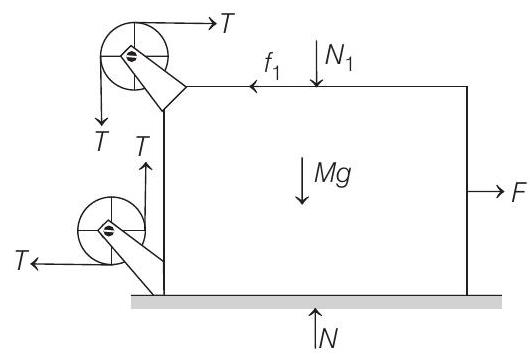
(a) Free body diagram of mass $M$ is given as
(b) The maximum value of $f_{1}$ is
$$ \left(f_{1}\right)_{\max }=(0.3)(20)(10)=60 \mathrm{~N} $$
The maximum value of $f_{2}$ is
$$ \left(f_{2}\right)_{\max }=(0.3)(5)(10)=15 \mathrm{~N} $$
Forces on $m_{1}$ and $m_{2}$ in horizontal direction are as follows

Now, there are only two possibilities :
(1) Either both $m_{1}$ and $m_{2}$ will remain stationary
(w.r.t. ground) or
(2) Both $m_{1}$ and $m_{2}$ will move (w.r.t. ground)
First case is possible when
| $T \leq\left(f_{1}\right)_{\max }$ | or | $T \leq 60 \mathrm{~N}$ | |
|---|---|---|---|
| and | $T \leq\left(f_{2}\right)_{\max }$ | or | $T \leq 15 \mathrm{~N}$ |
These conditions will be satisfied when $T \leq 15 \mathrm{~N}$
say $T=14 \mathrm{~N}$, then $f_{1}=f_{2}=14 \mathrm{~N}$
Therefore, the condition $f_{1}=2 f_{2}$ will not be satisfied.
Thus, $m_{1}$ and $m_{2}$ both cannot remain stationary.
In the second case, when $m_{1}$ and $m_{2}$ both move
$$ \begin{aligned} & f_ {2}=(f_ {2})_ {\max }=15 \mathrm{~N} \\ \therefore \quad & f_ {1}=2 f_ {2}=30 \mathrm{~N} \end{aligned} $$
Now, since $f_ {1}<(f_ {1})_ {\max }$, there is no relative motion between $m_ {1}$ and $M$ i.e. all the masses move with same acceleration, say $a$
$$ \therefore \quad f_{2}=15 \mathrm{~N} \text { and } f_{1}=30 \mathrm{~N} $$
Free body diagrams and equations of motion are as follows
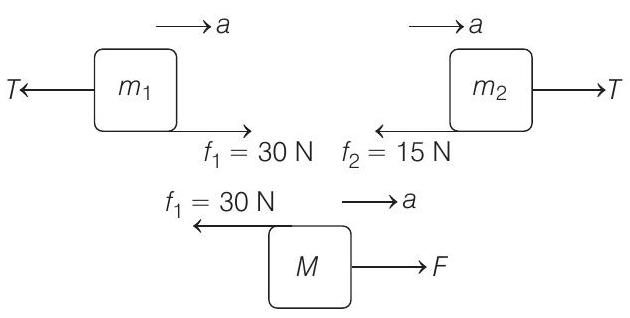
For $m_{1}, \quad 30-T=20 a \cdots(i)$
For $m_{2}, \quad T-15=5 a \cdots(ii)$
For $M, \quad F-30=50 a \cdots(iii)$
Solving these three equations, we get
$$ F=60 \mathrm{~N} $$
$$ T=18 \mathrm{~N} \text { and } a=\frac{3}{5} \mathrm{~m} / \mathrm{s}^{2} $$
NOTE
-
Friction always opposes the relative motion between two surfaces in contact.
-
Whenever there is relative motion between two surfaces in contact, always maximum friction (kinetic) acts, but if there is no relative motion then friction force ( $f$ ) may be less than its limiting value also. So, don’t apply maximum force.
 BETA
BETA


